


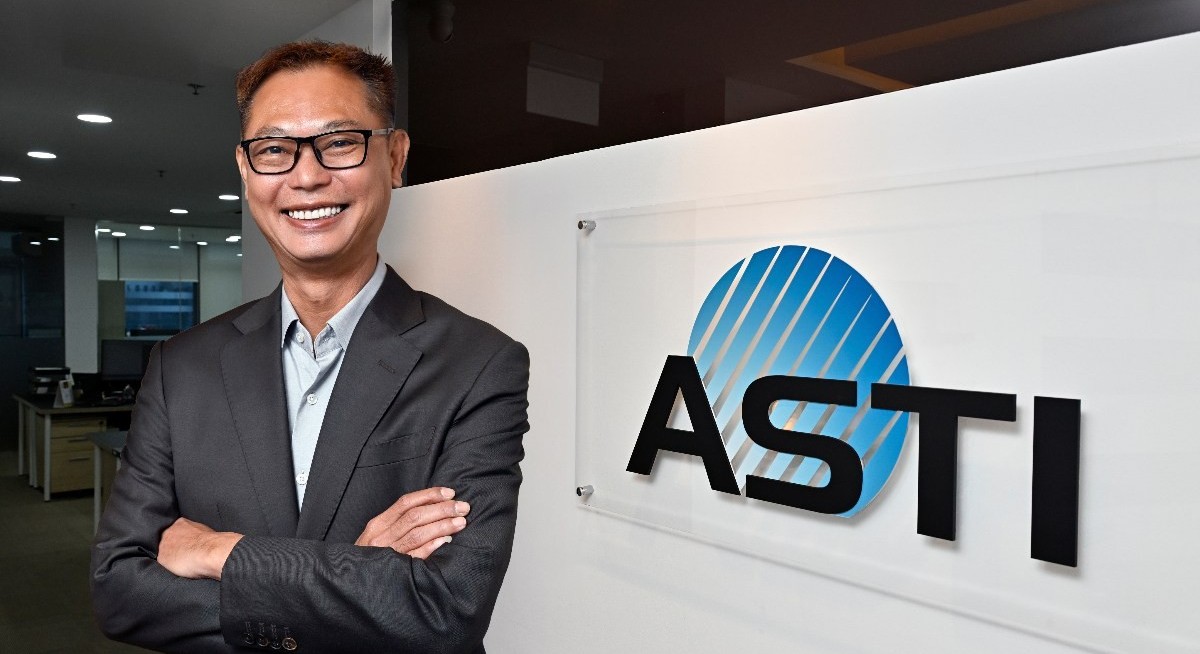


For much of the past four years, however, ASTI Holdings has been better known for a governance crisis that saw its shares suspended and its annual reports years overdue.
From shareholder to CEO
In January 2024, CEO Ng Yew Nam stepped into the role with a mandate to fix the problems. Before ASTI Holdings, he founded iTrue Technologies in 2005 and led it for nearly 20 years, building it into a specialist in machine vision inspection for passive electronic chip components.
Prior to that, Ng had been an employee within one of ASTI Holdings’ subsidiaries, and later became a substantial shareholder in the group. When trading at ASTI Holdings was suspended in 2022, he offered to step in, though that opportunity did not materialise.
See also: Hyphens Pharma: From dispensary to Asean’s dermatology specialist
By early 2024, the previous board had been entirely replaced. Ng became CEO in January and was elevated to executive chairman by November.
“The decision to take on this role was a combination of factors. I invested in the company, and I wanted to protect my investment,” he adds.
“But more importantly, after carefully evaluating the situation, I was convinced that the challenges were structural rather than fundamental.”
See also: Soon Hock Enterprise: From operator to developer
He observed that despite the trading suspension, the company continued generating revenue, and customers had not walked away. “That is why I thought it was worth fixing,” he says.
Rebuilding ASTI
In January 2024, ASTI Holdings held meaningful cash across its operating subsidiaries, but “the corporate had no money,” Ng says plainly.
Beyond the cash, the compliance backlog was substantial. The company had not held its FY2021 AGM by the required date and had missed successive deadlines for FY2022 and FY2023. Auditors had issued qualified opinions, and the previous board had been in breach of regulatory requirements.
As a result, Ng’s immediate priority was not growth but governance.
He adds: “Without resolving the audit backlog, we could not talk to the Singapore Exchange [SGX]. We could not engage any potential acquirer. We could not do anything. What we were focused on was fixing the compliance, so that we could be in a position to attract an exit offer for shareholders.”
Between May 2024 and February 2025, ASTI Holdings completed four overdue AGMs and one EGM — covering financial years 2021 through 2024 — within 15 months.
To stay ahead of Singapore and the region’s corporate and economic trends, click here for Latest Section
New auditors were appointed, and loss-making subsidiaries were wound down. Dragon Group International, a separately listed subsidiary with a troubled history, was placed into creditors’ voluntary liquidation in October 2024.
ASTI Holdings eventually resumed trading on SGX on Jan 22, ending a suspension of more than three years. In March, ASTI Holdings also reached an amicable settlement with Advanced Systems Automation (ASA) to recover $6 million in legacy debts.
While the governance work was underway, the operating business still had to run. Ng describes the challenge of managing customers through a period of deep uncertainty as one of the harder aspects of the turnaround.
“To be honest, they did not believe in the business in the beginning. But I personally visited the customers. Openly, transparently, I explained to them the situation, what we were trying to fix, what our roadmap was,” Ng says.
That transparency, he adds, was what eventually converted scepticism into something more durable: “They even share their expansion plans with us now. They want us to be part of their total supply chain in the future.”
Competitors as customers
After semiconductor components are manufactured and tested, they undergo visual inspection — camera-based systems check for surface defects at high speed.
The components are then placed into embossed plastic carrier tapes, sealed with a cover tape, and wound onto reels. This is the format required by the automated surface-mount assembly machines that build circuit boards.
“And even though the components look small, they require special equipment, precise handling and consistent quality control. Not every company is willing to invest in this.”
Most of ASTI Holdings’ customers — integrated device manufacturers and contract electronics manufacturers — choose not to maintain this capability in-house. “We have 30 years of experience and more machine capability than most,” Ng adds.
Even some customers with in-house capabilities still come to ASTI Holdings when volume overflows, or they encounter product types outside their toolset. “So sometimes our competitor is also our customer,” says Ng.
The AI boom
The semiconductor industry’s dominant narrative over the past two years has been the AI boom, marked by soaring demand for advanced chips, record revenues for companies like Nvidia, and rising valuations across the supply chain.
ASTI Holdings, however, does not serve that segment. As Ng notes, its business lies in standard IC packaging for consumer electronics, industrial applications, and automotive markets, where the recovery has been more muted.
Yet he disputes the idea that ASTI Holdings is being left behind. “The initial AI boom was concentrated in high-performance computing, GPUs and CPUs. We are not in that segment. But we represent the broader semiconductor ecosystem. More and more devices are now being built with embedded AI capabilities. That will benefit us.”
ASTI Holdings itself has also begun integrating AI models into its manufacturing processes to optimise throughput and reduce defects.
But Ng’s ambitions go beyond operational stabilisation. He wants to transform ASTI Holdings from a pure services provider into what he calls a “technology-driven company” — one that controls the service of packaging chips, the machines used to do it, and the materials consumed in the process.
The next stage
The reference point is the company’s own history. The group once owned Semiconductor Technologies & Instruments, a subsidiary that manufactured the taping machines used in its own operations. That capability was later lost. “We want to go back to that and become a technology-driven company,” Ng says.
“If we can control the machine, control the material, and have the service in-house, we can offer customers a complete solution. If I can tell a customer: the old way costs you a dollar, and my way costs seventy cents, that is a no-brainer decision for them.”
He also flags a shift in packaging technology as an area of expansion.
Wafer-level packaging — where chips are mounted directly onto circuit boards without traditional leads or wiring — is becoming the standard for advanced components, including AI chips. ASTI Holdings is moving into this process as an adjacent service to its core tape-and-reel business.
Geographically, Thailand is the next step. Ng says a major customer is planning significant capacity expansion there, aiming to grow revenue from US$12 billion ($15.2 billion) to US$20 billion by 2030, and has invited ASTI Holdings to participate. A factory is planned.
For shareholders who spent three years unable to sell their shares, the immediate question is what the return to trading actually means. “I recognise their patience,” Ng says. “I have received many calls at AGMs. People asking: Is there still any value? Is the company still operating? My focus has been on rebuilding a solid foundation, so that they can benefit from what we are building now.”
ASTI Holdings returned to profit in FY2025, posting net earnings of $1.1 million on revenue of $36.9 million, following a loss of $18.9 million the year before.
The group entered 2026 free of bank borrowings, holding a net cash position of $13.1 million, after netting lease liabilities and long-term payables. In January, a share placement raised additional gross proceeds of $3.2 million for expansion.
The tape-and-reel business is still running, and customers are still placing orders. For Ng, who stepped into a role few wanted, the focus is now on what comes next.
About ASTI Holdings
Listed on the mainboard of the Singapore Exchange, ASTI Holdings is a global leader in backend semiconductor tape and reel packaging and integrated circuit programming services. As one of the world’s largest independent providers, the company serves a broad spectrum of integrated device manufacturers, contract manufacturers, and component distributors worldwide. On June 6, 2022, ASTI received a delisting notification from SGX-ST, and trading in the Company’s securities ceased on July 5, 2022, and was to remain suspended until the completion of an exit offer. On Dec 4, 2025, SGX-ST informed ASTI that it had no objection to ASTI’s application to resume trading.
On Jan 20, ASTI obtained concurrence from SGX-ST on the application to resume trading of its shares with effect from Jan 22, and ASTI’s shares resumed trading on the same day.
With a robust and synergistic portfolio, the ASTI Group of companies delivers comprehensive, integrated solutions tailored to meet the diverse needs of our clients. ASTI’s extensive reach and capabilities position it as a trusted partner in the semiconductor industry.
Headquartered in Singapore, ASTI operates seven strategically located factories across Southeast Asia, Greater China and the UK.
This expansive network ensures we remain close to our customers, facilitating efficient distribution and exceptional service across key markets in Asia and beyond.
About kopi-C: The Company Brew
kopi-C is a regular column by SGX Research in collaboration with Beansprout (https://growbeansprout.com), a MAS-licensed investment advisory platform, that features C-level executives of leading companies listed on SGX. These interviews are profiles of senior management aimed at helping investors better understand the individuals who run these corporations.




