


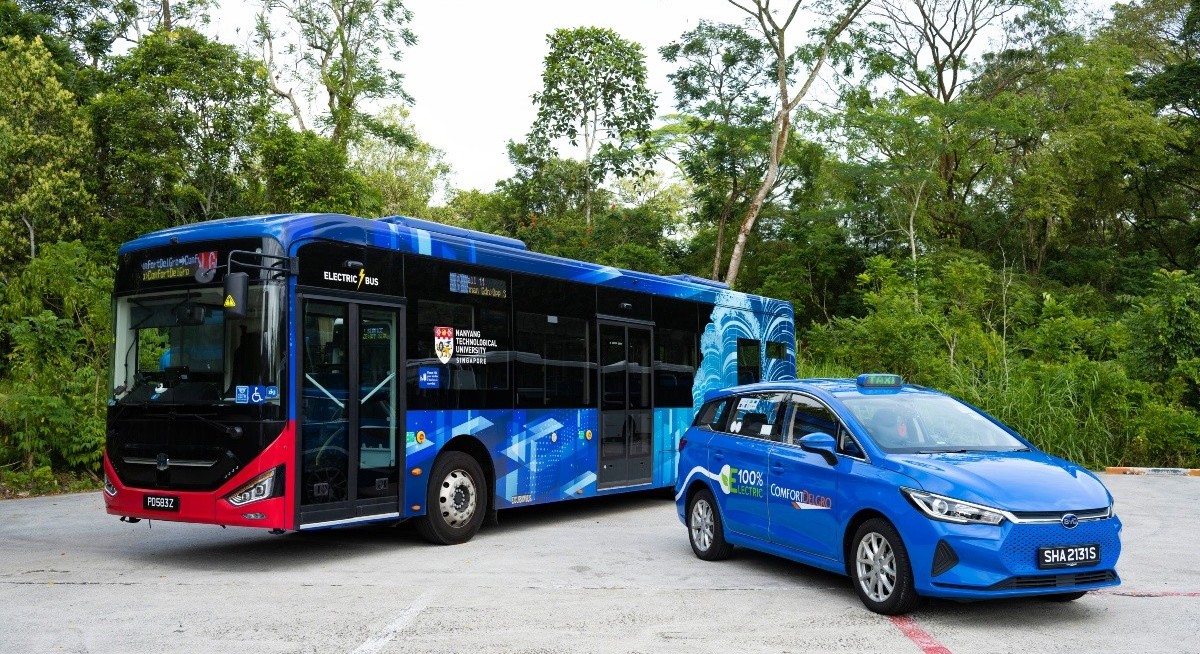


Today, over 55% of the group’s revenue comes from overseas operations. ComfortDelGro is a diversified multimodal transport operator with a strong global footprint across 13 countries. It runs public bus networks in London, Greater Manchester and major Australian cities, owns the established premium point-to-point brand Addison Lee in the UK, and is actively scaling autonomous vehicle (AV) deployments in China and Singapore. The group also holds significant international rail contracts, including operations in Stockholm and an upcoming role in the Paris Metro Line 15, while actively bidding for the Copenhagen Metro.
“When I joined ComfortDelGro, I was somewhat overwhelmed by the scale and diversity of the business,” says White, who assumed the role of group CFO in 2026. “Most people still see us as the Singapore taxi company — but when you look across our global operations, the picture is very different.”
White believes the share price continues to reflect, to a large extent, the outdated view of a domestic taxi operator facing structural challenges. In his view, the market has yet to appreciate the group’s transformation fully.

See also: Hyphens Pharma: From dispensary to Asean’s dermatology specialist
ComfortDelGro's group CFO Christopher White. Photo: ComfortDelGro
Singapore: A stable anchor, not the primary growth engine
Singapore continues to be ComfortDelGro’s largest single geography by operating profit, contributing more than half of the group’s earnings. However, as a mature market leader, organic growth opportunities here are relatively limited compared to the substantial base already in place.
See also: Soon Hock Enterprise: From operator to developer
On the public transport side, the shift since 2016 to a government asset-light model has removed fleet ownership and passenger revenue risk. Operators earn a service fee per kilometre operated, with major costs (fuel and wages) indexed. Although the group has handed over two bus packages (Jurong West and, from July, Tampines), it continues to operate just over half of Singapore’s public bus network under stable contractual terms.
The rail business operates under the New Rail Financing Framework (NRFF) — a profit and risk sharing arrangement with the Land Transport Authority (LTA) designed to reduce commercial volatility. If profits fall short of projections, LTA shares in the shortfall; if they outperform, the operator pays an increased licence charge. The result is a structure that aims to deliver predictable, sustainable returns over the long term.
The point-to-point (P2P) segment presents a more nuanced picture. The traditional rental model has evolved into a hybrid platform combining owned taxis, private hire vehicles (PHVs), and the Zig app. According to White, the biggest constraint is not competition from ride-hailing platforms, but a structural driver shortage.
“Regulations require taxi and PHV drivers to be at least 30 years old and Singapore citizens,” he notes. “This creates a limited talent pool for the entire industry.”
This driver challenge is precisely why autonomous mobility has become a key strategic focus for the group.
Overseas: The engine of growth
In FY2025, ComfortDelGro’s UK & Europe operating profit surged 75% year-on-year. Key drivers included the full-year contribution from the 2024 Addison Lee acquisition, the successful launch of Metroline’s Manchester bus operations (approximately 450 buses) and improved contract margins as weaker operators exited the market post-Covid.
To stay ahead of Singapore and the region’s corporate and economic trends, click here for Latest Section
The Addison Lee acquisition has been particularly transformative. Unlike many traditional taxi businesses, a significant majority of Addison Lee’s revenue comes from high-value B2B corporate clients. This premium expertise is now being rolled out across the group’s P2P operations in Singapore and Australia, with technology platforms and dispatch systems being harmonised.
London bus margins, which were previously in the 7%–9% range pre-Covid, continue to recover through contract renewals at improved terms. White expects further positive margin momentum over the next one to two years.
The group’s international strategy follows a clear dual-pillar approach: stable, long-term public transport contracts provide resilience and predictable cash flows, while point-to-point operations deliver higher returns and faster scalability through targeted acquisitions and integration.
Autonomous mobility: Addressing the driver shortage
ComfortDelGro views autonomous vehicles not as a replacement for its human workforce, but as a complement to address service gaps.
“The goal is never to replace existing drivers,” White emphasises. “Autonomous solutions are best suited for less desirable routes or underserved areas where traditional driver supply is constrained.”
The group has set an ambitious target to transition approximately 10% of its global fleet to robotaxis by 2030. In Singapore, by-invite autonomous shuttle rides in Punggol commenced in April, with public deployment planned via the Zig app later in the year. In China, its commercial robotaxi trials with Pony.ai are already operating on public roads. Similar pilots are being explored in London.
White acknowledges that regulatory approval and public acceptance will ultimately determine the pace of adoption more than the technology itself.
Attractive dividend: around 6% yield with room to grow
ComfortDelGro currently offers a dividend yield of approximately 6% (based on the prevailing share price). The group’s policy is to distribute at least 70% of profits, but it has consistently achieved around 80% payout in recent years — even during the 2024 acquisition phase when the balance sheet shifted from net cash to modest net debt.
“We are fortunate that our businesses generate strong operating cash flows,” says White. “As profits grow, we expect dividends to increase in a measured way going forward.”
With net debt well within comfortable levels (internal gearing limit of 30%), the group retains ample headroom to fund both growth initiatives and shareholder returns.
When asked whether ComfortDelGro should be seen as a growth stock or a dividend stock, White offers a balanced perspective: “We are neither purely one nor the other. We aim to deliver sustainable profit growth that supports both continued reinvestment and progressively higher dividends.”
What the market may be missing
White’s candid assessment is that many investors still underappreciate the group’s global scale and diversified conglomerate structure.
“The blue-and-yellow taxis remain part of our heritage, but they are no longer the whole story,” he says. “We are now a global multimodal transport group with two strong earnings pillars — public transport and point-to-point mobility — improving margins in key markets, exportable B2B capabilities, and a forward-looking autonomous programme.”
Looking five years ahead, White’s aspiration for ComfortDelGro is clear: “Bigger, better, stronger — and hopefully with greater recognition in the share price.”
About ComfortDelGro Corporation
ComfortDelGro is a leading multimodal transport operator offering a comprehensive suite of transportation solutions. Our extensive network spans public transport, including buses and rail, point-to-point transport with taxis and private hire cars, and business-to-business mobility solutions. Every day, millions rely on our services across 13 countries, including Singapore, Australia, the UK, New Zealand, China, Ireland, Sweden, France, Malaysia, Spain, Portugal, Greece and the Netherlands.
As a global operator, we play an important role in steering the transition towards a low-carbon economy. With about 60% of our owned fleet comprising cleaner-energy vehicles, we support governments and cities in enabling inclusive and sustainable transport systems. For our efforts, ComfortDelGro has been included in the Dow Jones Best-in-Class Indices since 2019, the only Singaporean transport company in the index.
About kopi-C: The Company Brew
kopi-C is a regular column by SGX Research in collaboration with Beansprout (https://growbeansprout.com). This MAS-licensed investment advisory platform features C-level executives of leading companies listed on the Singapore Exchange. These interviews are profiles of senior management aimed at helping investors better understand the individuals who run these corporations.




