


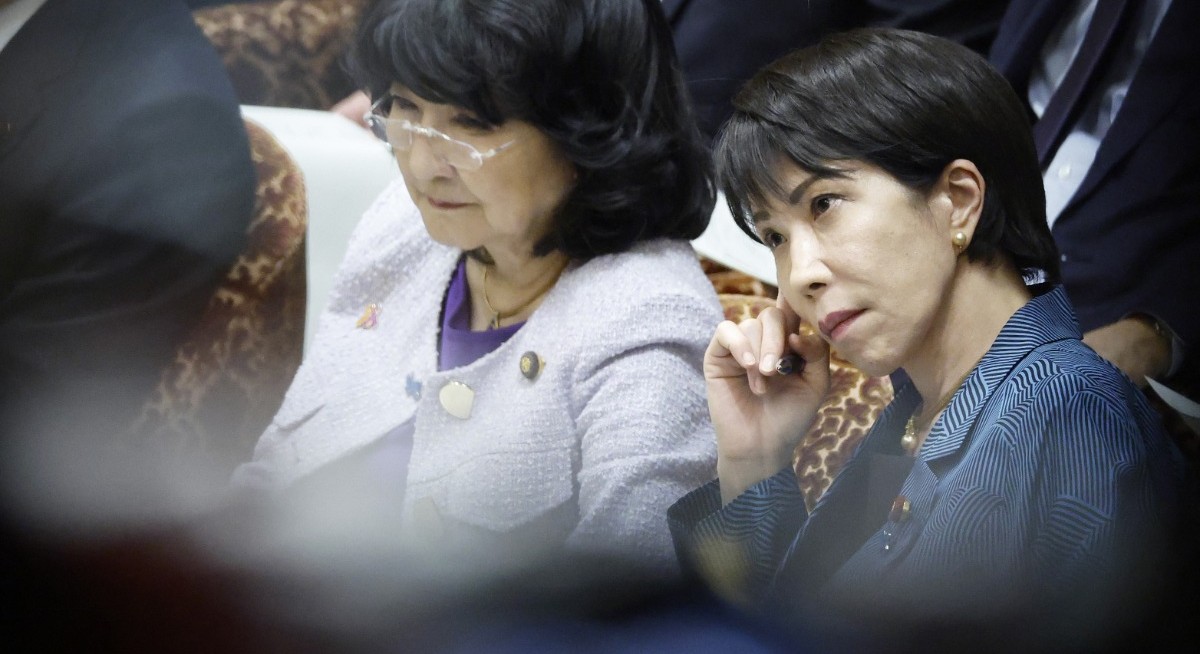


(March 24): Japanese Prime Minister Sanae Takaichi is encountering the limits of her historic mandate as she struggles to get an annual budget through parliament in time for the start of the new fiscal year in April despite setting that goal.
Finance Minister Satsuki Katayama said Tuesday that the government would draw up an 11-day stopgap budget in case the annual budget remains stuck in parliament, an indication that such an outcome is now seen as highly likely. This would be the first provisional budget since 2015.
The stopgap budget would fund spending through April 11 until the annual budget takes effect, Katayama said. Under the Constitution, once the lower house approves the spending plan, it is enacted 30 days after submission to the upper house if there is no vote prior to that. The record ¥122 trillion budget passed the lower house on March 13.
The likelihood of Takaichi missing her goal underscores the limits of her power in parliament. While her recently won supermajority in the lower house gives her firm control there, she still lacks a majority in the upper house. In the case of the budget, the lower house can ultimately force through passage but most other draft legislation can be stymied by the upper house.
“Takaichi has floated policies such as creating a national intelligence agency and penalising flag desecration, which are likely to face resistance from centrist parties” in the upper house, said Yu Uchiyama, a political science professor at the University of Tokyo.
Uchiyama added that it remains unclear whether the premier will seek cooperation from the opposition to pass bills in the upper house or choose instead to rely on her party’s two-thirds majority in the lower house to override it.
See also: BOJ says will raise rates if outlook stays on track after hold
Takaichi’s objective of passing the budget by the end of March looked like a tall order from the get-go as it required strict limitation of the time allowed for parliamentary deliberation. That turned her insistence on trying to railroad it through parliament into a litmus test of her ability to utilise her historic mandate to speed up and control the parliamentary process.
While the premier was able to get the budget passed by the lower house after the shortest debate period since 2000, opposition parties in the upper house have been calling for more time to discuss it.
“We believe it is essential for the fiscal 2026 budget to be enacted within the current fiscal year and deliberations are currently under way in the upper house,” Katayama told reporters. “As we cannot allow a gap in budgeting for even a single day, we are preparing a provisional budget in cooperation with relevant ministries to guard against any contingencies,” she said.
See also: Japan's Takaichi says Trump visit to be ‘extremely difficult’ after warship spat
While last month’s general election significantly strengthened Takaichi’s power in parliament, it also delayed the budget process. The lower house budget committee began its discussions on the plan on Feb 27, nearly a month later than the previous year.
A recent report over Education Minister Yohei Matsumoto’s extramarital affair has further slowed proceedings, with opposition parties calling for his resignation and creating another speed bump for Takaichi.
Public support for Takaichi remains high, with approval ratings at around 70% in some polls, partly reflecting positive views of her recent meeting with US President Donald Trump.
Still, a Yomiuri survey found that 64% of respondents favoured a thorough deliberation of the budget, compared with 30% who supported its passage by the end of March.
Experts suggested voters’ preference for balance between deliberation and decisiveness may be shifting. “In the past, forcing a vote would usually trigger public backlash but these days, especially online, showing a strong, assertive stance could actually strengthen support among Takaichi’s core base,” Uchiyama said.
Uploaded by Arion Yeow




