


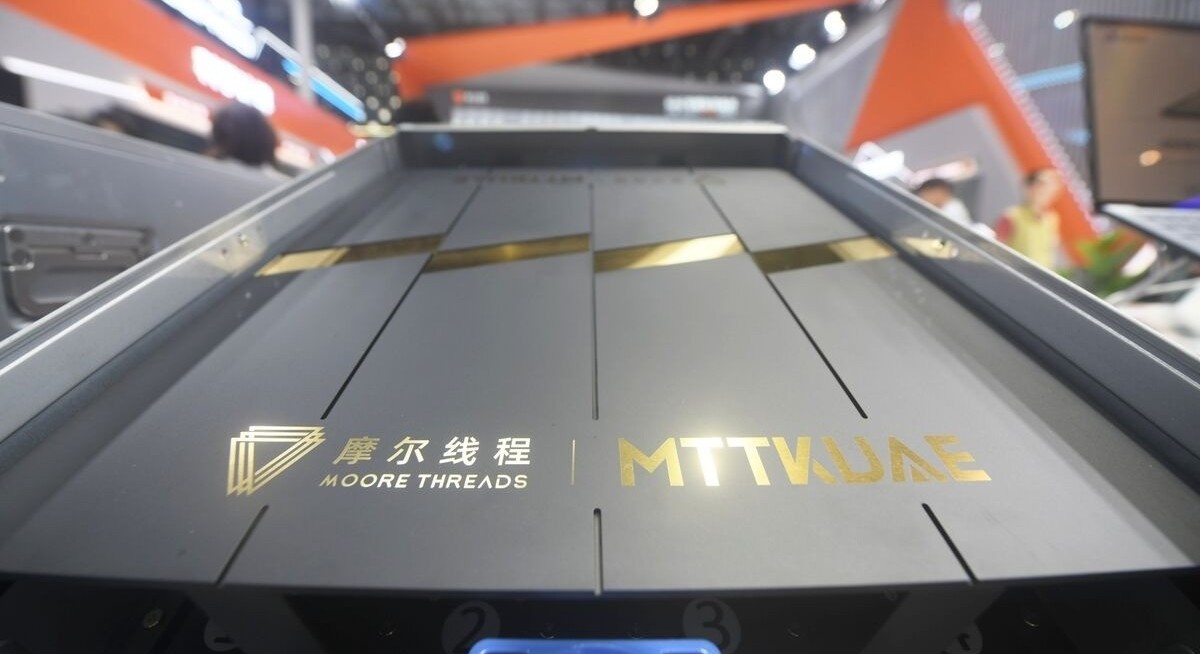


Two years later, Zhang has delivered on that promise. His firm raised eight billion yuan in the year’s second-largest initial public offering in mainland China, with the stock soaring 425% in its trading debut in Shanghai on Friday (Dec 5).
That surge gave Moore Threads a market value of almost US$40 billion and transformed the former Nvidia Corp executive into one of China’s latest AI billionaires. Zhang’s stake in the company is worth more than US$4.3 billion, according to the Bloomberg Billionaires Index, which is valuing him for the first time.

Moore Threads shares closed about 1% lower in Shanghai on Monday.
See also: Syngenta hiring banks for potential Hong Kong IPO, Bloomberg reports
The IPO also minted additional billionaires, including co-founders such as vice president Zhang Yubo (US$1.7 billion), director Zhou Yuan (US$1.4 billion) and vice president Wang Dong (US$1.4 billion).
The demand highlights the immense optimism fuelling China’s drive for tech self-sufficiency as trade tensions with the US intensify. It also underscores a broader frenzy for domestic chipmakers, filling the market void left by Nvidia’s forced exit due to export controls. The Star 50 Index, a proxy for China’s homegrown tech companies, jumped 34% this year, while Cambricon Technologies Corp has doubled in value.
Still, the stock rally in China may reflect domestic cheerleading as much as sound business prospects, according to some analysts.
See also: GIC-backed Thai start-up weighs IPO in Hong Kong or New York
“In the context of the US-China tech war, valuations in the A-share market have detached from reality, driven by politics rather than logic,” said Shen Meng, director of Beijing-based investment bank Chanson & Co, referring to the domestic stock market. “These ‘new generation’ firms serve as powerful political symbols, yet their tangible contribution to technological development remains minimal.”
Moore Threads and Zhang didn’t respond to a request for comment.
Zhang is no stranger to the semiconductor elite. Born into a generation of tech leaders who cut their teeth at Western giants, his resume is a blueprint of the industry. He began in 1990 as a senior researcher at the Metallurgy Automation Research & Design Institute. He then spent years climbing the corporate ladders of US firms in China, first as a product general manager for Hewlett-Packard and later as a manager at Dell Technologies Inc.
He then spent 15 years as Nvidia’s China general manager, building the very ecosystem that he’s now attempting to replace.
Zhang founded Moore Threads in 2020, parlaying his extensive experience at Nvidia to attract billions of yuan in financing just one year after its founding.
“He walks away at the peak of his career to build a national champion,” said Ray Wong, partner at Asymmetry Capital, an investment management firm in Hong Kong. Zhang represents “a new generation of AI founders in China”, he said.
Fresh capital
To stay ahead of Singapore and the region’s corporate and economic trends, click here for Latest Section
For Zhang, the latest injection of capital is critical. The proceeds from the IPO will fund next-generation AI and graphics chip projects, according to the prospectus, essential for survival in a market cut off from Western tech.
“Policy support is the ‘booster’ for strategic high-tech breakthroughs,” Zhang said in an interview with local media in December, acknowledging the capital-intensive nature of the business. The company’s prospectus estimates it expects to turn a profit by 2027.
While revenue is skyrocketing — hitting 785 million yuan in the first three quarters of 2025, up 181% year-over-year — the company is burning cash at an alarming rate. From 2022 to late 2025, Moore Threads accumulated nearly 6 billion yuan in losses.
“This is a domestic substitution play,” said Duncan Clark, chairman of BDA China, a business advisor. Moore Threads can leverage the founder’s industry knowledge from his many years at Nvidia and win domestic contracts, as the government is requesting companies to buy local chips and sectors like the military must source 100% locally, he said.
Unlike many domestic peers focusing solely on AI accelerators, Zhang is targeting full-function graphics processing units, or GPUs. Moore Threads designs chips that handle AI training, 3D graphics rendering and physical simulation simultaneously, mirroring the versatility that made Nvidia dominant.
Still, it will be challenging for the company to catch up with the US giant.
“The technology of companies like Nvidia was formed over decades of constant iteration,” said Shen. “The possibility that Chinese companies can suddenly go toe-to-toe with them is very slim.”
Uploaded by Arion Yeow




