


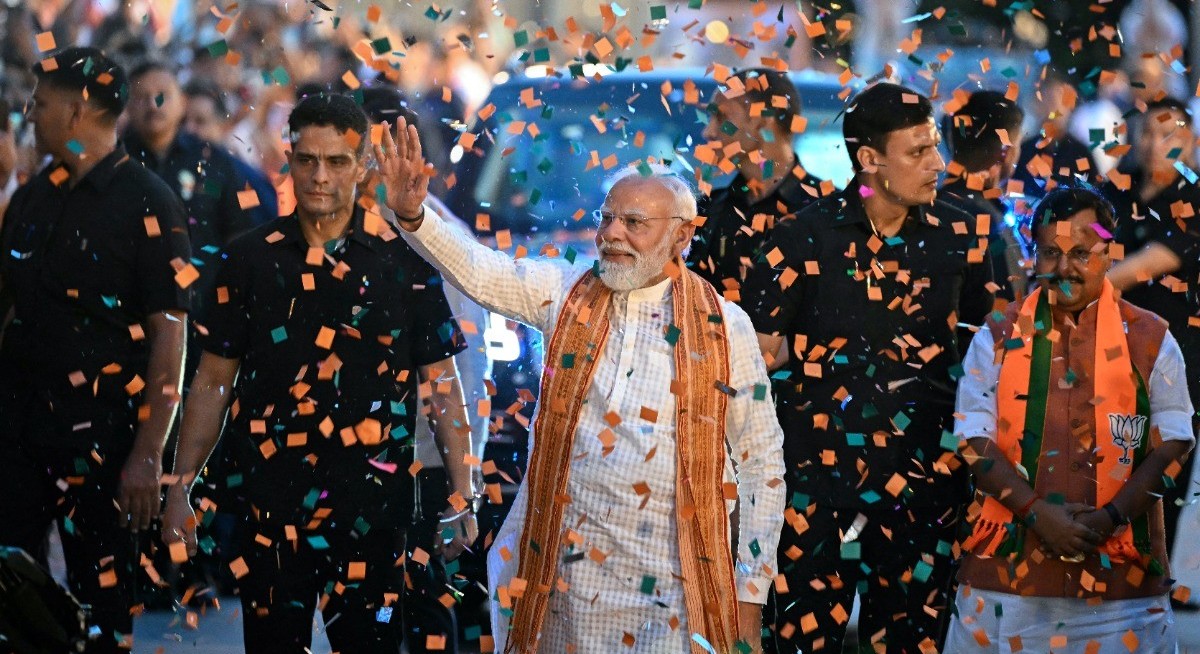


(May 8): A landslide win by Prime Minister Narendra Modi’s party in a key state election this week has sparked debate over whether controversial changes to voter rolls helped secure the surprise result.
Modi’s Bharatiya Janata Party (BJP) won 207 seats in the 294-member legislature in West Bengal, ending the 15-year rule of the All India Trinamool Congress, or TMC, which was reduced to 80 seats. Although most exit polls predicted the BJP would oust the incumbent, the surveys had pointed to a much closer contest.
Just two weeks before the vote, the Election Commission removed about nine million names — nearly 12% of voters — from the rolls, saying the exercise was aimed at weeding out duplicate entries and illegal migrants. Opposition groups alleged the process disproportionately targeted poor and Muslim voters, tilting the election in the favour of the BJP, a Hindu nationalist party.
Trinamool Congress leader Mamata Banerjee has rejected the results and refused to resign as chief minister in the state.
Analysts, however, remain divided over the impact of the voter roll changes. Neelanjan Sircar, an associate professor at Ahmedabad University, said there’s evidence to suggest there were more voter deletions in constituencies where TMC was strong.
“It’s actually impossible that the SIR had no impact, there’ll be an impact,” said Sircar.
See also: Indian small-caps rally 20% from March lows to near bull market
Others like Yashwant Deshmukh, the founder of survey company C-Voter, say the voter roll changes had little impact on the results, and that the outcome shows a swing away from Banerjee’s party because they were disillusioned by her rule.
The BJP’s victory in West Bengal was a milestone for the party, marking its first ever win in the eastern state. The campaign was acrimonious and dominated by disputes over the voter roll revisions, known as the special intensive revision, or SIR, eclipsing issues such as jobs and inflation.
Banerjee has alleged irregularities in the vote-counting process, claims echoed by other senior opposition leaders, who accused Modi’s party of using the election body and federal forces to influence the outcome. The BJP has dismissed the allegations. A spokesperson for the ECI didn’t respond to a text message on the allegations.
See also: Modi's win boosts Indian industrial stocks in catalyst-dry market
Millions of those struck off the rolls filed appeals, but many did not receive decisions in time to vote. Some 3.4 million people — including 2.4 million Muslims — among those removed from the rolls had approached appellate courts with valid documents to seek reinstatement, but were effectively made to sit out the election, said Maidul Islam, a professor of political science at the Centre for Studies in Social Sciences, Calcutta.
“These are genuine voters with proof of citizenship,” he said. Even if the rest of the people struck off the roll were removed for legitimate reasons, “there’s no doubt about the genuineness of this group,” he said.
Banerjee, who was seeking a fourth term as chief minister, petitioned the Supreme Court to intervene and halt the exercise. While the court allowed the revision to proceed, it directed the creation of appellate tribunals to hear challenges.
Even so, there was significant anti-incumbency sentiment because of corruption allegations against TMC officials, and many voters abandoned the party, he said.
Deshmukh said his analysis showed the TMC’s performance was better in areas where there were voter deletions from the registered roll. He also rejected the view that most of those removed from the list were Muslims.
He said Banerjee’s party continued to secure support from Muslim and women voters, but that anger over the government’s handling of security matters, including a rape case at a hospital, had turned voters against her.
Since the 2024 national elections, Modi’s party and its allies have made steady gains in state elections, using a mix of religion and economic policy to lure voters. The BJP secured victories in Maharashtra and Haryana, and retained power in Bihar with coalition partners. The party also won control of the national capital, Delhi, after more than two decades.
Uploaded by Evelyn Chan




