


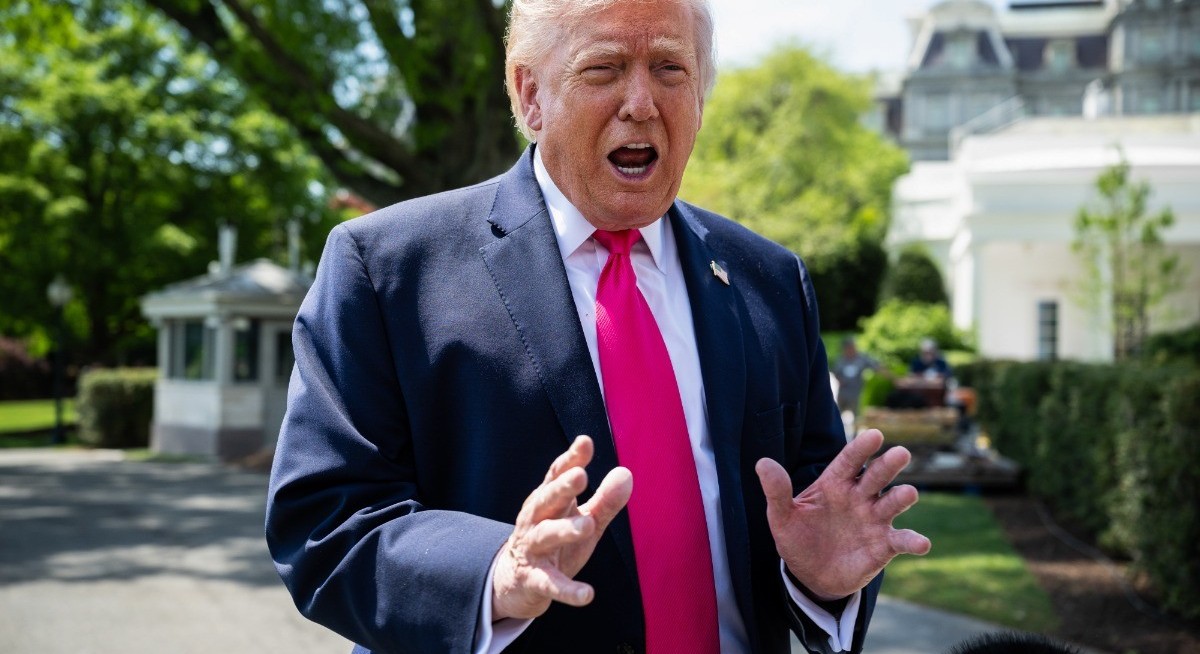


(May 6): President Donald Trump said he would pause a US-led effort to help stranded ships exit the Strait of Hormuz to see if an agreement with Iran to end the war could be reached.
“Project Freedom (the movement of ships through the Strait of Hormuz) will be paused for a short period of time to see whether or not the agreement can be finalised and signed,” Trump said in a social media post on Tuesday.
The president cited “great progress” towards “a complete and final agreement with representatives of Iran”. He said the decision had been made at the request of Pakistan — which is helping mediate talks between Washington and Tehran — as well as other countries. He added, however, that a US blockade of ships transiting to and from Iranian ports would “remain in full force and effect”.
It was not clear what progress Trump referred to, and he didn’t provide details on what, if any, negotiations were in the works. His comments marked an abrupt shift from recent days when he had voiced frustration over the pace of talks and indicated he wasn’t satisfied with Tehran’s proposals.
Brent crude oil dropped towards US$108 ($137.53) a barrel on Wednesday after sliding 4% a day earlier, while West Texas Intermediate was near US$100.
The administration appears to be looking for ways to ease the stand-off that has escalated fuel prices, exacerbating economic strains that Republicans fear could lead to their party losing control of both chambers of Congress in the November midterm elections.
See also: Abu Dhabi mulling new entity to drive global defence ambitions — Bloomberg
Hours before Trump’s announcement, Secretary of State Marco Rubio told reporters at the White House that offensive operations against Iran were over as the US shifts to protecting shipping in the Strait of Hormuz. But the targeting of another cargo vessel after a day of strikes indicated that hostilities continue.
While the US now seems intent on trying to deescalate the conflict, which has killed thousands of people in Iran and Lebanon and roiled global energy markets, the pathway to a deal that reopens the strait, which carries a fifth of the world’s oil exports, remains distant.
The US president has cast Project Freedom as a humanitarian gesture to rescue seafarers stuck in the strait and ease the flow of commodities through the strategic waterway, which has been largely closed since the start of the war in late February. Yet the effort has been plagued by confusion and failed to address the safety concerns of shippers.
See also: US-Iran ceasefire holds after Hormuz clashes and UAE strikes
The operation spurred fresh violence on Monday, posing one of the biggest challenges to the already tentative ceasefire between the US and Iran. The American military fought off attacks from Iranian drones, missiles and armed small boats as it facilitated the passage of two US-flagged vessels through the strait. The United Arab Emirates also said it had intercepted Iranian cruise missiles.
As Rubio spoke on Tuesday, a British monitoring organisation reported that a cargo ship in the strait had been struck by an unknown projectile. The US said the shutdown around Hormuz has left more than 1,550 commercial vessels, carrying some 22,000 sailors, trapped in the Persian Gulf.
Iran has been blocking international traffic and constricting oil and gas flows, generating turmoil in energy markets.
The US in turn has been blockading Iranian ports. Trump ordered the blockade more than three weeks ago in a bid to throttle Iran’s crude exports and intensify economic pressure on Tehran, building leverage for talks on a potential nuclear deal.
Trump has said the stand-off is damaging Iran’s economy and forcing the Islamic Republic to make concessions, but the situation has spurred uncertainty in financial and energy markets with fears that there is no end in sight to a nine-week old conflict.
Before Trump’s announcement, Iran’s president dismissed American demands to resume talks as “impossible”.
“The problem is that while the US pursues a policy of maximum pressure against our country, it also expects the Islamic Republic of Iran to come to the negotiating table and ultimately submit to its unilateral demands — an equation that is impossible,” President Masoud Pezeshkian said in a call with Iraq’s prime minister-designate Ali al-Zaidi, according to the semi-official Fars News Agency.
To stay ahead of Singapore and the region’s corporate and economic trends, click here for Latest Section
The president and top administration officials have described challenges with talks, in part because of divisions within Iran itself.
Sometimes after an offer is made, Rubio said, “it takes five or six days to get a response”, since it has to wind its way through a system and be put in front of the supreme leader.
“Their system has always been multilayered in this way. It’s obviously become more complex because of the damage they suffered during the war,” he said.
At the United Nations, the US and its allies backed a draft Security Council resolution that would open the door to sanctions or even military action if Iran doesn’t ease its chokehold over the strait. The proposal would require support from China and Russia to pass.
Uploaded by Tham Yek Lee




