


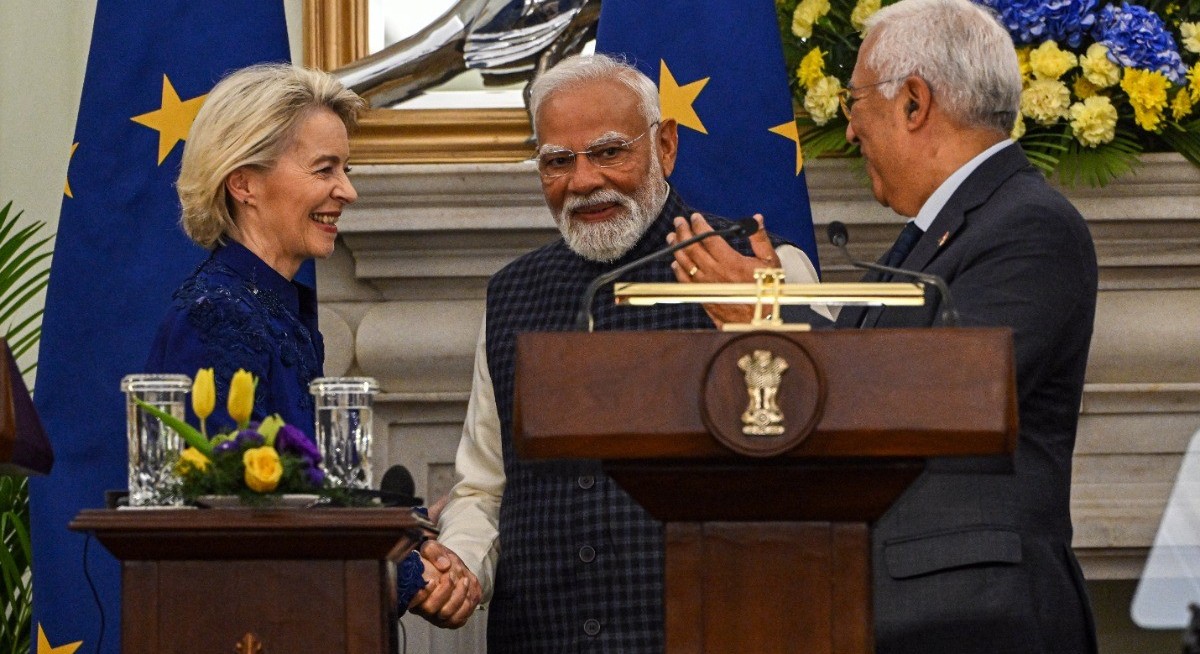


(Jan 27): The European Union (EU) and India concluded a free-trade agreement after almost two decades of negotiations, part of an effort to deepen economic ties that has gained momentum due to the Trump administration’s aggressive tariff policies.
“We have concluded the mother of all deals,” European Commission President Ursula von der Leyen said on Tuesday in a social media post. The head of the EU executive, who was in New Delhi to mark the moment with European Council President Antonio Costa, added that the accord “created a free trade zone of two billion people, with both sides set to benefit.”
Indian Prime Minister Narendra Modi hailed the agreement as a means of strengthening India’s manufacturing and services sectors while boosting investor confidence in Asia’s third-largest economy.
“India has completed its biggest and most historic free trade agreement,” Modi said at a joint press briefing in New Delhi. “This historic agreement will make it easier for our farmers and small businesses to reach the European markets.”
The conclusion of negotiations reflects the rapidly shifting global alignment under US President Donald Trump. The EU, despite long clashing with Indian officials on trade policy, is focused on paring back its economic reliance on the US and China. India is trying to shake its protectionist reputation and offset a 50% Trump tariff, while at the same time balance ties with Russia.
The deal is expected to double EU goods exports to India by 2032 after New Delhi agreed to eliminate or cut tariffs on 96.6% of shipments, according to a European Commission press release. The EU, in turn, will eliminate or reduce tariffs on 99.5% of goods imported from India over seven years, India’s Ministry of Commerce and Industry said.
See also: Trump vows to raise tariffs to 25% on South Korean goods
It’s India’s most ambitious trade pact to date. New Delhi has agreed to allow up to 250,000 European-made vehicles to enter the country at preferential duty rates — a quota more than six times larger than other recent deals.
The agreement would give India a competitive edge in exporting labour-intensive goods hit hard by Trump’s tariffs, including apparel, gems, jewellery and footwear. Brussels has also offered binding commitments on student mobility and post-study visas, along with concessions across 144 services sectors. India has kept its politically sensitive dairy sector out of the deal.
“India has risen and Europe is truly glad about it because when India succeeds, the world is more stable, more prosperous and more secure,” von der Leyen said at the briefing, adding that the pact sends a “strong message that cooperation is the best answer to global challenges”.
See also: Norway’s US$2.1 tril fund told to prepare for more US threats
| India to cut tariffs on key EU products | ||
|---|---|---|
| Product | Current tariffs (%) | Future tariffs (%) |
| Cars | 110 | 10 with quota of 250,000* |
| Wines | 150 | 20 (premium range); 30% (medium range)* |
| Spirits | up to 150 | 40 |
| Beer | 110 | 50 |
| Processed food such as pasta, chocolate | up to 50 | 0 |
| Aircraft and spacecraft | up to 11 | 0 for almost all products |
| Machinery, electrical equipment | up to 44 | 0 for almost all products |
| * Duty cuts over a period of time | ||
The pact is expected to be formally signed after legal vetting, which will likely take around six months. The European Parliament will also have to ratify it.
The announcement comes days after EU finally secured a long-gestating trade deal with the Mercosur bloc of South American countries — another pact meant to help the EU pivot away from the US and China. EU lawmakers have yet to ratify that deal, however.
Modi is similarly trying to find new markets for a country Trump once dubbed the “tariff king”. Tuesday’s agreement marked Modi’s fourth trade deal since last May, following pacts with the UK, Oman and New Zealand.
The South Asian nation is also seeking partnerships with the Mercosur bloc, Chile, Peru and the Gulf Cooperation Council, hoping to secure strategic resources and expand India’s global footprint.
| EU to slash tariffs on key Indian goods | ||
|---|---|---|
| Products | Current tariffs (%) | Future tariffs (%) |
| Gems and jewellery | 4 | 0 |
| Textiles and apparels | 12 | 0 |
| Leather | 17 | 0 |
| Chemicals | 12.8 | 0 |
| Base metals | 10 | 0 |
| Furniture | 10.5 | 0 |
Bilateral trade between the EU and India stood at US$136.5 billion ($172.9 billion) in India’s fiscal year through March 2025, with the EU making up more than 17% of India’s total exports, according to official data. India is the EU’s ninth largest trading partner.
To stay ahead of Singapore and the region’s corporate and economic trends, click here for Latest Section
The announcement drew an immediate positive response from industry groups and business executives in Germany, the EU’s biggest economy, as well as from members of Chancellor Friedrich Merz’s ruling coalition in Berlin.
Ola Källenius, chief executive officer of carmaker Mercedes-Benz Group AG, said the agreement was “very good news both for the EU and for Germany, but also for India”.
“If we can strengthen trade relations with this rapidly growing economy, then that will also support the German export industry,” Källenius said in an interview with Welt TV.
The EU and India are also growing closer on the defence front, unveiling a new security partnership.
The pact broadens cooperation in traditional defence areas, including the joint development and production of weapons, and provides a mechanism for sharing classified information, according to a joint statement on Tuesday.
Modi has been seeking to ramp up defence production in India and is looking to acquire technology from countries such as Germany and France. The agreement provides a framework for Indian industry to partner with European counterparts in the production of military hardware.
The pact will also see the two sides cooperate more closely in monitoring the Indian Ocean region, where China has expanded its presence in recent years by deploying flotillas of warships.
“We are not only making our economies stronger, we are also delivering security for our people in an increasingly insecure world,” said von der Leyen.
Uploaded by Tham Yek Lee




