


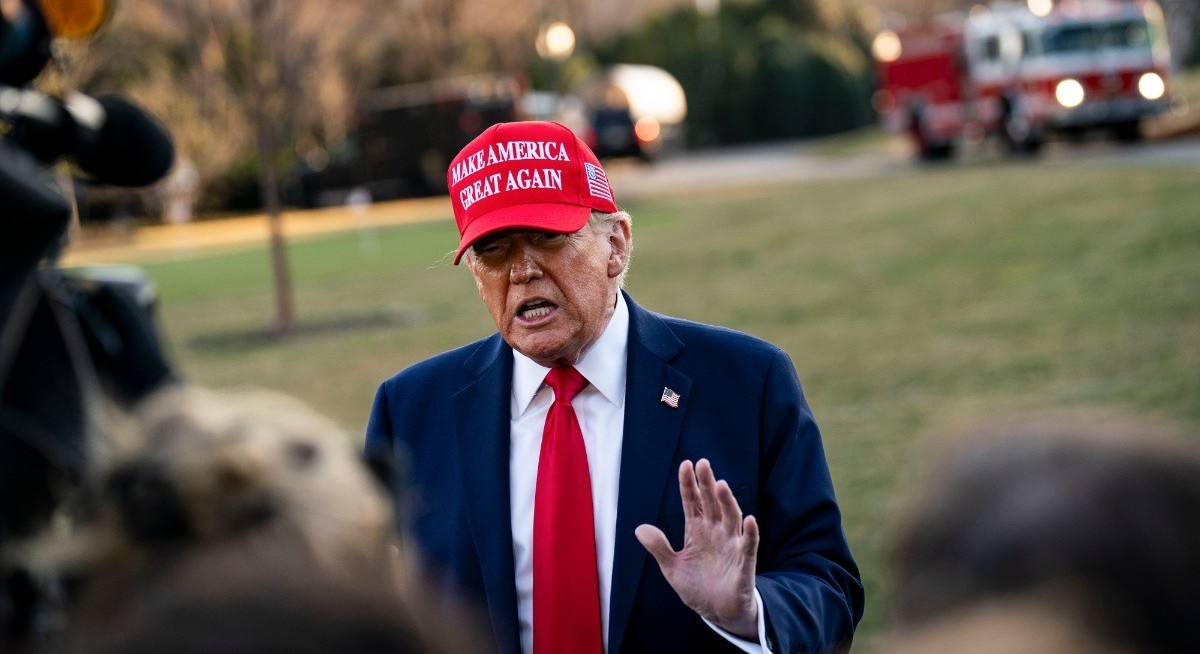


(Jan 27): US President Donald Trump threatened to hike tariffs on goods imported from South Korea to 25%, citing what he said was the failure of the country’s legislature to codify the trade deal the two nations reached last year.
Trump in a social media post on Monday said the new rate would apply to autos, lumber, pharmaceutical products and “all other reciprocal tariffs”. Under the existing agreement, the president set a 15% levy on South Korean exports.
“South Korea’s legislature is not living up to its deal with the US,” Trump said in his post. “In each of these deals, we have acted swiftly to reduce our tariffs in line with the transaction agreed to. We, of course, expect our trading partners to do the same.”
If implemented, the move could have wide-ranging effects on major South Korean companies that export to the US, such as Hyundai Motor Co, which sent 1.1 million vehicles to America in 2024. Hyundai shares fell as much as 6.1% on the news on Tuesday, but then pared losses amid expectations that Trump may not follow through with this threat.
Trump’s announcement marks his latest move to ratchet up trade tensions with allies. In recent weeks, he has threatened to raise duties on Canadian products to 100% if Ottawa signed a trade deal with China and to slap new charges on European countries’ goods over his quest to seize control of Greenland. The president has also said he would place tariffs on imports from countries doing business with Iran in an effort to pressure Tehran over anti-government protests.
Still, Trump’s tariff threats have often been scaled back or reversed. Data compiled by Bloomberg showed that about 27% of such threats since late 2024 were fully executed, with the share that remained in place lower at around 20%.
See also: Russia cuts key rate to 15.5% despite uptick in inflation
South Korea has been lauded as a model ally by the US for raising its defence spending to 3.5% of gross domestic product, but tensions remain over the pace at which Seoul provides investment to the US under its earlier trade deal, and regulations seen to be inhibiting US digital commerce firms. There’s also a lack of clarity over an agreement to help with US shipbuilding, the construction of nuclear submarines and the provision of nuclear fuel for submarines.
Following last year’s trade deal announcement, a domestic bill called the “special law on strategic investment with the US” was introduced to the South Korean Parliament in late November, triggering a retroactive cut in US auto tariffs from 25% to 15%.
Once passed, it will give South Korea’s government the legal authority to manage and carry out the large-scale investments it pledged to the US under the trade deal, but it hasn’t been put on the fast track for approval for now.
See also: BOJ hawk Tamura flags spring as possible timing for rate hike
A Bloomberg report last week said Seoul would hold off this year on implementing its annual US investment pledge that was part of the trade deal framework amid concerns over capital outflows and currency volatility.
Finance Minister Koo Yun Cheol subsequently said the government was not intentionally delaying the investment, but was still in the process of selecting projects and completing required procedures. He said it would be difficult for the funds to be allocated in the first half of the year given the time needed to identify sites, finalise designs and carry out approvals.
South Korea’s presidential Blue House said it hasn’t yet received any formal notification or detailed explanation from the US regarding Trump’s post on Truth Social. Industry Minister Kim Jung-kwan plans to travel to the US as soon as possible to discuss the matter with Commerce Secretary Howard Lutnick, it said. Trade Minister Yeo Han-koo is also expected to visit the US soon for talks with US Trade Representative Jamieson Greer.
Officials from relevant ministries held a meeting on Tuesday with senior aides from the Blue House to review progress on proposed special legislation as part of follow-up measures to Trump’s announcement, presidential spokesperson Kang Yu-jung said.
“Any tariff increase would require administrative steps, including publication in the federal register, to take effect, and our government plans to convey its commitment to implementing the tariff agreement to the US,” Kang said in a statement.
The US is South Korea’s second-largest export destination after China, accounting for over 17% of outbound shipments worth US$122.9 billion ($155.92 billion) last year. The Office of the US Trade Representative said the US ran a US$66 billion trade deficit with South Korea in 2024, its eighth-largest bilateral gap. While China remained South Korea’s top export market in 2025, Seoul ran a far larger trade surplus with Washington than Beijing.

To stay ahead of Singapore and the region’s corporate and economic trends, click here for Latest Section
When the investment bill was submitted in November, Huh Young, the senior policy floor leader of the ruling Democratic Party, said Parliament was not considering putting the bill on a fast-track process, hinting at some of the domestic concerns over the deal.
“If there are any provisions that could potentially undermine the national interest, we hope the ruling and opposition parties will put their heads together to ensure the bill passes as a more complete piece of legislation governing investment in the US,” Huh told reporters on Nov 26.
Since the bill’s submission, deliberations have stalled in the National Assembly as the main opposition People Power Party calls for ratification of the tariff deal before passage of the special law. Finance Minister Koo plans to meet with the head of Parliament’s finance committee to seek cooperation on the legislation, his office said.
The latest threat is consistent with Trump’s standard approach to trade, in which agreements often remain subject to change, according to Peter Kim, managing director at KB Securities in Seoul. He said South Korea’s delayed implementation reflects the typical pace of its legislative process rather than any intentional strategy.
The won weakened as much as 0.7% while bond futures edged higher on Tuesday morning in Seoul. The currency had risen more than 2% over the past week after President Lee Jae Myung vowed to stabilise it. The benchmark Kospi fell as much as 1.2%, before erasing the loss to gain more than 2%.

“Tariff headlines may keep stock prices volatile in the near term, but further pullbacks may be limited,” Jung In Yun, the chief executive officer of Fibonacci Asset Management Global. “For me, any pullback will likely be a sentiment-driven dip, not a structural issue. South Korea’s key exporters remain globally competitive and capable of adapting supply chains.”
Beyond the investment legislation, the US has also voiced concerns over South Korea’s handling of digital regulation, citing what they see as disproportionate scrutiny of US-linked technology firms amid a high-profile data-breach incident at Coupang Inc. The issue has added to broader friction between Washington and Seoul over market access and regulatory treatment in the digital sector in recent months.
“If South Korea responds promptly by accelerating the process, there is a high probability that the tariffs will be swiftly lowered again,” said Ha SeokKeun, the chief investment officer of Eugene Asset Management Co. “Since both nations desire this outcome, the impact of this news on the domestic stock market is expected to be limited, provided no extraordinary external variables arise.”
Uploaded by Tham Yek Lee




