


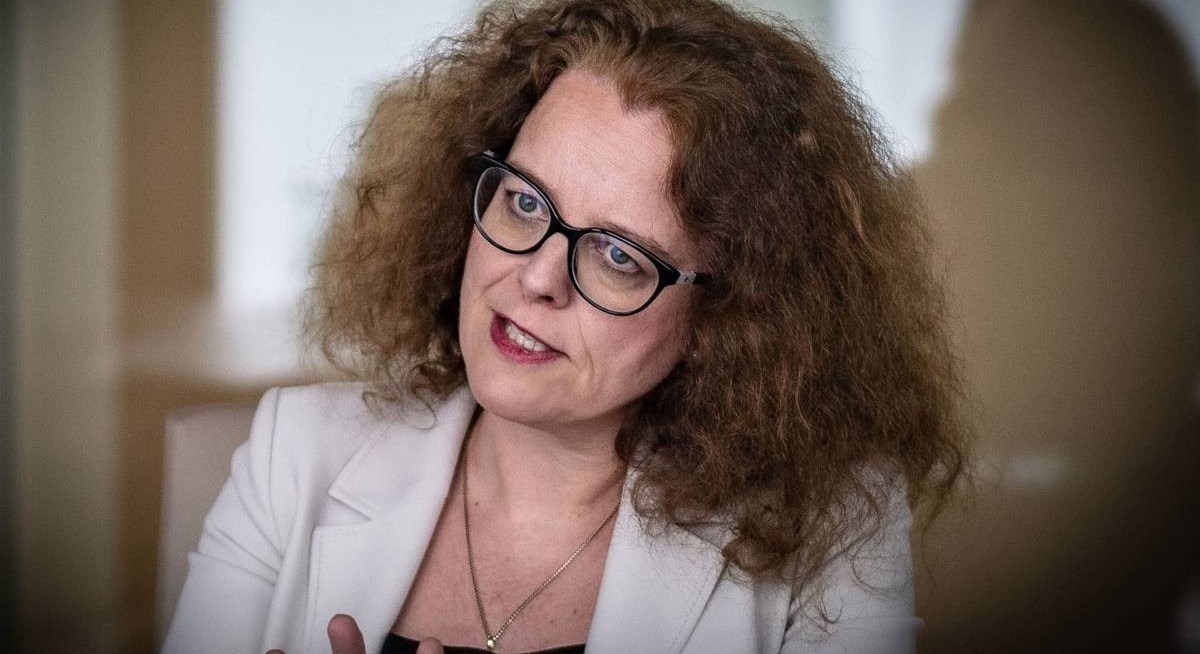


“Both markets and survey participants expect that the next rate move is going to be a hike, albeit not anytime soon,” she said last week in an interview in her office in Frankfurt. “I’m rather comfortable with those expectations.”
The German hawk described risks to the economy and inflation as tilted to the upside. She signalled that new growth projections might be revised higher at December’s meeting, where analysts see the deposit rate being left at 2% for a fourth time.
Schnabel is the first ECB policymaker to declare with any certainty that borrowing costs aren’t simply in a “good place” — as president Christine Lagarde and others have repeatedly said — but have reached a floor.
While many on the Governing Council reckon the ECB’s next step could be in either direction and some won’t exclude adding to the eight cuts enacted to date, her stance highlights the varying fortunes of major central banks: The US and the UK are still in cutting mode as they grapple with stickier inflation.
See also: Canada employment falls by 24,800, jobless rate down to 6.5%
Schnabel’s conviction stems from how well Europe has weathered the tariff turmoil unleashed by President Donald Trump. Consumers have benefitted from rapid increases in pay alongside unemployment that’s near a record low. Favourable financing conditions and a rally to adopt AI technology, meanwhile, have bolstered investment.
Growth “has been much more resilient than could have been expected in the face of the greatest disruption of the international trade order since the Second World War,” she said, noting surveys that point to “solid expansion” into year-end. “One reason why the impact of tariffs has been milder than expected is that uncertainty has come down quite quickly.”
The ECB’s last batch of forecasts suggested growth would slow to 1% next year before picking up again in 2027. Since then, Schnabel said “the outlook has brightened.” Data Friday already showed a better performance for the third quarter than initially thought.
See also: India central bank set to allow banks to lend to REITs
ECB watchers will have a close eye on the inflation side of the ECB’s outlook, which will include 2028 for the first time, to gauge whether a dip below the 2% target will turn out worse than previously envisaged. A big concern is a likely delay in the European Union’s carbon-pricing system that could act as a drag in 2027.
Schnabel downplayed such fears, arguing that the ECB can tolerate “moderate deviations from target” as long as there’s no sign of them becoming sustained.
“It’s important not to pin things down to any particular number,” she said. “What really matters is the overall macroeconomic narrative, which tells you something about how the economy and inflation are going to move over time.”
While inflation “is in a good place” for now, services prices remain the “most important” challenge due in no small part to wage rises, according to Schnabel.
At the same time, downward pressure on goods due to a stronger euro, cheaper energy and potential trade re-routing from China has been more muted than feared.
“This means that the decline in core inflation has stalled at a time when the economy is recovering, the output gap is closing and fiscal policy is expanding, all of which would tend to be inflationary,” Schnabel said. “This has to be monitored very carefully.”
Schnabel declined to comment on analyst forecasts for the timing of the next rate move, with some betting on an increase as early as June. “This is not currently on our minds,” she said. “We’ll cross that bridge when we come to it.”
To stay ahead of Singapore and the region’s corporate and economic trends, click here for Latest Section
Looking ahead, she stressed that the ECB must keep a close eye on whether longer-term phenomena — like shifts in the economy’s potential and the impact of AI — render monetary settings that would otherwise be appropriate too loose.
“We have to monitor whether our policy becomes more accommodative over time, and potentially too accommodative, which would then be a time to think about another rate move,” Schnabel said.
Turning to the ECB’s balance sheet, she said the process of allowing maturing bonds to roll off is progressing “smoothly,” with stable money-market rates indicating excess liquidity remains “abundant.”
That contrasts with the US, where the Federal Reserve halted its rundown this month. While Bloomberg Economics has suggested the ECB could follow in the second half of next year, Schnabel said any such predictions are difficult.
“That broadly corresponds to one end of our range,” she said. “The other end of the range is much later.
While a review on the ECB’s future operational framework will start next year, it may not be concluded until 2027, Schnabel said.
Uploaded by Magessan Varatharaja




