


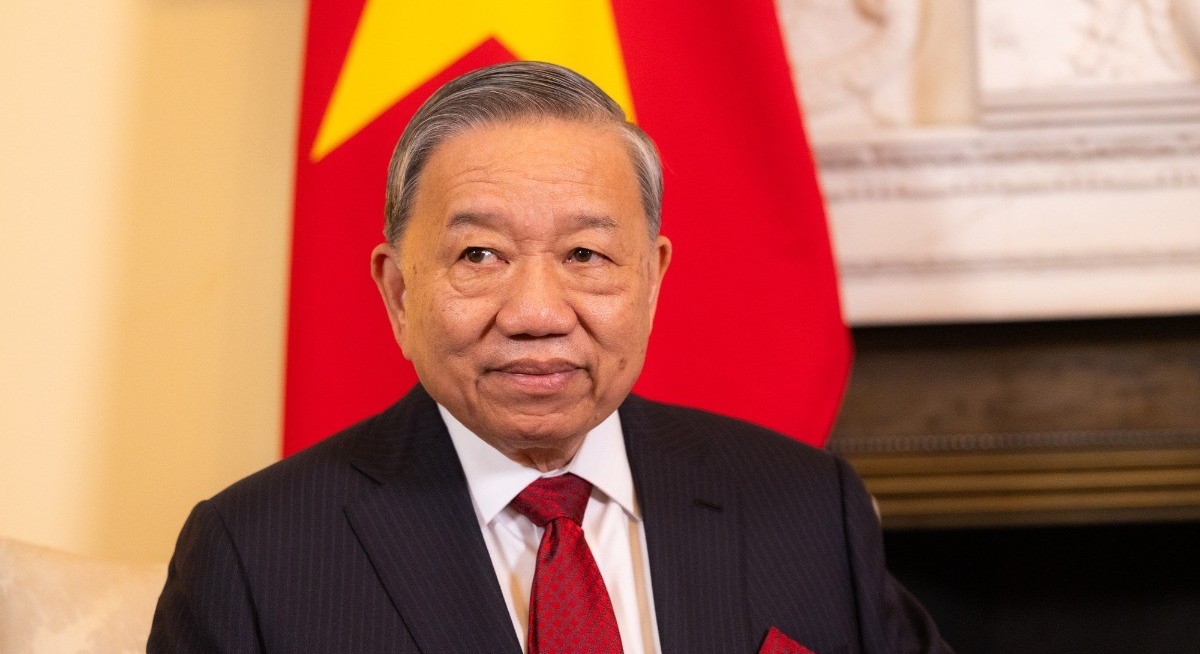


(Jan 23): Vietnam’s leader To Lam has secured further authority from the ruling Communist Party to guide the country’s future and continue his aggressive “new growth model” for the economy.
The announcement on Friday that he takes on a new five-year term as the party chief was widely expected as the National Congress concluded in Hanoi. But he will also take on the role of the president, according to people familiar with the situation, putting him in a rare position that signals his power and influence within the party.
Former central bank governor Le Minh Hung, 55, has also been tapped as the prime minister after being elevated in 2024 to the Politburo, the party’s top decision-making body, said the people. They requested anonymity as official confirmation hasn’t yet been announced. The government on Friday didn’t immediately respond to a request for comments.
In the 18 months since taking over after the death of his predecessor, Nguyen Phu Trong, Lam has pushed through some of the biggest changes in four decades by slashing the size of the bureaucracy, eliminating a tier of local government and elevating the economic role of the private sector.
That’s won plaudits from foreign investors for seeking to cut red-tape and speed up approvals. Along the way, however, he’s faced criticism within party ranks for upending established power structures.
Still, the party on Friday cemented those policies by approving a new five-year development plan for the country, which targets 10% growth or more until 2030.
See also: Tankers speed through Hormuz chokepoint on US-Iran tensions
“Without innovation and reform, there cannot be breakthrough, there cannot be competitiveness, there cannot be development,” Lam said in his closing remarks, speaking under a towering statue of Ho Chi Minh.
Lam taking on the presidency would allow him to set core policy as the party leader and lead foreign relations as the president, an increasingly important combination amid the global trade dislocations caused by the US-China rivalry.
“If To Lam simultaneously holds the roles of general secretary and president, he and his allies will be more emboldened to take decisive action, in a shift from Vietnam’s typical calculated, consensus-based policymaking,” said Laura Schwartz, a senior Asia analyst at Verisk Maplecroft.
See also: Iran signals US negotiations won’t lead to quick resolution
Without referring to the global diplomacy role of the president, Lam told reporters on Friday that Vietnam’s foreign relations have been elevated to a level of importance on a par with security and defence.
“In order to reach our double-digit growth, we need to focus on further integration into the global economy,” Lam said. “We will also need to integrate further in terms of regional and international security.”
He also flicked at contributing to world peace, a favourite theme of US President Donald Trump, whose administration is still negotiating the final details of a trade deal with Hanoi.
“We stand ready to contribute in a greater way to the building of peace,” he said.
Lam came up the ranks in the Ministry of Public Security as the top corruption cop, spearheading Trong’s “blazing furnace” anti-corruption drive that’s taken down top leaders and tycoons.
While Lam’s unquestioned grip on power is similar, his pivot towards pro-investment growth differentiates him from Trong’s commitment to party discipline and internal security.
“The focus was much more on domestic stability, cracking down on corruption, strengthening the role of the party,” in the latter part of Trong’s time, said Dan Kritenbrink, a partner at the Asia Group and former US ambassador to Vietnam. “The end result of that is most business people in Vietnam and most foreign investors would say things sort of slowed down.”
To stay ahead of Singapore and the region’s corporate and economic trends, click here for Latest Section
“The focus very clearly now is economic growth,” he said. “It’s private-sector led growth, and it’s also growth fuelled by technology, innovation, clean energy and supported by good foreign direct investment.”
Lam has made clear he sees the private sector as “one of the most important growth engines”, while the state-owned sector will provide stability, strategy and guidance as the country targets high-income status by 2045.
Vietnam is one of the world’s fastest-expanding economies, growing 8% last year as aggressive lending, supportive state policies, along with surging tourism, helped it navigate the imposition of a 20% US tariff.
It’s betting on an infrastructure spending splurge this year to accelerate industrialisation and production capacity to position itself as a manufacturing and logistics hub.
“Our reforms are a continuous process,” Lam told reporters after the congress was over. “Our ultimate goal is to improve our people’s lives.”
Uploaded by Tham Yek Lee




