


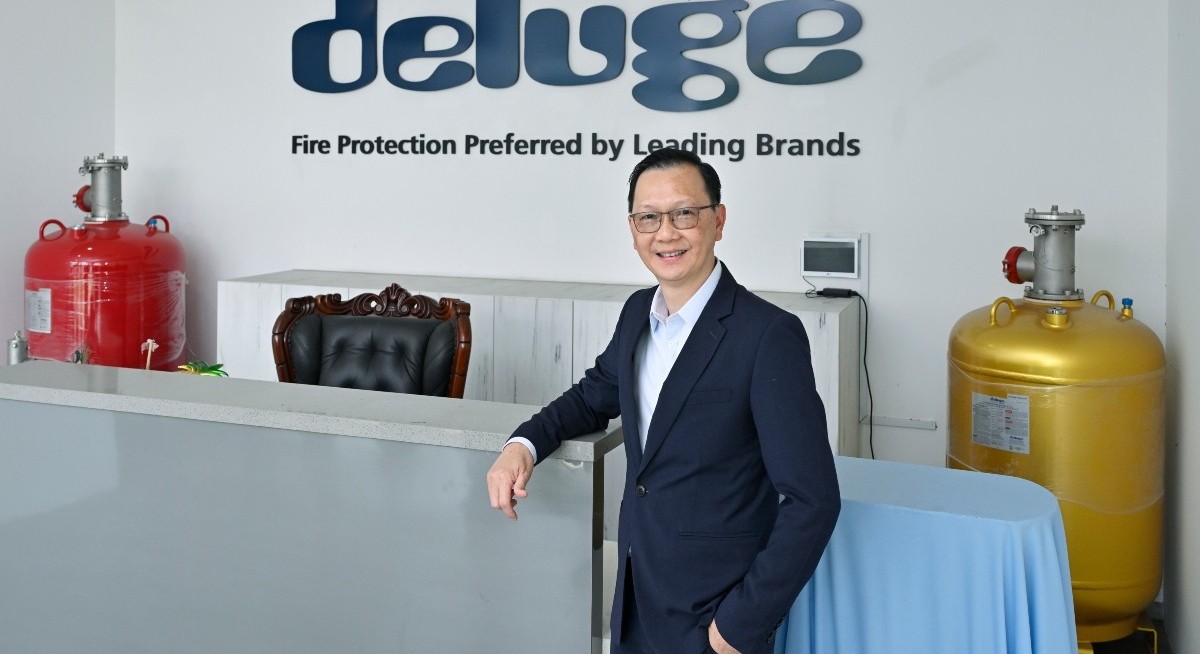


Set up in 1983, the company, founded by chairman Vincent Cheo, has grown into one of the leading fire prevention and protection specialists in Singapore. With its Building and Construction Authority (BCA) L6 grade certification, Deluge can bid for jobs of unlimited contract value.
“Since 1986 to date, we have built up more than $1 billion worth of cumulative project works across Singapore’s critical infrastructure,” says Lee in an interview with The Edge Singapore.
According to him, Deluge is involved in a wide variety of projects ranging from aviation, offshore & marine, petrochemical, warehouses & factories, commercial & residential, pharmaceutical and refinery to wafer fabrication.
“What differentiates us from the rest is that we offer an integrated, end-to-end suite of fire detection and protection services and solutions, spanning the full fire protection lifecycle from design, fabrication and installation through to maintenance, servicing and training,” Lee adds.
See also: Trek 2000 puts legacy issues behind just as AI opportunities emerge
He explains that most fire protection systems on the market are quite standard, except for certain types of buildings. “Some of the projects that we secured, like high-end aircraft hangars, require complex and technically demanding systems and that is where our expertise comes into play,” Lee elaborates.
Meanwhile, the booming AI trend accelerated the construction of data centres. From Lee’s point of view, data centres and server rooms, which contain sensitive electronic equipment, cannot be exposed to water; therefore, Deluge has to deploy clean-agent systems that extinguish fires without leaving residue or damaging the equipment, enabling business continuity.
Apart from data centres, Lee shares that LNG plants also require specialised fire protection systems. “These plants have different fire classifications. We have to deploy explosion-proof equipment to cater for the hazard classification. On top of that, we use dry chemical systems that contain high-expansion foam systems to fight the gas fire,” Lee adds.
See also: Reini Otter, CEO of Frasers Property Industrial to step down and join ESR
Some of the past projects that Deluge has been involved in include GDS Nusajaya Tech Park Data Center, Hyundai Motor Group Innovation Center at Bulim, Changi Airport Terminals 1 & 2, various stages of the Circle Line, Downtown Line and Thomson East Coast Line, Marina Bay Sands, VivoCity and the SUTD campus.
Revenue visibility
With Singapore in a multi-year construction supercycle, Lee says this is a favourable backdrop for companies like Deluge. “This makes us especially relevant in the current environment given that fire protection is a regulatory requirement in every building, so the demand is built in,” Lee explains.
He shares that, these days, projects are increasingly weighted toward complex, high-value developments such as transport infrastructure and healthcare facilities, where fire protection plays a more important role than ever before.
On the other hand, Lee is confident that Deluge will have good revenue visibility ahead, especially for the next three to five years, given a healthy order book. However, no exact figures were provided for revenue and the order book.
Nonetheless, Lee shares that the company recently secured a $109 million contract in relation to the ongoing construction of the North-South Corridor and a $73.5 million contract from LTA for the Cross Island MRT line.
When asked about the breakdown between public and private projects, Lee did not share the actual breakdown, but he indicated that Deluge’s revenue is well diversified across both segments.
To stay ahead of Singapore and the region’s corporate and economic trends, click here for Latest Section
“In particular, for the public sector, we are involved in most of the infrastructure projects ranging from MRT stations, tunnels and depots where we deploy specialised fire detection and protection systems such as water mist and deluge suppression and advanced detection systems,” Lee shares.
Deluge’s list of clients includes the Land Transport Authority (LTA), the Defence Science & Technology Agency (DSTA), JTC, City Developments, Siltronic and ExxonMobil.
Lifecycle maintenance
While project-based revenue can be lucrative due to the substantial top-line numbers, this will also result in lumpy revenue recognition. For Deluge, they are relying on their lifecycle services to generate recurring revenue for the company.
“For every system we install, it requires ongoing maintenance, inspection, servicing and repairs throughout its life and much of that is driven by mandatory compliance rather than discretionary spend. For example, at Marina Bay Sands, we also took on servicing after the project was completed. In fact, the servicing has been ongoing for more than 10 years,” Lee claims.
Apart from being recurring in nature, Lee adds that this servicing revenue tends to be sticky, as the company knows the systems well and clients tend to retain it for recurring work. “Hence, project work tends to convert into long-term relationships as every project we win today seeds a stream of recurring service revenue,” Lee points out.
Complexity for higher margins
From Lee’s perspective, lucrative margins are determined not by whether the contract win comes from the public or private sector, but by the project’s complexity and level of specialisation.
“For instances like offshore installation where space is constrained and evacuation options are limited, fire protection systems must be tailored to the unique requirements, such as explosion-proof equipment rated for hazardous-zone classifications, designed and installed in accordance with international standards and maritime classification-society rules. That’s the type of technically demanding work where we add the most value,” Lee shares.
Meanwhile, having its own in-house prefabrication workshop could also help to improve its margins. “By prefabricating all the pipework on our site, we can reduce the installation work at the project site and, at the same time, improve our quality and reduce our headcount requirement,” Lee adds.
Active in bidding
On the bidding front, Lee notes that while bidding for contracts can be competitive, the pool of contractors genuinely capable of competing for the work is relatively small.
“The top end of our market is genuinely hard to enter and considering the high-specification work, especially for critical infrastructure projects, that pool will narrow down considerably,” Lee says.
Meanwhile, Deluge is benefiting from the AI trend, given that the company also provides installation services at semiconductor plants. “We have started to get projects from Micron for their clean room site at their fabrication plant,” Lee adds.
Recently, US semiconductor giant Micron Technology, which already has an extensive presence here, announced plans to spend US$24 billion ($31 billion) to expand over the next 10 years by building a new advanced wafer fabrication plant, in addition to a separate US$7 billion facility announced in 2025.
Funds to expand capabilities
Given Deluge’s expertise and profile, the company has attracted some investment in recent times. In April, Deluge announced that it had raised $3.6 million from investors including Alan Wang, managing director of Asdew Acquisitions, ICH Asset Management, and Von Lee, founder and executive chairman of Expand Construction.
“This latest fundraising exercise reflects market interest in fire protection specialists like us. Of course, this also gives us the funding to invest in new capabilities and technology. This includes the rollout of automated welding machines for prefabricating our fire protection pipes and components and robotic powder-coat painting,” Lee shares.
Lee explains that these rollouts will help improve Deluge’s efficiency and free up manpower, allowing the company to take on more projects. “At the same time, the industry is moving toward smart, IoT-enabled detection and predictive maintenance and that is a direction we’re investing in too,” Lee adds, where IoT refers to the Internet of Things.
Potential corporate action
With this supercycle, Lee is looking ahead to Deluge’s next strategic growth path. “Right now, we are considering one of the many corporate developments to help us accelerate our growth plans, including but not limited to fundraising activities, M&A and a possible listing,” Lee claims.
In terms of growth plans, Lee shares that Deluge will continue to expand its core business, namely its integrated project segment, which designs and installs fire protection systems for various buildings and critical infrastructure.
“We also stand a good chance of growing our life cycle services segment as the installation projects that we completed right from the start could potentially translate to recurring revenue for the company. This is because we know the systems well and have the programme on hand to conduct regular inspections and maintenance. The stickiness is there,” Lee explains.
Lastly, Lee wants to improve its product distribution segment. “Deluge supplies a wide range of fire protection-related products, and one of them that we are looking at is our prefabricated pipe. These pipes can be prefabricated at our factory and once they are delivered on site, they can be installed straight away without further work on the site,” Lee shares.




