


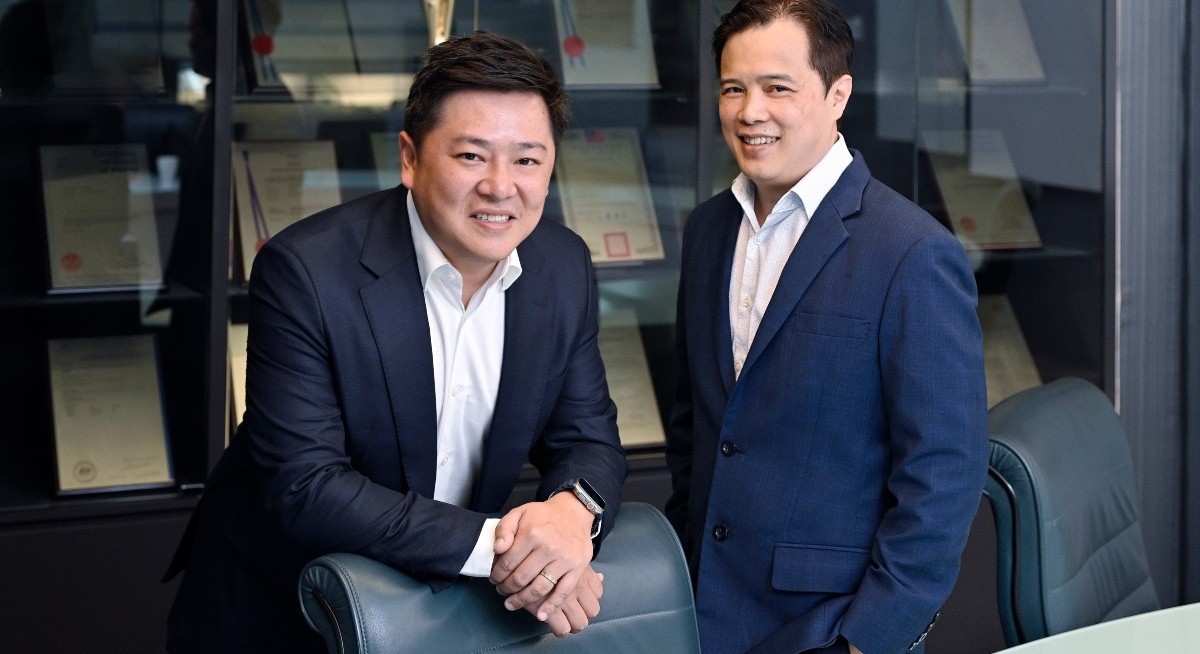


Since 2018, Henn’s son Wayne Tan has taken on leadership of the company. He believes Trek 2000 is entering a new era, with the invention of the thumb drive and other past issues becoming part of its legacy rather than defining its future.
Today, the company is organised into three main business segments. First, the Artificial Intelligence of Things (AIoT) segment focuses on applications that use memory-based solutions and incorporate AI capabilities.
The second business segment focuses on customised solutions, where the company undertakes design projects tailored to customers’ specific needs. Finally, the company applies AI capabilities to solar energy systems.
Trek 2000, says Wayne, has been a very research and development (R&D)-focused company. “We do not develop hardware or solutions from scratch. Instead, we focus on application-based R&D where we integrate different technologies to serve our potential customers,” he tells The Edge Singapore recently.
See also: Fire protection specialist Deluge mulls over next major corporate action in construction supercycle
Following the legal challenges it faced in defending its thumb drive IP against imitators, the company makes it a point to patent the outcomes of its R&D. “Our patents can range between 15 and 20 years, and we build our patents around the product itself. For example, the patent for a certain design of the thumb drive can last about 20 years, but we also put in new features derived from our R&D efforts and then we could extend the longevity of the patent,” adds Wayne.
With the legacy issues largely settled and renewed investor interest, Trek 2000’s share price has recovered some momentum. Over the past year, Trek 2000’s share price has gained 124.8% to 24.5 cents as of July 13.
Financially viable AI-related projects
See also: Reini Otter, CEO of Frasers Property Industrial to step down and join ESR
Last October, Trek 2000 entered into a strategic partnership with software developer Aboard AI Inc, which specialises in creating AI-powered data management platforms. The partners are co-developing an AI-powered solution for the aviation sector. The solution will combine Trek 2000’s patented wireless memory technologies and AI avionic solutions, which leverage NAND and dynamic random access memory systems for data-intensive processing and secure transmission, with Aboard AI’s proprietary artificial intelligence algorithms to compute and analyse real-time flight data.
“We focus a lot on the general aviation industry, which comprises private jets, private airlines and personal aeroplanes. We do not dabble with the commercial airlines given that they possess all the latest technology embedded in their aircraft,” says Wayne.
He adds that the majority of general aviation incidents have been attributed to pilot error; therefore, Trek 2000 is working with Aboard AI to develop a solution to help pilots reduce these incidents. “This solution will help prompt pilots in terms of how much runway you need to land, how much speed you need for your plane to take off, and at what angle you need to take off.”
These AI-enabled solutions will gather data from flight instruments. The data will then be transferred to a central module where the AI algorithm will process it. While taking on more projects will boost its revenue, he is also cautious on this front, as he wants to ensure that the projects Trek 2000 takes on are all financially viable. “When we select our project, the number one consideration is profitability. We will also evaluate the company’s profile behind each project, long-term sustainability of our solution to customers, capex requirement and cash flow as well.”
Apart from being financially viable, Wayne says the projects Trek 2000 takes on are recurring, thereby providing better revenue visibility two to three years out than one-off projects.
For example, the partnership with Aboard AI is projected to generate revenue exceeding US$15 million ($19.33 million), which will contribute positively to the company’s FY2027 results. “In fact, we are now negotiating with them to extend this contract even further.”
With a focus on more financially sustainable projects, Trek 2000’s financial numbers began to turn around. While revenue for FY2025 ended Dec 31 was down 1.1% y-o-y to US$19.6 million, earnings surged by 1,275% y-o-y to US$4.6 million. Net profit margin improved significantly from just 1.6% in the previous year to 23.4% in FY2025.
To stay ahead of Singapore and the region’s corporate and economic trends, click here for Latest Section
Memory chip supply shortage
With the booming AI trend, the market has seen an unprecedented shortage of memory chips as technology giants Amazon, Google, Microsoft, and Meta compete for them to power their AI servers. To deliver its projects smoothly, Trek 2000 also requires a steady supply of these components, making it challenging for the company to secure a consistent supply of these essential resources.
However, Wayne has the backing of one of Trek 2000’s substantial shareholders for its memory chip supply in the current environment. Previously known as Toshiba Memory Corporation, the company was acquired in 2018 by a Bain Capital-led consortium and rebranded as Kioxia in October 2019. As indicated in Trek 2000’s July 14 filing, Kioxia holds a 17% stake in Trek 2000 and is the company’s second-largest shareholder.
In December 2024, Kioxia was listed, allowing Bain Capital to eventually divest its stake amid a period of strong growth in the semiconductor industry. Over the past year, Kioxia’s share price has skyrocketed by more than 2,600%, giving the company a market capitalisation that, at one point, surpassed Toyota Corporation, Japan’s most valuable publicly traded company.
“We are fortunate that Kioxia is our substantial shareholder, as they are key to our supply chain. Of course, amidst the current memory chip shortage, they still value us as one of their valued partners, and we are still getting strategic memory chip supply from them to service our customers,” says Wayne.
Even as Kioxia has to meet demand from other customers, he believes Trek 2000 will continue to receive a regular monthly allocation of chips from this substantial shareholder and supplier. He acknowledges that, due to the shortages, there will be “pricing uncertainty”. For example, one memory chip that cost just US$3 or so last October now costs nearly 10 times as much today. “Will the price continue to increase? I have no answer to that for now.”
Amid the severe industry-wide shortage, with new capacity already committed years in advance, Wayne says Kioxia’s continued supply of memory chips to Trek 2000 is a strong statement in the industry today. “Not many companies out there can get direct supply from these memory chip manufacturers today, such as Micron and Samsung. The fact that we are still getting direct memory chip supply from Kioxia says a lot about us.”
Rather than viewing the broader AI boom as a challenge, Trek 2000 will continue to leverage its strategic relationship with Kioxia and invest heavily in developing new products and solutions to capture these emerging opportunities. “They are not just a passive investor, and they have been with us for over 30 years, and they have no intention to leave us.”
Azure Capital steps in
Besides its association with Kioxia, Trek 2000 was recently in the news for receiving strong backing from another party. On May 28, Azure Capital, led by Terence Wong, emerged as a substantial shareholder of the company after acquiring more than 22 million shares at 12 cents each, giving it a 7.3% stake. Wong bought the shares from Ron Sim, the founder of the Osim massage chair brand.
Sim, who retains a 2% stake, had initially paid 43.65 cents for 24 million new shares in 2015. In conjunction with the sale, he withdrew a letter of demand that had been served in December 2024, alleging “fraudulent misrepresentations”. News that Wong had emerged as a substantial shareholder sent Trek 2000’s shares from below 10 cents to a high of 30.5 cents before easing to close at 24.5 cents on July 13, valuing the company at $74.1 million.
Besides this investment in Trek 2000, Wong and Azure Capital have been actively seeking opportunities in the market amid improving sentiment in Singapore’s stock market. This has led to their participation in various share transactions involving companies such as Salt Investments, Clearbridge Health, ASL Marine and ISOTeam.
Wong recalls having followed Trek 2000 for many years. During his time as a sell-side analyst covering technology stocks, he met Henn, who showed him a thumb drive prototype and described it as a device that would take over the world. At the time, floppy disks, with their much smaller storage capacities, were the standard for software distribution and data backups.
That prediction eventually became reality. On Feb 26, 2000, Trek 2000 announced its first commercial USB thumb drive at the CeBIT trade fair in Germany. It had just eight megabytes of storage, less than the size of a single image from a modern smartphone camera.
Then, each megabyte of storage cost around US$1, and the eight-megabyte thumb drive would be around US$8. In today’s context, a 32-gigabyte thumb drive could cost just around $20. The thumb drive subsequently took the world by storm and changed the way computer files are stored and transferred.
Wong says he is also impressed by how Trek 2000 has, over the years, focused so “religiously” on R&D, a rarity among local companies. “We were also encouraged by the step-up in profitability and Trek 2000’s debt-free and cash-rich balance sheet, providing a solid foundation to support future growth initiatives,” he adds.
The cash balance of around US$27.3 million as at Dec 31, 2025, will be used primarily to fund R&D, enabling the company to pursue new growth opportunities related to AI, says Wayne. “Looking ahead, we will need to hone our skills in terms of AI application and algorithm; we will continue to use our cash and invest in our R&D activities. Secondly, we want to focus on synergistic companies that we can invest in and will help us in growing our business.”
China’s chip specialist Star Semiconductors is one such example. In October 2024, Trek 2000 acquired a 20% stake in the Shenzhen-based company for approximately US$1.6 million. “With this investment, they have successfully entered China’s automotive industry by using our solutions,” Wayne adds. Through such investments, he hopes to continue exploring strategic opportunities.
Buybacks and trading liquidity
With the overall pick-up in vibrancy and investor participation, Wayne and the company’s board are exploring ways to enhance shareholder value. Before the recent sharp run-up in Trek 2000’s share price, the stock had traded between 6 cents and 13 cents over the past five years. This presented an opportunity for Trek 2000 to conduct share buybacks, and the company has since accumulated more than 22.2 million treasury shares as of June 23. These treasury shares represent 7.3% of the company’s total issued shares.
He believes these treasury shares give the company considerable flexibility. For one, they can be used to fund employee share options, allowing the company to retain and attract talent. The shares can also be used for “potential strategic corporate needs”.
When asked for further details, Wayne declines to elaborate, although he hints that Trek 2000 will continue buying back shares. “We have the share buyback mandate from our shareholders, and we will follow the mandate and make the necessary announcements when we execute our share buyback.”
Despite Trek 2000’s low trading liquidity, he remains unfazed. As CEO, he says his role is to focus on the fundamentals, build a sustainable growth trajectory and improve the company’s profitability. At the same time, he hopes to engage with analysts and the media to raise awareness, with trading interest and liquidity expected to follow.
Echoing Wayne’s views, Wong says that few companies in the Singapore market possess this kind of fundamental strength and debt-free balance sheet. “The cash hoard in their balance sheet gives them the ammunition to do many things, and I think that this would be interesting for shareholders.”
Growth strategy
Given that Trek 2000 predates the current AI boom, Wayne wants to position the company as an application-focused R&D company, rather than one tied to any specific technology trend. “Regardless of either the AI boom or memory boom, we always pride ourselves in terms of how we use different forms of technology to come up with a solution to solve a person’s needs. Basically, we don’t like to reinvent the wheel.”
Throughout this interview, he emphasises the importance of R&D at Trek 2000. He adds: “R&D remains a core strength in our future growth. We want to improve our capability to ensure that we can secure various projects out there.”
Apart from that, Wayne aims to pursue strategic collaborations and selective investments going forward to ensure the company continues to grow over the long term. At the same time, he wants to maintain financial prudence in the current operating environment.
“The lump sum of cash in our balance is not only to invest in R&D and investment in other companies, but it is also to safeguard Trek 2000 in times of rainy days,” he adds. “I believe that we need to prepare ourselves for the worst-case scenario, and in our case, the cash on hand will ensure that the company will continue to stand strong, and that’s how we managed to survive over the years.”




