


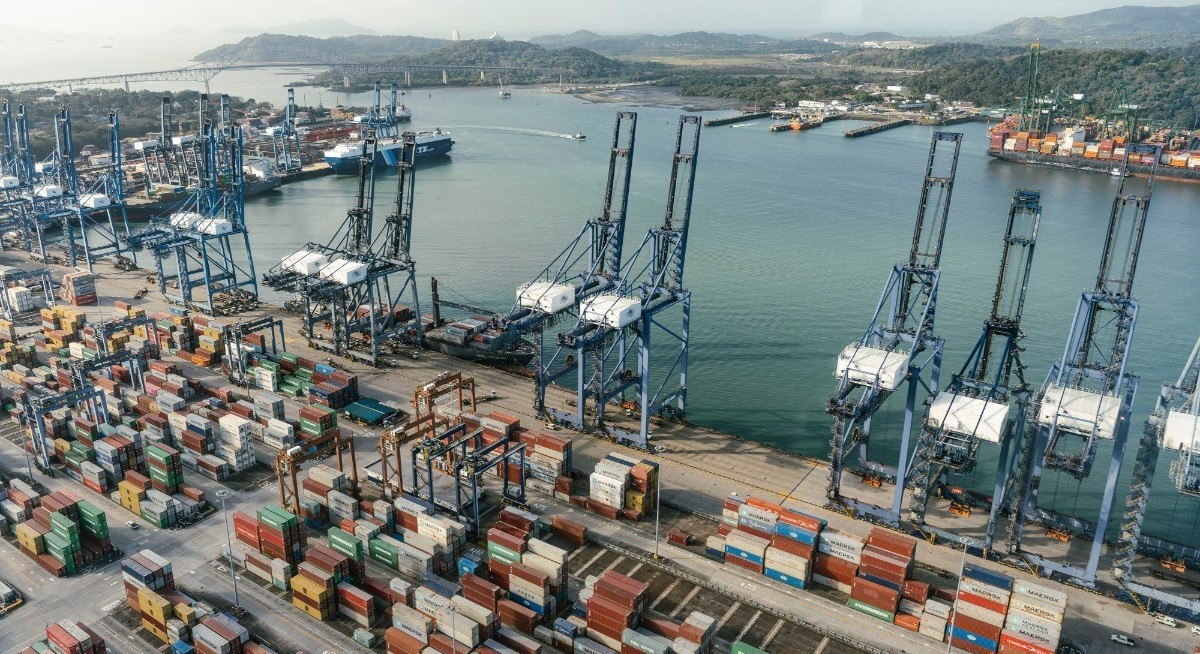


(Jan 30): Panama’s top court has ruled that the contract granted to Li Ka-shing’s CK Hutchison Holdings Ltd. to operate two ports near the Panama canal is unconstitutional, delivering a win for Donald Trump’s drive to rein in China’s control of strategic infrastructure in Latin America.
The ruling, announced by the court late Thursday in a short post on Instagram, injected fresh uncertainty into the Hong Kong conglomerate’s long-running effort to sell off the facilities. CK Hutchison’s shares fell as much as 5.7% in Hong Kong trading Friday, the steepest drop since April.
Panama President Jose Raul Mulino said in a televised address on Friday that the government is in talks with APM Terminals, a division of AP Moller-Maersk, to run the ports in the interim. CK Hutchison’s local unit Panama Ports Company will continue operating them until proceedings conclude, after which APM Terminals would take over until a new contract is tendered “through an open process that defends the interests of Panama,” Mulino said.
Mulino instructed Panama’s Maritime Authority to meet with Panama Ports Company and said he hopes all involved parts “collaborate openly in this process.”
CK Hutchison’s local unit, Panama Ports Co, said in a statement that it has not yet been formally notified on the court’s decision, but argued the ruling is inconsistent with the legal framework underpinning its operations at Balboa and Cristobal. The company called for coordination with the government to avoid disruption and safeguard the concession, while reserving all legal options.

See also: Ever Glory wins new contracts worth $508 mil in 2025
“China will take all measures necessary to firmly protect the legitimate and lawful rights and interests of Chinese companies,” Chinese Foreign Ministry spokesman Guo Jiakun said at a briefing in Beijing on Friday, when asked about the Panamanian court ruling.
The court decision adds to the ports’ history as a geopolitical flashpoint. Trump has criticised what he perceives as Chinese influence over the canal and threatened to place it under American control, while Mulino has repeatedly asserted his nation’s full sovereignty over its operation. CK Hutchison began operating the facilities in 1997, with the contract later extended in 2021.
The legal challenge was brought last year by Panama’s Comptroller Anel Flores, who alleged the extension cost Panama more than US$1 billion ($1.3 billion) in lost tax revenue and that Panama Ports Co failed to secure proper approvals. Flores initially announced an audit of Panama Ports on Jan 14, 2025.
Parent CK Hutchison has limited options following the verdict. It can file a motion seeking clarification on the court’s ruling, but cannot appeal. The company can also seek international arbitration.
Panama Ports Co will continue operating the facilities until requests for legal clarifications are resolved, a person familiar with the matter said. The process could take several weeks.
The two ports are part of the Hong Kong conglomerate’s plan to sell its 43 global terminals to a consortium led by Italian billionaire Gianluigi Aponte’s Terminal Investment Ltd and US investment firm BlackRock Inc. While Trump has cast the sale of the two facilities as a win for US influence in the strategic Panama Canal, China saw it as kowtowing to American pressure and selling out the country’s trade and shipping interests. To secure Beijing’s approval, CK Hutchison last year invited state-owned China Cosco Shipping Corp to join the buyer consortium.
The latest twist “reflects the broad Donroe Doctrine policy direction and the emphasis on security, which will continue to bring headwinds to the US-China relation,” said Gary Ng, senior economist at Natixis SA. “Countries may face greater pressure from the US to screen foreign ownership of infrastructure, and geopolitics will be an even more critical factor.”
Trimmed valuation
If the transaction is completed, it could net CK Hutchison more than US$19 billion in cash. To move discussions forward and reduce potential regulatory risks, parties involved in the deal have been considering splitting the deal into separate parcels with different ownership structures, so Cosco may have larger stakes of ports in regions more friendly with China, people familiar with the matter have said earlier.
“The Panama ruling will trim CK Hutchison’s port‑deal valuation and proceeds, though it was largely expected given prior legal and political signals,” said Bloomberg Intelligence analyst Denise Wong. “With Panama contributing under 10% of overseas port throughput and the shift to a parcel‑based sale structure, the company can still likely complete most of the port divestment and secure reduced yet meaningful cash inflows.”
To stay ahead of Singapore and the region’s corporate and economic trends, click here for Latest Section
It’s not the first time that countries have terminated concessions for private businesses to run public infrastructure projects. Panama last year took back land from a Chinese company after the firm failed to build a port on the site as required by a government concession.
In 2015, Egypt’s Damietta Port Authority terminated a concession agreement awarded to a private consortium to operate a container terminal. An international tribunal in 2020 approved the consortium’s request for damage compensation. While Egypt’s top court rejected the tribunal decision, the case was eventually settled with a partial payout.
“There is a long list of precedents where states clawed back control of ports and other infrastructure from private or foreign operators,” said Winston Ma, adjunct law professor at New York University. “Concession contracts typically reserve to governments the right to terminate for cause or public interest.”
Uploaded by Magessan Varatharaja




