


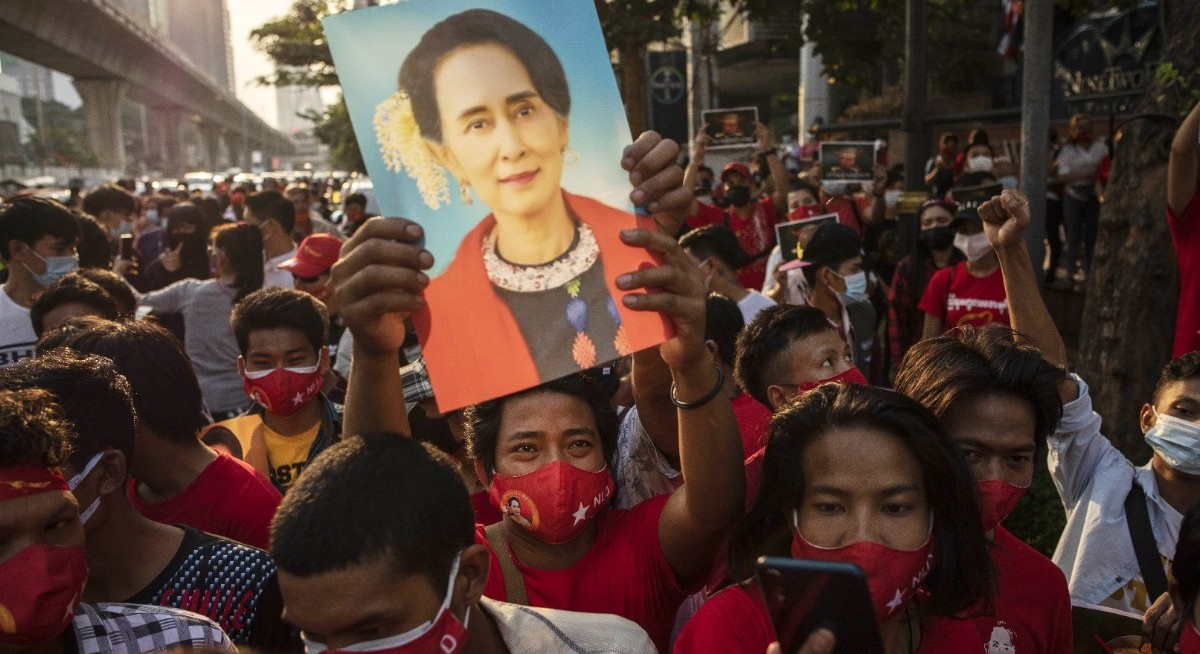


Fifteen months later, the junta has clawed back some territory and is about to hold the first polls since it seized power in a bloody 2021 coup that ousted Aung San Suu Kyi and kicked off a civil war.
It hopes the phased elections which begin on Sunday will give it a veneer of legitimacy and help it return to the global stage.
But the military’s tenuous control over the country, a raging civil war and brutal crackdown on political opponents have already cast the polls as a sham, according to most observers.
The military-controlled ballot will create a path for junta-aligned Union Solidarity and Development Party’s (USDP) return to office and close the loop on a short-lived democratic opening once hailed as a reform success story.
See also: Prabowo puts Indonesia on collision course with global markets

The United Nations has described the election backdrop as “an atmosphere of fear, violence and deep political repression, with thousands detained and major parties excluded in a process that risks entrenching instability rather than restoring democracy”.
The party of democratic leader Suu Kyi, brought to power a decade ago under competitive polls, is now banned and its leaders jailed or exiled.
See also: Billionaire clan is said to weigh US$2 bil Thai Summit sale — Bloomberg
Fighting has killed as many as 90,000 people with vast swaths of territory under rebel control and roughly half the population living in poverty.
At stake for the junta is a chance to end its broad isolation and renew investments, making the case that it’s following the constitution and holding elections under leader Min Aung Hlaing.
“While the vote will be deeply flawed and exclude most political parties that won in the 2020 polls, this ostensible return to elected government and constitutional order can normalise the regime’s control,” said Paul Vrieze, an associate research fellow at the Swedish Institute of International Affairs, who has spent more than a decade writing about the country.
It will also “give political cover to foreign governments” which want to engage with Myanmar, Vrieze said.
Myanmar’s generals have access to vast rare-earth reserves and a strategic maritime corridor linking India and Southeast Asia.
Foreign investment — which surged during Myanmar’s short-lived political opening — has plunged 92% over the past decade, to US$690 million (RM2.81 billion) last fiscal year. The exodus of multinational brands, a collapsed currency and chronic power shortages have wiped out much of the economic progress of the previous decade.
Many Western nations have shunned the generals and have no plans to send observers for the elections, which will be held in phases in military-controlled areas and conducted via junta-approved voting machines. Even neighbouring Thailand has called the election “imperfect”.
To stay ahead of Singapore and the region’s corporate and economic trends, click here for Latest Section
For the Tatmadaw, as the military is known, the vote is an opportunity to move towards the political order envisioned in the 2008 constitution, a charter written by the generals that guarantees them sweeping authority even under a nominally civilian government.
“We expect the new government could earn some sort of legitimacy,” Hla Thein, spokesman of the junta-aligned USDP said in an interview. “Many countries will recognise a government elected by the people in a free and fair election. It is usual that international trade and business opportunities will boom.”
The diplomatic landscape is shifting as governments confront China’s expanding influence, and as Washington’s longstanding rejection of autocracies erodes under President Donald Trump’s transactionalism.
After years of US-led condemnation, Trump has refrained from criticising the junta or denouncing the elections, despite bipartisan pressure. His administration has also rolled back some sanctions as Washington hunts for leverage in the contest for critical minerals. Secretary of State Marco Rubio said in October that the administration was still reviewing its Myanmar policy.
India’s Prime Minister Narendra Modi has also signalled support for the vote.
Junta leader Min Aung Hlaing, 69, has also cultivated deeper ties with Vladimir Putin over multiple visits to Russia, as well as Belarusian President Alexander Lukashenko.
But Beijing has emerged as the junta’s most significant supporter.
China provided key military and diplomatic backing when the junta risked losing control to rebels last year. It brokered ceasefire talks, and when those failed it threatened to cut off trade and close key border crossings with northern armed groups.
Beijing’s pressure on the United Wa State Army, the most powerful rebel group, led to it reducing arms supplies to other groups. Within months, captured territory was being returned to a Myanmar military, which was boosted by mandatory conscription, allowing the junta to lift a nationwide state of emergency that had been in place since the coup.
“With no bullets, no budget and fewer men left to die, we had to negotiate a ceasefire,” Tar Bone Kyaw, General Secretary of Ta’ang National Liberation Army, wrote this month in a poem lamenting the handover of two towns renowned back to military forces. “I would like to apologise to those who sacrificed” their lives.
China has long balanced ties with competing armed groups to keep its 2,204km (1,370 miles) border stable, and it views Myanmar as central to its regional ambitions. During Chinese President Xi Jinping’s 2020 visit, the two nations signed dozens of agreements fast-tracking Belt and Road projects including a US$7.3 billion deepsea port, a special economic zone and high-speed railway.
Last year, China was Myanmar’s largest trading partner with exports totalling over US$7.7 billion, according to government data.
“The regime has had to sell a part of its soul to China in return for these gifts,” said Richard Horsey, senior adviser on Myanmar at the International Crisis Group. “That’s absolutely not a position that the military wants to be in. They do not want to be a client of China in any way, shape or form.”
A sign of the junta’s allegiance emerged last month, when it publicly sided with China versus longtime partner Japan over Prime Minister Sanae Takaichi’s remarks on Taiwan, a shift observers say would once have been inconceivable.
Myanmar is one of the world’s largest producers of dysprosium and terbium, critical for high-tech applications, including permanent magnets used in electric vehicles and wind turbines. From 2017 to 2024, it supplied China with nearly two-thirds of its imports, or 290,000 tonnes, through networks spanning both junta-held and rebel-controlled areas, creating a strategic conundrum for armed groups that rely on the trade even as they fight the regime.
“China’s continued support to the junta is totally against the desire of the people of Myanmar,” Nay Phone Latt, spokesman for the pro-democracy National Unity Government, said in an interview. However, he conceded “there are Chinese-owned businesses that our troops have to protect”.
Uploaded by Felyx Teoh




