


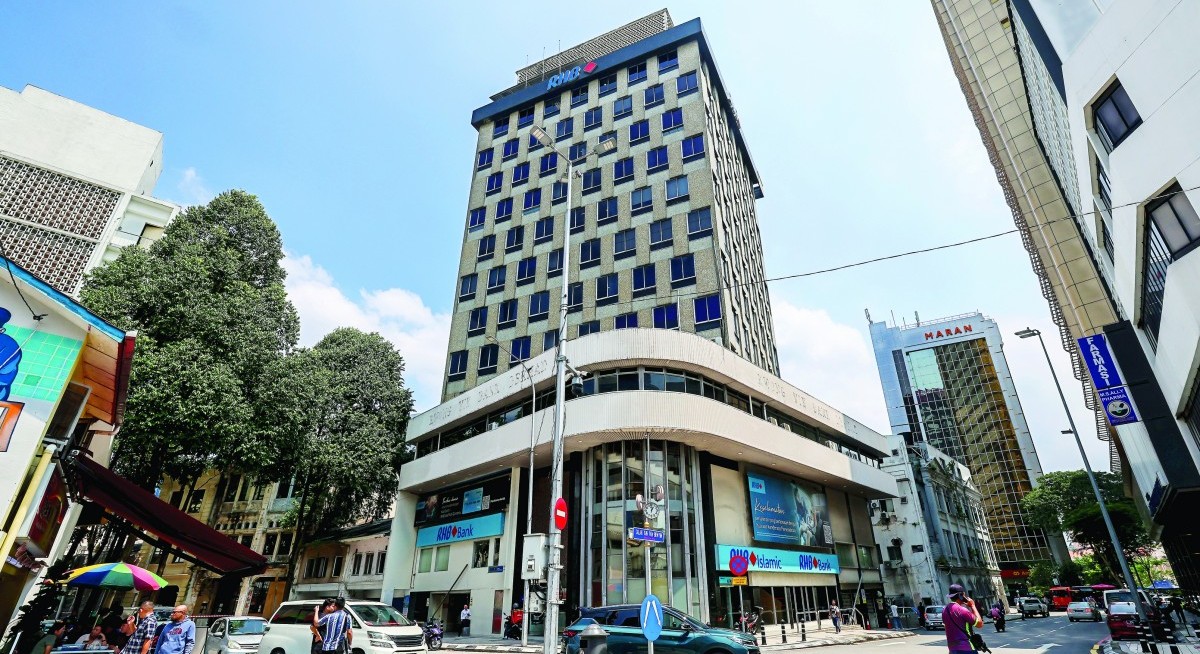


RHB announced on April 17 that the Jalan Tun H S Lee branch would cease operations on Jan 8, 2027, while its Kenanga Wholesale City branch would close on Dec 18 this year.
Situated near Chinatown, Pasar Seni and Masjid Jamek, Jalan Tun H S Lee is a tightly held commercial pocket dominated by pre-war shophouses, corporate offices and heritage buildings. Transaction volume remains relatively low compared with that of residential suburbs, but demand is strong, according to an agent familiar with the area. Recent auctions saw five-storey shopoffices on the same street being sold at between RM3.5 million and RM3.84 million, with market values exceeding RM4 million. Ground-floor retail units can command rents of more than RM15,000 per month, driven by tourist traffic and the area’s expanding café culture.
Industry experts also note the area’s strategic location within Kuala Lumpur’s old central business district.
“That’s where it all started and expanded from there to the present Kuala Lumpur city centre. There is a lot of interest in the area due to its proximity to the Merdeka 118, which is the catalyst for the revival or gentrification of the surrounding area,” says Siva Shanker, senior director of real estate agency at Rahim & Co Chestertons.
See also: Sime Darby Property, ESR break ground on Metrohub 3 logistics facility in Klang
“You will see more hipster cafés, hidden bars, for example, coming up in the area. Older shops and buildings will eventually be refurbished and modernised, preserving their original character and feel while being upgraded for more contemporary use.”
The prospective sale comes against the backdrop of broader heritage-led revitalisation efforts in the Malaysian capital.
Think City, a wholly owned subsidiary of Khazanah Nasional, revitalised Jalan Sang Guna (formerly Madras Lane), just off Jalan Tun H S Lee, under the Kuala Lumpur Creative and Cultural District framework launched in 2019. The street reopened to the public earlier this year.
See also: Bangladesh PM met labour tycoon Amin on Malaysia trip — Bloomberg
Since 2024, Creador Foundation has spearheaded restoration projects around Medan Pasar and Central Market, alongside other public and private sector partners, under the Warisan Kuala Lumpur initiative.
Apart from Creador Foundation and Khazanah Nasional, Permodalan Nasional, Railway Assets Corp (RAC) and Prasarana Malaysia are revitalising landmarks such as the Bangunan Sultan Abdul Samad (BSAS) complex, the Masjid Jamek enclave, Seri Negara, the KL Railway Station and Stadium Merdeka.
According to biographical notes from Singapore’s ISEAS-Yusof Ishak Institute, the street’s namesake, Tun H S Lee or Henry Lay Hau Shik, served as the first Finance Minister after Malaysia gained independence, founded China Press and helped set up the Malayan Chinese Association in 1949.
This story first appeared in the July 13 issue of The Edge Malaysia




