


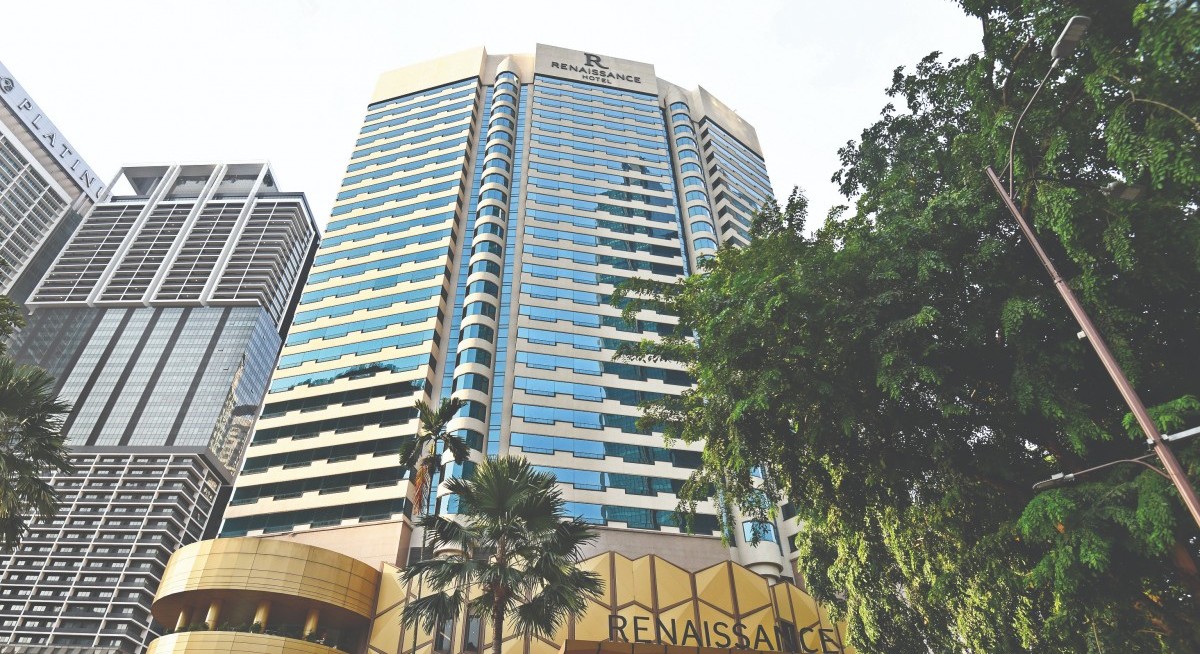


Perhaps one of the most visible pieces of Alam’s international portfolio sits at the corner of Jalan Sultan Ismail and Jalan Ampang in the heart of Kuala Lumpur — the Renaissance Kuala Lumpur Hotel and Convention Centre and the adjoining Four Points by Sheraton Kuala Lumpur City Centre.

Both hotels, which sit on the same land title, are owned by Ventura International Sdn Bhd (formerly Canali Logistics Sdn Bhd), which is reportedly linked to the S Alam Group. In 2016, IGB, then known as IGB Corp, sold the original Renaissance Hotel property to Ventura International for RM765 million.
A company search on Ventura International shows that YIF Holding Malaysia holds a 100% stake in the company, while a search on the latter company shows that Wong Wai Cheong, Poo Sin Yee and Arivalagan Chokalingam are its directors, and that it is wholly owned by Singapore’s YIF Holding. Another search on YIF Holding lists its primary activity as that of a holding company for firms engaged in non-financial and insurance-related activities, with Hildrics Asia Growth Fund VCC as its shareholder. Choo Kee Siong is listed as its director and is also the CEO, executive director and chief investment officer of Hildrics Capital.
See also: RHB Bank bucks banking malaise as investors bet on yield and ROE growth
Hildrics Capital’s portfolio includes Malaysia’s rubber compound manufacturer and distributor GIIB Holdings, in which HAGF Investment (I), a wholly-owned subsidiary of Hildrics Asia Growth Fund 1, previously held a 16.56% stake before disposing of some of its shares and ceasing to be a substantial shareholder, according to filings dated May 21. GIIB has been in the news for multiple reasons, including corruption probes, corporate intimidation, legal disputes and financial losses. More recently, Bursa Malaysia queried GIIB after its share price jumped by as much as 50% in a single morning, hitting a more than four-year high on May 4.
In March, Hildrics Asia Growth Fund VCC stepped in as Singapore entertainment company mm2 Asia’s main rescue investor, signing a term sheet with mm2 Asia to inject new capital via a $15 million share placement and a fully underwritten rights issue of up to $10 million. The deal is still being finalised.
A global tightening of the net
See also: Maybank handles US$4.9 bil deals for Singapore, Malaysia hub
On May 19, the Nicosia district court issued a freezing order against a two-storey residential property in Parekklisia, Cyprus, owned by Bangladeshi businessman Mohammed Saiful Alam and his wife Farzana Parveen. The order followed an application by Cyprus’ anti-money laundering unit, Mokas, acting under mutual legal assistance procedures initiated by Bangladesh.
The investigation, which Bangladesh’s central bank governor has publicly described as involving more than EUR8 billion ($11.9 billion) allegedly transferred out of the country, centres on allegations that companies linked to Alam secured substantial loans from major Bangladeshi financial institutions — including Islami Bank Bangladesh and First Security Islami Bank — many of which subsequently defaulted. Investigators are examining whether the proceeds were channelled abroad through a web of companies and trusts registered in Cyprus, the British Virgin Islands and Jersey.
Part of the probe also involves ACLARE International, a Cyprus-registered company that Alam acquired in 2016 through the purchase of ACLARE Investment Ltd. Alam had obtained Cypriot citizenship that same year through the “golden passport” citizenship-by-investment scheme, which has since been terminated by the Cypriot government.
According to documents submitted to Cypriot authorities, Bangladeshi investigators are examining financial transactions and business activities linked to Alam and associated entities spanning 2009 to 2024. Alam, whose international legal team is led by Quinn Emanuel Urquhart & Sullivan, denies any wrongdoing and maintains that his investments were financed through legitimate foreign sources.
The day after the Cyprus freezing order, a court in Bangladesh dealt Alam another blow. On May 21, Judge Md Helal Uddin of the Chattogram Money Loan Court-1 sentenced Alam and 10 relatives and associates — including his wife, sons and brothers — to five months’ civil imprisonment for failing to repay a EUR6 million loan from Islami Bank Bangladesh’s Khatunganj branch. The loan had been disbursed for the purported purchase of 134 buses by group subsidiary OG Travels.
It marked the first time a Bangladeshi court had formally sentenced the tycoon since the fall of the Sheikh Hasina government in August 2024, under whose patronage S Alam Group allegedly accumulated enormous financial clout. Alam and his family have not been seen publicly since Sheikh Hasina’s ouster and are believed to be living in Singapore.
$1 bil Singapore empire under the microscope
Singapore, where Alam obtained citizenship in 2023, has emerged as the central hub of his offshore holdings. Bangladeshi investigators allege that he built a business empire worth at least $1 billion in the city state, acquiring hotels, homes, retail properties, and corporate stakes without obtaining permission from Bangladesh Bank to transfer or invest funds abroad.
Previous news reports have identified several acquisitions linked to Alam between 2014 and 2019. These include the 328-room Hotel Grand Chancellor for US$177 million, retail space in Little India for US$100.53 million, and the Ibis Novena in 2019 for US$125.6 million.
Meanwhile, in July 2025, a Dhaka court ordered the freezing of 40 bank accounts held by Alam, six accounts belonging to his wife, and shares in eight Singapore-registered companies. Additional accounts linked to his sons, Ashraful and Ahsanul Alam, brother-in-law Ahmed Belal and sister Maimuna Khanam were also frozen. Investments totalling about $6.8 million in two Singapore companies jointly owned by the couple were blocked.
Singapore’s Financial Intelligence Unit has formally written to its Bangladeshi counterpart, the Bangladesh Financial Intelligence Unit, requesting detailed disclosures on the local and foreign assets of S Alam Group — a signal that Singaporean regulators are taking the matter seriously. The Bangladesh Criminal Investigation Department separately alleges that Alam laundered as much as $12.89 billion abroad, including through a Singapore-based entity called Canali Logistics, which later became the vehicle through which he acquired real estate assets in Malaysia.
Alam’s Singapore lawyers, Wong Partnership, have described the Bangladeshi proceedings as politically motivated, arguing that the asset freezes were carried out in an “unlawful, arbitrary and discriminatory fashion” and have materially harmed legitimate business operations.
Coordinated response in the works
The sequence of events — a court conviction in Chittagong, a property freeze in Nicosia and mounting pressure in Singapore — reflects the increasingly coordinated international response to what Bangladeshi authorities have described as one of the most extensive cases of financial crime in the country’s history.
In December 2025, Bangladesh’s National Coordination Committee on money laundering prevention revealed it had seized assets worth about $683 million from 10 major business groups, including S Alam Group, in connection with alleged laundering under the Sheikh Hasina administration.
India Today reported that a White Paper commissioned by Chief Adviser Muhammad Yunus found that as much as US$234 billion may have been illegally siphoned out of Bangladesh during Sheikh Hasina’s 15-year tenure.
Alam and his family have reportedly applied twice to formally renounce their Bangladeshi citizenship. Last November, Bangladesh’s High Court suspended acceptance of the first renunciation application. In February this year, a fresh application was filed but subsequently blocked by a stay order, leaving the Alam family in legal limbo. Officials worry that allowing the family members to renounce their citizenship could hinder efforts to recover allegedly laundered funds, seize domestic assets and defend Bangladesh’s position in ongoing international arbitration proceedings.
For the man who once commanded at least five Bangladeshi banks, an industrial conglomerate and a gleaming hotel empire stretching from KL to the Mediterranean, the world is growing considerably smaller.
This story first appeared in The Edge Malaysia.




