


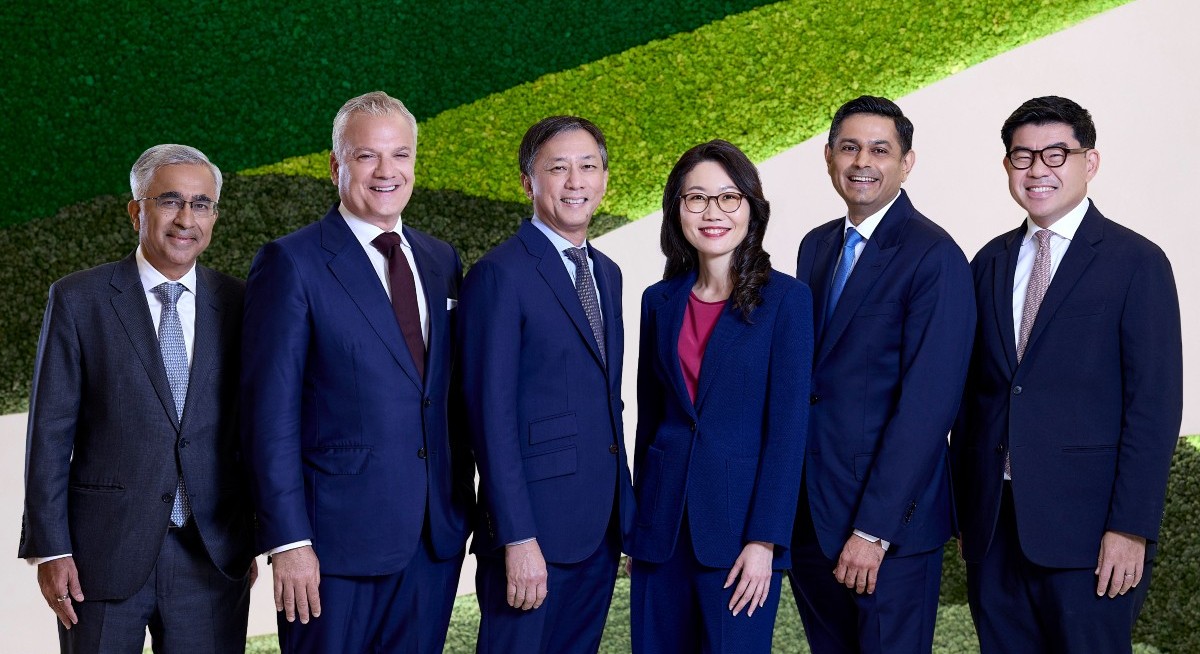


“As a long-term investor seeking to deliver sustainable returns, we have had to navigate volatility and uncertainty over the years. But the environment we are in today is the most complex that we have seen in five decades,” he adds.
Amid the unprecedented convergence of geopolitical tensions and energy concerns, technology is transforming at a breakneck pace, throwing up both opportunities and risks from the AI frenzy. “Taken together, this is one of the most challenging environments we have had to navigate as an investor seeking good sustainable returns over the long term,” Pillay says.
For its FY2026 ended March 31, Temasek reported a mark-to-market (MTM) net portfolio value (NPV) of $518 billion, up 10.4% y-o-y, and almost double from a decade earlier.
This year marks Temasek's move to MTM valuation for its unlisted investments, a change from book value reporting. The shift better reflects its portfolio's risk and volatility and aligns its reporting with its global peers. About 75% of Temasek's value — including listed investments at market prices, as well as unlisted funds and co-investments marked to market — has already been valued on an MTM basis.
See also: Indonesia’s Danantara wealth fund sees senior management shakeup
On a book value basis, Temasek's NPV stood at $486 billion, also a record high. The number is 11.98% higher, or $52 billion up from last year's NPV of $434 billion.
Total shareholder return (TSR) over the past year was 10.5%, driven by outperformance by the listed Temasek portfolio companies and divestment gains. However, this was offset by events in the Middle East, resulting in a 2% NPV drawdown in the final month of the financial year.
A stronger Singapore dollar against major foreign currency exposures also reduced the group's one-year TSR by about two percentage points. Excluding this impact, the figure would've been 12.9% on a constant currency basis. In US dollar terms, Temasek's one-year TSR was 14.8%.
See also: Relocation specialist Chasen rides chip growth; eyes more solar panel projects
Over the longer term, Temasek's 20-year TSR was 6.8%, while its 10-year TSR was 7.1%. Its five-year TSR was 4.6%, hampered by headwinds in China's capital markets from 2021 to 2024.
“For a long-term investor like us, it is very important to be clear-minded about how we need to operate to achieve the returns that we want,” says Pillay.
Resilience and returns
Temasek, now in its 52nd year, has undergone numerous changes to the composition of its portfolio. When it was incorporated in 1974, the initial portfolio of 35 Singapore-based companies was worth $354 million.
Today, Temasek's portfolio is far more diverse. As at March 31, 52% of its portfolio is headquartered in Singapore, followed by 22% in the Americas, 10% each in China and Europe, the Middle East and Africa, 4% in India, and 2% in Asia Pacific (excluding Singapore, China and India). The majority (73%) of Temasek's underlying country exposure is overseas. Beyond Singapore's 27% exposure, 26% is from the Americas, followed by 17% from China, 12% from Europe, the Middle East and Africa, 11% from Asia Pacific (excluding Singapore, China and India) and 7% from India.
Geographical diversity is just one aspect. Capital flexibility is another. As at March 31, about a quarter of the portfolio is in liquid and listed assets, including stakes in Alphabet, BlackRock and ICICI Bank.
Its unlisted investments, such as Mapletree and PSA, continue to be a "meaningful source" of long-term value creation and cash generation, says a spokesperson.
To stay ahead of Singapore and the region’s corporate and economic trends, click here for Latest Section
A third pillar of resilience is the way Temasek structures its portfolio, split into three segments: the TPCs, global direct investments (GDIs) and partnerships, funds and asset management companies (PFAs).
TPCs are Temasek's "stalwarts" leaned on to deliver stable and sustainable returns over the long term. GDIs mainly comprise public and private equity investments in emerging and established market leaders. At the same time, PFAs include partnerships with other investors, investments in private equity (PE) funds, private credit, impact investments and asset management companies.
Since 2018, these segments have held an approximate 40-40-20 distribution, and this is expected to remain stable in the near future. As at March 31, TPCs, GDIs and PFAs accounted for 43%, 38% and 19% of Temasek's portfolio value, respectively, with 10-year internal rates of return (IRRs) of 8.1%, 7.6% and 7.7%.
With effect from April 1, Temasek has restructured the management of its investment portfolio into three new entities: Temasek Singapore, Temasek Global Investments and Temasek Partnership Solutions.
Areas of growth
Some of the promising new areas Temasek has identified include AI, private credit and so-called core-plus infrastructure. According to a Feb 26 article published by Temasek, core-plus infrastructure is “an asset class that can provide resilient risk-adjusted returns, and stable cash yields”. It also “marries the stability of traditional infrastructure with the opportunities that innovation and technological advances offer”.
“Core-plus infrastructure projects range in complexity, depending on the geography or level of development of the existing assets. In developed markets, innovative enhancements can unlock additional value, while in emerging markets with existing but underdeveloped facilities, upgrades and modernisation can enhance operations and improve returns,” the group adds.
By March 31, 2031, Temasek aims to increase its AI stake to 10%–15% of its portfolio, from 6% currently. Core-plus infrastructure has a target of 5%, up from 1%, while private credit also has a target of 5%, up from the current exposure of more than 2%. These figures exclude the related exposure of the TPCs to AI and core-plus infrastructure.
Chief investment officer Rohit Sipahimalani says he is "very encouraged" by strong earnings growth across almost all markets globally, with double-digit growth expected in most markets in 2027 and 2028, thanks to a big bump in investment spending. "Yes, AI capex is a big part of it," he says. "But it's also around capex, defence, around energy security and many other areas such as electrification."
While the capex momentum may taper off, he does not see it pulling back significantly in the near future. AI, he notes, is a "big theme," and Temasek is "investing significantly" alongside it. At the same time, he recognises "a lot of risks" in the environment, which Temasek will try to balance with higher exposure to areas such as core-plus infrastructure and private credit, which are more resilient to volatile environments and higher inflation.
Overall, though, he adds, the general trend should remain positive.
Temasek, a net investor
In FY2026, Temasek invested $51 billion in companies such as Anthropic, OpenAI and Luckin Coffee, while divesting $31 billion, resulting in a net investment of $20 billion. This includes the sale of ST Telemedia's (STT) remaining 82% stake in ST Telemedia Global Data Centres (STT GDC) to KKR and Singtel for $6.6 billion, and its exit from Schneider Electric India Private.
"The key is all going to be about discipline and being able to adapt, basically, and be very nimble when we need to," says Nagi Hamiyeh, president of Temasek Global Investments and head of its Europe, Middle East, and Africa portfolios.
"We don't take this constructive pattern for granted; we will keep on fixing the portfolio as we go along. We have a big chunk of our portfolio in the public markets. We have added more complementary skills to the team, so we will obviously be investing more dynamically in that part of the portfolio," he adds.
"On the private side, we are being selective. We are trying to invest as much as we can according to the trends we see, and the two most important trends for us are AI and sustainability. The two core-plus infrastructure options are: one is high growth, high returns; the other is more stable, more resilient. It gives you a narrower set of outcomes, but which we can more easily underwrite."
"In today's complex operating environment, clarity of purpose matters more than ever," says Pillay. "We must think across systems, not silos, be thoughtful about risk, and act with conviction where we see opportunity.




