


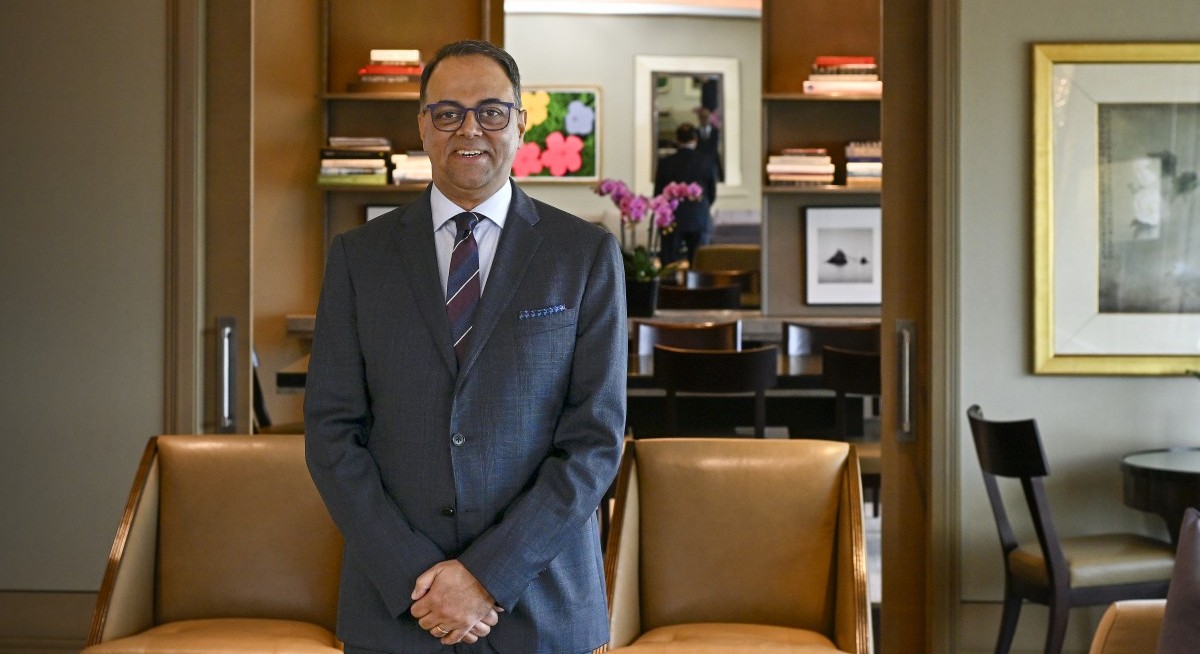


Earlier that year, Marriott veteran Rajeev Menon took on additional responsibilities as chief operating officer for the brand’s business across Asia Pacific excluding China (Apec). Menon, a Marriott veteran since 2001, had been based in Sydney, Delhi, and Mumbai over the years. With the promotion, he moved to Singapore, where he began overseeing the region.
The Starwood acquisition would take more than a year to complete. “When we closed it, at the start of 2017, in Asia Pacific ex-China, Marriott had some 270 open hotels,” says Menon to City & Country in a recent interview.
Menon would receive another promotion in October 2019, becoming Marriott’s Apec president. “By the time I became president, we had over 350 hotels.”
One would think the global lockdowns during the Covid-19 pandemic would have crippled hospitality players like Marriott. Instead, Marriott picked up the pace. Over the six years from 2019 to 2025, the group doubled its hotel count in the region.
See also: Muslim tourists set to drive US$310 mil in annual spend by 2030
“Becoming president in October of 2019 and going straight into Covid-19 was single-handedly the biggest learning experience,” says Menon. “Our industry experienced considerable shock at that point in time, when the world shut down overnight. But while most pundits had said that was the end of travel, we saw exactly the opposite as borders reopened.”
In December 2025, just weeks before our first interview with Menon, Marriott announced its 700th property in Apec — with the Legacy Mekong, Can Tho, Autograph Collection joining its portfolio.


In December 2025, Marriott unveiled its 700th property in Apec: the Legacy Mekong, Can Tho, Autograph Collection
By the numbers, Marriott operates more than 730 properties across 27 brands in 22 countries within Apec, with 400 more in the development pipeline. “We are well on track to get to 1,000 hotels in the next three years,” says Menon of the brand’s 2028 target.

Apec promise
The build-up of the “China-plus-one” strategy even before the pandemic precipitated “considerable economic growth”, says Menon. “More importantly, [this led to] real strong growth in the middle class in major countries around the Asia Pacific.”
Vietnam has grown at an “exponential pace”, alongside India, Indonesia, Malaysia and Thailand, he adds. “By 2030, 700 million people will be coming into the middle class. As people acquire wealth, their aspiration to travel grows, and they are getting out and about.”
Pre-Covid-19, about 35% of Marriott’s Apec business “came from within the region”. Today, that figure has grown to between 55% to 60%, notes Menon.
“I strongly believe, given what we are experiencing with the growth of the middle class [and] the amount of investments that are coming in, [that] this part of the world remains a decades-long growth story, particularly driven by the demographics,” says Menon.
New travellers start with exploring “their own backyard first”, he adds. “As a result, we continue to see very strong intra-Apec and intra-Asean travel.”
In 2025, Marriott’s Apec team signed a record 187 organic deals, totalling more than 28,000 rooms, a 32% y-o-y increase. Nearly half of these deals (99) were in India, representing over 12,000 rooms.
Revenue per available room (RevPAR) rose 8.4% y-o-y in 2025, while the average occupancy rate was up 1.5% y-o-y, according to figures shown at a media briefing here on Feb 9. “Growth for us has been phenomenal,” says Menon. “We are now, by a long shot, the hospitality leader in Apec — well ahead of all our competitors.”
Marriott ended the year with over 86,000 rooms in the pipeline.
All in on Vietnam
Vietnam continues to be one of Marriott’s “most exciting growth markets”, says Menon. “Look at what Vietnam has to offer: population of over 100 million; the landscape of Vietnam is extremely diverse, from North Sapa, which has beautiful mountains, nine Unesco [world] heritage sites, be it Hoi An or Ha Long Bay and so on; incredible beaches; and as the China-plus-one story was playing out across Asia Pacific, Vietnam was one of the biggest beneficiaries of that.”
A “pretty compelling destination”, Vietnam has attracted South Koreans and Chinese tourists, he adds. Vietnam welcomed a record 21.2 million international visitors in 2025, a 20% increase from 2024.
Marriott has 32 open properties across Vietnam and a development pipeline of over 50 projects. Over there, 2025 RevPAR is up some 25% y-o-y, notes Menon. “It’s, in fact, the top-performing market in terms of RevPAR growth across Apec for us.”
As a result, an increasing number of Vietnamese businesses and developers are focusing on tourism and developing more tourism assets. “It makes me very bullish on the country,” says Menon.
Marriott’s strategy for the country begins in the gateway cities. The JW Marriott Hotel Hanoi, opened in 2013, has hosted US presidents Donald Trump, Joe Biden and Barack Obama, as well as Chinese president Xi Jinping over the years.


The JW Marriott Hotel Hanoi, opened in 2013, has hosted US presidents Donald Trump, Joe Biden and Barack Obama and Chinese
president Xi Jinping over the years
There is also a JW Marriott Hotel & Suites Saigon in Ho Chi Minh, along with Vinpearl Landmark 81, Autograph Collection — located within Vietnam’s tallest skyscraper.


Vinpearl Landmark 81, Autograph Collection, is located within Vietnam’s tallest skyscraper
From there, Marriott is branching out to open hotels in “major leisure destinations” like Phu Quoc, Da Nang, Cam Ranh Bay, Hoi An, Ha Long Bay and more, says Menon. “When you think about Vietnam from a long-term perspective, you are going to see growth both in business travel as well as leisure travel. As a result, we are not only in the major markets now; we are growing into secondary and tertiary markets, because as more and more travellers start to go within the country, we want to make sure our hotels are present in these destinations.”
Singapore as a Mice hub
Speaking to City & Country in the presidential suite of The Ritz-Carlton, Millenia Singapore, Menon says Singapore is the “perfect place” for delivering “the best Mice experience you can think of”.
“There is enough to offer from a leisure point of view, but Singapore also has focused on a few other things, [such as] wellness tourism and events,” says Menon, who joined the Singapore Tourism Board (STB) as a board member in 2023. “We all saw what Taylor Swift did to Singapore and to Asia, broadly. [There is also the] Singapore Grand Prix and a very strong focus around cruise tourism.”
According to the STB’s Tourism 2040 roadmap, Singapore is targeting $50 billion in tourism receipts, with meetings, incentives, conferences and exhibitions (Mice) events as a strong driver.
Mice travellers reportedly spend twice as much as leisure travellers; in 2019, Singapore recorded 19.1 million international visitor arrivals and posted $27.7 billion in tourism receipts. In 2024, Singapore received 16.5 million tourists, but they spent more, with receipts totalling $29.8 billion.
Could cultural and experiential offerings be pushed to the wayside if Singapore optimises itself to attract business travellers?
Menon cites research from the Sydney Convention and Visitors Bureau, now known as Business Events Sydney, which markets Sydney and New South Wales as a Mice destination. “People who come for Mice have a very strong probability — if they enjoy the destination — of bringing their families back and returning to the city. Think about Singapore and everything it has to offer. If you’re able to satisfy that Mice customer, there is every likelihood they are going to come back with their families.”
Not enough is said about Singapore’s historical and cultural “nuances”, says Menon. “People often view this as a very efficient city that is brilliant at delivering Mice experiences, hotel experiences and so on. But I would love for more people to visit, to experience the cultural aspects of Singapore that it has to offer.”
‘Tough market’ for branded residences
Aside from its hotel offering, Marriott took another route into Singapore’s prime District 1 last year with the launch of W Residences Marina View — Singapore, a tie-up with Malaysia-listed IOI Properties Group. The first branded residence in Singapore to be fully integrated with a five-star hotel, 683 residential units will sit atop the 360-room W Singapore — Marina View hotel.

Developed by IOI Properties Singapore and managed by Marriott International’s W Hotels, the 683-unit W Residences Marina View – Singapore was launched for public sale in October 2025
Set to receive its Temporary Occupation Permit in 2029, IOI launched 100 units for public sale in October 2025, following the sale of two units at a “private VVIP preview phase” in July. The luxury development has sold around 2% of its total stock, as at March 16.
Singapore is a “tough market for branded residences”, says Gautam Bhandari, Marriott’s Apec chief development officer, in response to City & Country.
“Generally, the value of the apartments is already very high. But developers look at branded residences not only for yield, but also to add certain elements to their project, [like] design,” adds Bhandari, who has been based in Singapore since 2019.
While the group “very rarely” does such deals in Singapore, “projects come up [and] definitely, we remain confident”, says Bhandari, an 18-year veteran at Marriott who was promoted in January from his previous role as senior vice-president of hotel development and operations.
The Ritz-Carlton Residences, for example, was developed by Catalist-listed KOP Properties. Launched in 2007 and managed by Marriott, the 56-unit freehold luxury residential tower along Cairnhill Road in prime District 9 “probably had a similar start”, says Bhandari, “but then it picked up traction and did exceptionally well”.
Still, Marriott remains “pretty confident about branded residences”, he adds. “When branded residences are launched for sale, there are multiple factors at play. There is the time of its launch and the supply in the market. How is the dollar doing? What’s the foreign investment permitted? How much can foreigners buy?”
Asia is “almost the last frontier on the branded residential space”, says Bhandari. “I think there’s a huge opportunity for growth.”
Photos: Marriott, IOI Properties Singapore, Albert Chua/The Edge Singapore
For more property trends and breaking news, visit City & Country’s microsite at theedgesingapore.com/cityandcountry




