


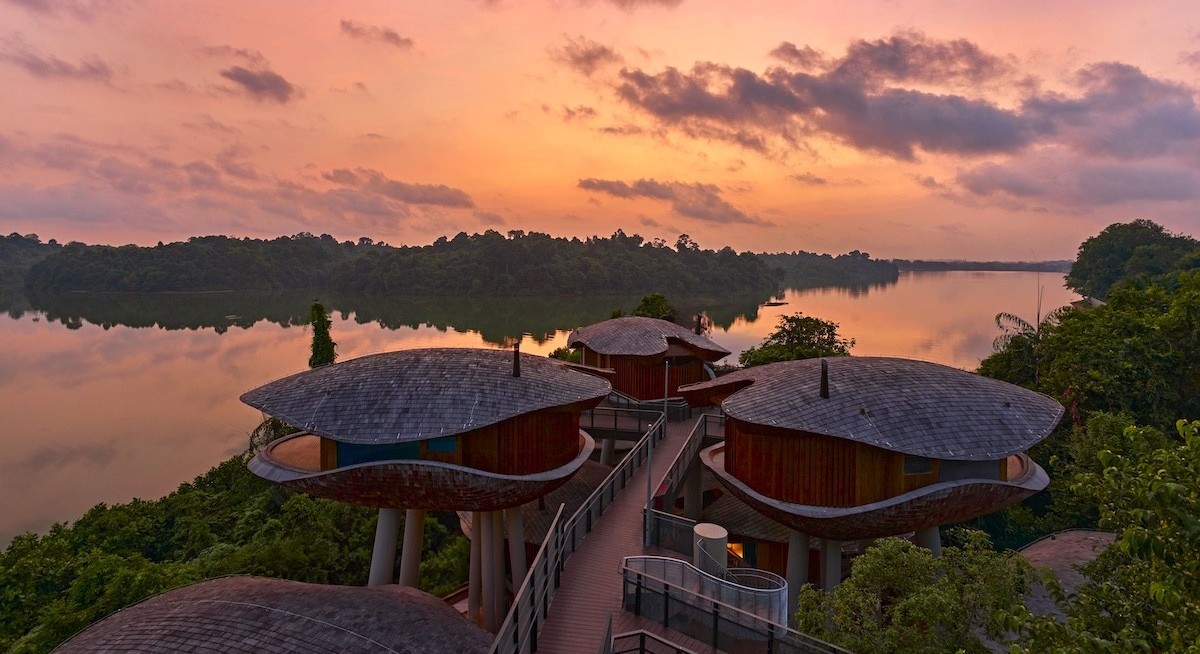


The 338-room resort marks the first property in Banyan Group’s home market and also its 100th hotel.
For a group that has spent 32 years building a reputation for resort-led luxury in places like Phuket, Bali and the Maldives, the Singapore opening is meant to be more than just a part of its current expansion plan. The statement property is nestled in a high-visibility location — inside the refurbished Mandai Wildlife Reserve — and is designed to anchor Banyan Tree’s positioning around nature, well-being and sustainability in an urban setting.
Eddy See, president and CEO of the Mainboard-listed Banyan Group, says: “As we mark our 100th hotel with our first in Singapore, Mandai Rainforest Resort by Banyan Tree represents a deeply meaningful homecoming. It brings together our legacy of design-led hospitality with our commitment to stewardship and shared impact.”

See also: Muslim tourists set to drive US$310 mil in annual spend by 2030
The Mandai Rainforest Resort by Banyan Tree boasts 338 guest rooms and suites, including 24 Mandai Sanctuary Treehouses with private patios
See adds: “Here, guests are invited to slow down, reconnect with nature and experience travel as a force that uplifts people, places and communities.”
Mandai Rainforest Resort by Banyan Tree is set within 4.6ha of greenery and is designed around what the group describes as biophilic architecture — elevated structures preserve the site’s natural terrain, while mature trees are retained as part of the arrival experience.
The resort includes elevated treehouses designed to resemble seed pods, offering views across Upper Seletar Reservoir, alongside a five-storey building with guestrooms and suites rising through the forest layers.
Sustainability is built into the guestroom design. Rooms feature full-length windows that open for natural ventilation, interactive displays that monitor power usage and rainwater harvested for flushing — all supporting the resort’s Green Mark Platinum Super Low Energy (SLE) certification.
The property leans into Mandai’s wider proposition as an integrated nature destination. Guests have easy access to the wildlife parks and attractions within Mandai Wildlife Reserve, including the Singapore Zoo, Night Safari, River Wonders and Bird Paradise. Guests who book a stay directly even enjoy two complimentary admission tickets to the Singapore Zoo.
For Banyan Group, Mandai comes at a time when the group is trying to clarify its operating model and growth story to investors and partners. In January 2024, it rebranded from Banyan Tree Holdings to Banyan Group to reflect a multi-brand portfolio and a more asset-light focus, expanding primarily through hotel management agreements rather than owning every hotel it operates.

Asset-light growth
The group’s expansion over the past few years has been anchored in management contracts. Since Banyan Group embarked on its asset-light journey, its property count has climbed sharply from its pre-pandemic base.
“For the longest time, pre-Covid-19, we had no more than 50 properties. Between then and now, we have doubled our property count, and we hope to double that again as we go along,” says See, who joined the company in 2004.
He adds that these targets are grounded in signed hotel management agreements “and not numbers on a wishlist”.
As of the end of January, the group operates 100 hospitality properties globally across 12 distinct brands. It also manages 140 spas and galleries. Banyan Group now counts over 20 branded residences operating in more than 20 countries.
In the pipeline are nearly 50 properties over the near-term, which See describes as an “exponential jump”. “We will continue the momentum and that momentum will probably build on itself and continue to grow.”
See, who was appointed CEO in 2022, describes an increased emphasis on business development and a push into markets where Banyan Group is under-represented. He points to the US and Europe as priority gaps, arguing that the group needs to be closer to its core traveller base given short-haul travel patterns.

The onsen at Homm Wenzhou Nanxijiang, which opened in August 2025. The hotel is located between the Yandang Mountains to the east and the Nanxi River to the west
China remains the group’s largest market, with 34 hotels across five brands. Last year alone, Banyan Group unveiled five hotels in China, including Banyan Tree Zhuhai Phoenix Bay, Homm Wenzhou Nanxijiang and Angsana Zhoushan. It also teased new brand debuts and pipeline growth in Southeast Asia, including a Garrya opening in Vietnam and an upcoming Homm opening in the Philippines.
At the same time, See is clear that Banyan Group does not want growth for growth’s sake. “Whatever we grow, we want it to grow with a purpose. Otherwise, it’s just a number or a digit,” he says, adding that the group will not sacrifice profits for the sake of growth.
As the group’s brand strength rises, See says it can be more selective, even as deals flow in. Rather than signing a management contract unthinkingly, the group conducts a rigorous review and due diligence process to ensure that any property it takes on aligns with its values and product requirements.
That approach also supports Banyan Group’s positioning as one of the few remaining independent hospitality groups worldwide. See says the group is “far away” from the world’s top five operators and does not intend to aspire for itself to become that sort of mass-scale platform.
Instead, he sees Banyan occupying a niche middle ground — not boutique and not playing a numbers game. With this niche positioning, See believes Banyan Group has “no real competitor”.
See also signals that the group may use targeted acquisitions to accelerate its asset-light footprint in new territories. When he talks about mergers and acquisitions, he frames it as “almost like buying management contracts”, especially in markets like the US, where there are smaller “white-label” operators managing hotels without owning them — and sometimes without strong proprietary brands.
In that scenario, Banyan Group would look to acquire a platform that is already asset-light, with operating capabilities and relationships, before layering Banyan Group’s brand and standards across the portfolio.
Another growth engine
Alongside hotels, Banyan Group is also leaning on its residential segment, led by Laguna Phuket, which it positions as both a long-duration development pipeline and a platform for fee and rental income.
Laguna Phuket began as a land rehabilitation story — one that Ho Kwon Ping, Banyan Group’s founder and chairman, has repeatedly told. Over 220 acres of degraded tin mine land were purchased cheaply in the 1980s and later redeveloped into an eco-friendly destination. Today, Laguna Phuket comprises six hotels, multiple residential developments and a golf course, supporting a broader township economy that supports the incomes of over 50,000 people.

An aerial view of Angsana Golf Residences Topaz at Laguna Phuket, which opened in January
See argues the township still has a runway. “There is still a lot more value to unlock here in Laguna,” he says, estimating US$4 billion to US$5 billion ($5.09 billion to $6.36 billion) of value to be realised in Laguna over the next one to two decades.
He also expects the Laguna community to grow further as current residential construction is completed, with new malls, schools and medical facilities opening to expand the township’s ecosystem.
In the near term, Banyan Group is strengthening its residential brand architecture. On Jan 26, the group launched its new branded residential project — Angsana Golf Residences Topaz at Laguna Phuket.

Angsana Golf Residences Topaz offers two- and three-bedroom residences, including exclusive penthouses with private rooftop pools and alfresco dining areas, as well as ground-floor residences with exclusive garden access
Comprising three elegantly curved low-rise buildings, each divided into two interconnected blocks, the architecture is designed to harmonise with the surrounding landscape. Tropical muted tones and Sino-Portuguese design accents subtly reference Phuket’s heritage, creating a balance of timeless elegance and modern sophistication.
The development offers two- and three-bedroom residences, including exclusive penthouses with private rooftop pools and alfresco dining areas, as well as ground-floor residences with exclusive garden access.
Banyan Group expects to launch up to US$1 billion in new luxury residential projects in Phuket over the next two to three years. Earlier in January, Banyan Group launched Bellaguna, a new standalone premium residences brand designed for year-round living. While professionally managed by Banyan Group, the brand operates independently of hotel inventory.
The first project under the brand, Bellaguna Lake Residences Lotus, is also located within Laguna Phuket, near Bang Tao Beach. The development features five elongated buildings with lagoon and sea views, rooftop infinity pools with private cabanas, landscaped gardens and a boardwalk and dock connecting residents to Laguna Phuket’s shuttle ferries.

An artist’s impression of the new Bellaguna, a new standalone premium residences brand managed by Banyan Group and designed for year-round living
Ownership benefits include property management and insurance for the first year, access to the Sanctuary Club programme, and membership at Laguna Phuket’s beach club.
Operationally, Banyan Group’s residential business has two distinct tracks. The first is direct development and sales within Laguna Phuket, which is landbank-driven and therefore finite.
The second is a more asset-light model outside Phuket, where Banyan Group licenses its branded residence concept to third-party developers and collects royalties.
See views the asset-light model — growing through management contracts with third-party property owners — as “infinite”, while the property development portion of the business that has a limited runway is expected to hit the ceiling in about 15 years at the current growth pace.

The first project under the brand, Bellaguna Lake Residences Lotus, is located within Laguna Phuket near Bang Tao Beach
However, the group may consider expanding its presence on adjacent land and pursuing joint ventures in other locations.
The licensing model is how Banyan Group aims to convert brand equity into recurring fees without tying up capital in land. See says attaching the brand enables developers to enhance their value from a selling perspective, which is where Banyan Group earns “royalty fees” of sorts.
He adds that the segment also creates ancillary business once homes are sold, especially in resort markets where owners are less likely to occupy the property full-time.
That leads to Banyan Group’s new rental platform. “That’s when we created a division called Banyan Living,” See says, describing it as a platform to lease out units for residential owners to benefit from “strong investment returns”.
Already launched for potential Bellaguna homeowners, the Banyan Living programme offers free entry and includes professionally managed residential hospitality experiences, providing flexibility for owners while also assuring guests a trusted, hotel-level standard of service.




