


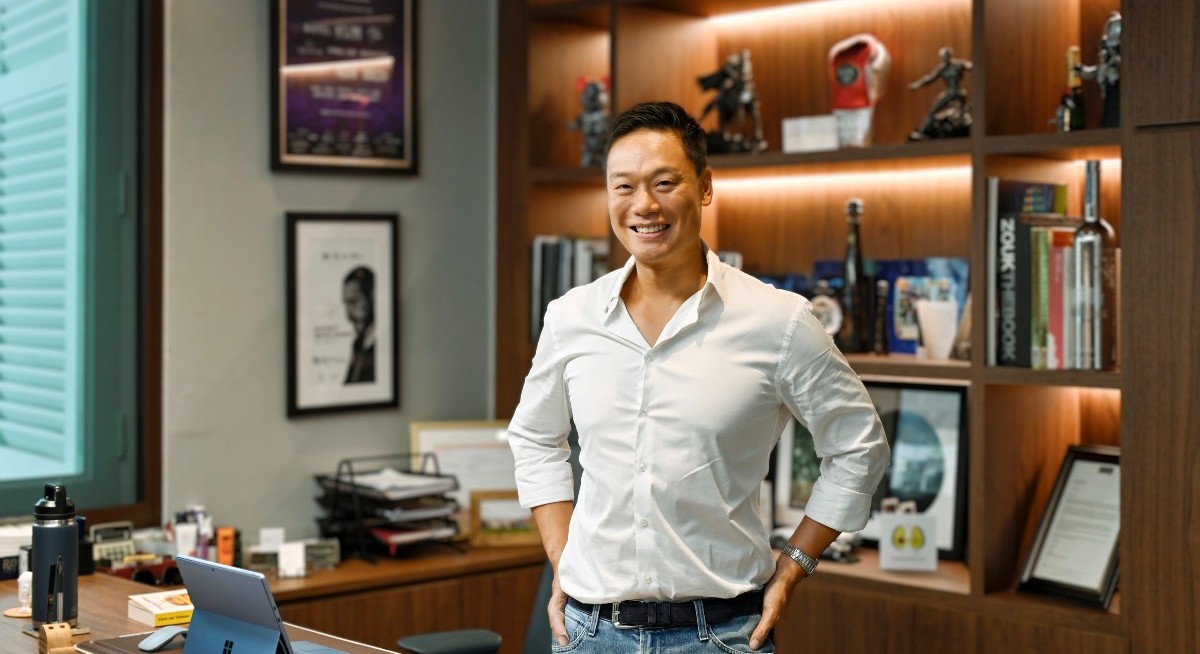


Zouk’s 2016 move from Jiak Kim Street to Clarke Quay marked the end of an era. Nearly a decade on, the club is reinventing itself once again to appeal to a wider crowd.
On June 18, Zouk reopened the Mainroom and Phuture after a multi-million-dollar renovation across its Clarke Quay premises. The refresh, which began in January, had been in the works for some time, says Zouk Group CEO Andrew Li.

The Mothership on the ceiling of Zouk Mainroom. The club's main dancefloor holds up to 1,939 people. Photo: Zouk Singapore
See also: How Singapore’s micro-climates affect the longevity of our homes
“Usually, the life cycle for a nightclub or entertainment venue is around five years. We moved here around the end of 2016. So, I think around the 2020 mark was when we were supposed to renovate,” Li tells City & Country. However, Covid-19 pushed back those plans. By the time the pandemic was over and restrictions were lifted, Zouk had to renegotiate with its landlord, CapitaLand Integrated Commercial Trust (CICT), for its second renewal for another five-plus-five-year lease.
“The [refresh] was always planned, but of course, I think the lease extension was always very critical to making sure that it actually went ahead,” Li adds.
Multi-million-dollar revamp
See also: Arcc Spaces appoints The Afternaut Group to design Bank of Singapore Centre co-working space
The latest revamp ushers in what Li calls “Zouk 3.0”, a refresh of all four rooms at the premises. Capital, an “ultra-lounge” targeted at the older crowd in their late-20s to 40s, was the first to reopen in March. The revamp by Josh Held Design — who had also worked on the interior architecture of Zouk Tokyo — features 25 sofas, 12 standing tables and an island bar, brought together with gold trimmings and accents.
The space, which accommodates a “comfortable” 542 people, also has a new private karaoke room for groups of up to 25, as well as a dry bar. “We still wanted something that was quite timeless,” says Li.
The approach extends to Capital’s positioning as a venue for large group milestone events such as birthdays, farewells and post-wedding parties, building on its history of hosting pre- and post-wedding celebrations in Singapore.

Capital, an "ultra-lounge" for visitors in their late-20s to 40s, was the first to reopen in March. The space features 25 sofas, 12 standing tables and an island bar. It now accommodates 542 people. Photo: Zouk Singapore
The Zouk Mainroom, Phuture and Capital — which operate independently but can be integrated into a larger space — can host up to 3,500 guests when modular areas are fully opened. The new spaces come with extensive audio, visual and lighting infrastructure, including large-format LED walls and end-to-end screen capabilities.
“For Capital, we actually spent a lot more money per square foot than we did with Zouk. With Zouk, you basically spend a lot more money on the audio, visual and lighting equipment, because that’s really the experience you want,” says Li. “It’s about visuals, it’s a big space.”
He adds: “For Capital, we spent a little bit more on the artwork, we spent a little bit more on the furniture quality, we spent a lot more money on just the kind of intimacy of the venue. The funny thing [is], when you go into Capital during the day, it still looks like a beautiful venue.”
Meanwhile, the club’s F&B concept, RedTail Bar, has been revamped as Rally Clubhouse — a new day-to-night social concept that operates as a co-working space in the day and a bar by night.
Mice-ready venue
The Zouk Mainroom has been redesigned from the ground up in collaboration with Superlative, an audiovisual company based in Spain. According to Li, the space is now “completely future-proof”, with kinetic LED screens installed throughout the club. The staircase leading to the dancefloor has been moved outside, while the DJ booth now doubles as a stage for live performances. The entrance has also been widened to accommodate luxury vehicles during events.
“We wanted to be Mice-ready (meetings, incentives, conferences and exhibitions) and live events-ready,” says Li. The strategy draws partly from Las Vegas, where a huge amount of revenue is derived from Mice events. “Vegas itself is one of the Mice capitals of the world. The convention centres, they have huge CES (consumer electronics show), car events — they’re on another scale. The city itself is based on huge Mice events,” he notes.
“Here in Singapore, what’s interesting is that STB (Singapore Tourism Board) is actually trying to [turn the city-state] into a Mice hub. Of course, when we heard about that, the last couple of years [has] triggered us to feel that… let’s give a proposition here that other places don’t have.”
To Li, Zouk’s capacity is another unique selling point, given that most hotels can fit up to 1,000 people. The club has managed to secure a venue booking from a fintech company during the Formula 1 Singapore Grand Prix weekend for 2,000 people.
Car brand activations, as well as partnerships with hotels and hospitality groups — including its landlord CapitaLand — are also part of Li’s plan to position Zouk as a Mice venue. The club’s redesign feeds into this strategy. Above the island bar, the original mosaic art piece has been replaced with a full-LED screen, allowing for flexible branding and dynamic lighting during events.
An operable wall now links Capital with the Zouk Mainroom’s second floor, allowing the spaces to merge for major DJ nights or large-scale functions. “When you’re able to expand your venue, you’re able to sell more tickets,” says Li. “That allows you to pay for bigger DJs.”
Zouk and Phuture combined can move around 2,000 tickets on a given night. With Capital added, that figure climbs to more than 2,800. However, that scale has not necessitated headcount growth. Despite plans to expand its Mice offerings, Li admits the group has kept staffing flat, focusing instead on promoting from within. He says this reflects the post-Covid-19 wave of revenge spending, which drove over-hiring across the industry before conditions normalised. The group now keeps its team lean and rewards staff taking on additional responsibilities.

Iman Fandi, daughter of Singapore football legend Fandi Ahmad and former South African model Wendy Jacobs, performed at the reopening of Mainroom and Phuture on June 18. Photo: Zouk Singapore
The Clarke Quay effect
While no rental figures were mentioned, Li says the numbers still work for the business. “We wouldn’t have invested so much if we knew that it wasn’t going to work financially for us,” he says.
Zouk’s relationship with CQ @ Clarke Quay benefits both sides and helps to sustain their partnership. “Ever since we’ve come here, we've been bringing in close to 2,500 and 3,000 per night on Fridays and Saturdays. Obviously, all these people who come to our club are going to have to drink somewhere. I think that definitely has had a knock-on effect with different venues as well as around the night entertainment venues.”
The knock-on effect on surrounding venues has been tangible, even as Clarke Quay has shifted from a nightlife-focused precinct to a more mixed-use destination. Zouk has not seen a drop in footfall over the past two years, and Li expects the area’s ongoing evolution to reinforce that trend.
Separately, the co-working offering at Rally Clubhouse is being driven by the impending launch of neighbouring Canninghill Piers, a mixed hospitality and residential development. Li expects this to provide a steady catchment of residents and visitors already embedded in the Clarke Quay precinct.
Announced earlier this month, the easing of restrictions on new hotels, hostels and serviced apartments at Upper Circular Road and Beach Road will also help in the longer term.
For now, the standardisation of 4am licences has had a more noticeable impact on footfall, says Li. In August 2025, the authorities announced that bars, pubs and F&B operators in the Boat Quay, Clarke Quay and Upper Circular Road precincts can apply to extend their liquor trading hours until 4am on Thursdays, Fridays and Saturdays.
“Our consumers, once they’re told to leave at 3am, [they’ve got it in their head] that [they’re] leaving at 3am every Friday and Saturday,” says Li.
The CQ Night Shuttle has also helped, though uptake was slow initially, says Li. The free service runs from CQ @ Clarke Quay to five locations around town — including Somerset MRT Station and Ion Orchard — as well as Tampines and Jurong. Launched in December 2025 by CapitaLand, it operates every Friday and Saturday from 11pm to 3am, with hourly departures at the top of each hour. One-way shuttles are provided for those going to Tampines, Bishan and Jurong at 4am.
CICT reopened the precinct as CQ @ Clarke Quay in April 2024 after a two-year, $62 million asset enhancement initiative that introduced supermarket FairPrice Finest as part of the “day-and-night destination”. At the time, its addition as an anchor tenant was said to impact bar sales in the area.
Despite cheaper alcohol being available at the supermarket, Li says Zouk has not seen a “massive drop-off” in sales due to the different operating hours. “I do know that back in the day, like even 10 years ago, there was a 7-Eleven around here that was incredibly popular. So if anything, it's just like a bigger 7-Eleven.”
Balancing younger and older crowds
Attracting Gen Z to nightlife has become an industry preoccupation. Younger consumers drink and spend less, and have more options on a Friday night than previous generations. While Li does not dismiss this shift, he is also not overly concerned.
For Li, the club does not need to attract the entire generation. Capturing even a “percentage” of those who want to go out is enough. “I think for us, maybe this is a little bit of a dip, but I always also feel that, as we go through the ages, there are dips and curves in terms of alcohol consumption as well.”
Higher prices for a night out could also be a factor, he adds. “Compared to 10 years ago, the cost of getting a car home or getting a drink is a lot more expensive, right? So, the price barrier and entry are a little bit harder. It could also be that they still want to go out, but there are certain macro factors that [make it] a bit too expensive for them to do it so often.”
The club has tried “different marketing programmes” for a more affordable night out, such as offering free-flow alcohol promotions at RedTail. “They don’t spend as much, but they’re here,” Li says. “That means they definitely want to go out. As I said, we don’t need every single Gen Z person; we just need a couple thousand every weekend.”
Zouk has also been leaning into nostalgia for an older crowd — those with fond, if hazy, memories of its parties. Its monthly Total Recall nights feature pop hits from early-2000s acts like the Backstreet Boys and Britney Spears.
“It’s very, very popular; it’s been one of our most popular nights ever since,” says Li. “I kind of helped conceive the night just because I felt like I needed to listen to music that was back in my age group, and it’s been great. People in their 30s and 40s really enjoy it because it feels very nostalgic — and they usually tend to have a bit more spending power as well. So, it has actually become our most profitable night.”
Mambo Jambo, a revival of one of Jiak Kim Street’s most popular nights featuring 1980s hits, is a regular crowd-puller, typically held on the eve of public holidays to allow revellers to recover the next day.
Asked about competition from pop-up event organisers like Above30Club, Li says he is unfazed. “I always feel like competition is always good for us,” he adds. “I’ve always found that people think it's very easy to open up a nightlife establishment. A pop-up is obviously a lot more risk-averse… You’re basically just renting out a venue for a night. [That] is very different from making it a sustainable business, where you have people coming in every Friday and Saturday.”

From left: Fabian Low, managing director of Falkcon Interior; Ervin Yeo, CEO of commercial management and group chief strategy officer of CapitaLand; Andrew Li, CEO of Zouk Group; Jean Ng, assistant chief executive, experience development group, Singapore Tourism Board; and David Long, vice president, hospitality, Zouk Group. Photo: Zouk Singapore
Li welcomes such popular pop-ups, even if they compete with Zouk for partygoers on weekends. “It’s allowing a different experience out there. It’s not like we’re going to copy that concept, but it shows that there are enough people who are going out. So as long as we make sure that we continue with our original programming and we upgrade our software [and] continue with our service, I think that we don’t see other kinds of competitors as a threat.”
Extending the experience
Rally Clubhouse, which reopened on June 25, is designed to extend Zouk’s reach beyond clubbing. Food is supplied by Korio, a homegrown sandwich shop with outlets at IOI Central Boulevard Towers and Midtown Mreodern, with an expanded kitchen able to cater for up to 800 people. Alongside Korio, Rally Clubhouse's all-day menu spans comfort food, bar bites and sharing plates. By night, it operates as a bar with live music and DJ sets. In addition, Rally Clubhouse will soon announce a late-night supper collaboration.
The group is also focusing on driving partygoers to its app, launched last year. It serves as a wallet and offers a tiered loyalty programme, with members able to use points to offset spending in the club.
To Li, Zouk 3.0 is the culmination of nearly a decade’s worth of lessons — from its Jiak Kim Street era to its Tokyo outpost, and from observing how Las Vegas has built an economy around large-scale events. “Singapore is our home base,” he says. “We wanted to make sure it’s future-ready for at least the next 10 years.”
Li foresees AI being integrated into entertainment, but says it was too late to be included in this phase. Zouk 4.0, he adds, will depend on how the next five years unfold. “Our DNA has always been about creating unforgettable experiences," Li says. “What we’ve realised is that we can traverse into a lot of verticals through that one core DNA. Whether it’s a sandwich at Korio or a French meal at The Plump Frenchman, we want to be able to create these experiences. So to me, success is being able to take that original DNA for Zouk and transpose it to the verticals we’re seeing.




