




Eu Yan Sang is Southeast Asia’s largest manufacturer and retailer of Chinese herbal medicine. It operates more than 210 stores and Chinese herbal medicine clinics, mainly across Singapore, Hong Kong and Malaysia.
The acquisition by Mitsui and Rohto provided a profitable exit for a group of earlier investors, including Tower Capital Asia, which helped take Eu Yan Sang private from the Singapore Exchange in 2016.
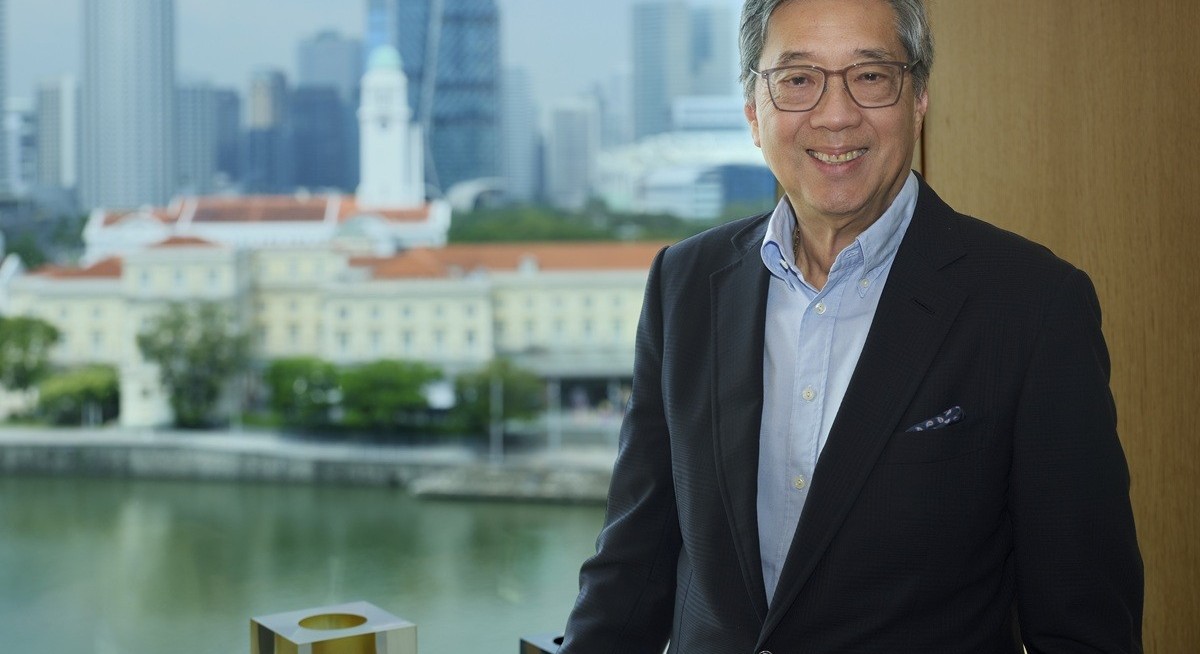
The shareholding has shifted once again, but one constant remains: the Eu family’s involvement. Led by the founder’s great-grandson Richard Eu, the family still holds a 10% stake in Eu Yan Sang, a business dating back to 1879.
It also means that Richard Eu’s journey with the company, already spanning decades and generations, will continue for the foreseeable future. For him, this journey can be summed up in seven “Cs”.
See also: Billionaires are fighting their heirs for control beyond the grave
Courage
The British Empire’s sun had set, and traditional Chinese medicine (TCM) seemed to be following the same path. Yet, Eu was convinced he could carve out a new future for TCM in Singapore, even as Western medicine came to dominate healthcare.
Eu, a fourth-generation descendant of Eu Yan Sang founder Eu Kong, joined the family’s TCM business in 1989 following an 18-year career across merchant banking, stockbroking and consulting at a time when the region’s financial services sector was booming.
See also: UBS finds record shift in portfolio strategy by global family offices
However, he had to convince his father to join the company full-time. This was the start of a series of well-documented challenges for the business, and how Eu successfully navigated complex family dynamics while reviving the struggling business.
Care
“I did not believe TCM was a sunset business,” says Eu in an interview with The Edge Singapore. He adds that he saw a market for alternative therapies that were in contrast to Western medicine.
To Eu, TCM was more than just treating illness. “TCM is about keeping people healthy,” he says. At that point in time, Eu was already contemplating ways to add “healthy years” to life — a perspective that only recently came into popular parlance in Singapore.
In addition, the second and third characters of the company’s Chinese name mean “caring for mankind”, which aligned with Eu’s thinking about the purpose of the business.
Surprisingly, Eu attributes his views on TCM to his Westernised upbringing. His formative years were spent in the UK when he was sent to boarding school at around 12 years of age. During his time there, Eu saw firsthand the demand for drug-free alternative therapies. He realised later on that TCM could be a potential alternative to Western treatments and saw potential in the family’s business when others did not.
Collaboration
For more stories about where money flows, click here for Capital Section
Upon joining the business full-time, he set out to modernise and expand the business. Eu later became CEO and led the company to a public listing on the Singapore Exchange in 2000.
In 2016, Eu Yan Sang was privatised at a valuation of around $270 million, with Eu joining forces with private equity firm Tower Capital Asia and Temasek unit Blanca Investments to steer the company’s growth. Subsequently, Eu stepped down as CEO and a professional CEO was hired to run the company, with Eu appointed as chairman.
Eu shares his thoughts on the company appointing a professional CEO in a study by UOB Private Bank, Boston Consulting Group and the National University of Singapore. He says: “You need to split the family from the business. I would reach a ceiling in competence — I have never led an MNC before. It is about the survivability of the business, and the firm needs the best man for the job.”
According to Eu, the decision to partner with Tower Capital was down to the latter’s strong belief in the Eu Yan Sang brand and its alignment with Eu’s values of integrity, empathy and care for people.
He also credits Tower Capital and Temasek for “elevating” the Eu Yan Sang brand and “institutionalising operations”, enabling the company to scale greater heights and further its attractiveness.
Character

Elaborating on values, Eu whips out his smartphone and shares an image of a Chinese poem composed by his great-great-grandfather for the Eu clan. Each character in the poem is a generational name for Eu descendants. A translation reads: “A crane in Guangdong that embodies principles; it upholds the path of righteousness to pass on to future generations, and it achieves success with righteous resolve.”
“I think you have to behave with integrity and honesty,” says Eu. “You don’t cheat people to make money.”
It is probably not a coincidence that Eu and his partners held their Eu Yan Sang shares in a holding company called Righteous Crane Holding after the 2016 privatisation.
Still, the acquisition by Rohto and Mitsui took place in 2024, but the seeds of this deal were sown a few years before, when in 2022, Mitsui collaborated with Tower Capital and invested in the fund that took Eu Yan Sang private. Mitsui, already an investor via the fund that owns Eu Yan Sang, has liquidated its stake and reinvested in Eu Yan Sang with Rohto.
The catalyst for the transaction came in 2023 when Japanese beverage giant Kirin Holdings bought Australian health supplements supplier Blackmores for around US$1.2 billion ($1.55 billion).
This transaction sparked interest among some shareholders to sell Eu Yan Sang, and feelers were put out to test market response, says Eu. There was interest from several parties, but Eu had a preferred buyer in mind, and it was the Japanese consortium.
In Rohto, Eu found a kindred spirit. Like Eu Yan Sang, Rohto, founded in 1899, is also a family business and just so coincidentally, its chairman and CEO, Yamada Kunio, is also a fourth-generation descendant of Rohto’s founder. “You must have a long-term vision for the company and not just look at short-term events,” says Eu. “The Japanese appreciate our heritage and take a long-term view as well.”
Mitsui’s involvement adds another dimension to the deal’s growth potential. It holds stakes in a range of healthcare companies across the region, including IHH Healthcare, which operates hospital chains in Singapore and Malaysia. According to Rohto, together with Mitsui and Eu Yan Sang, the partners can combine their strengths and take on challenges they could not address alone. This underpins the decision to partner with Mitsui.
Conviction
Post-acquisition, Eu still plays a role in the company. “I still have a lot of conviction for the business,” he adds. “I was asked to stay on, and I am happy to contribute in whatever way I can.”
As chairman of Eu Yan Sang and a board director of several other companies, Eu mentors the next generation of business leaders. He tells aspiring entrepreneurs that success starts with a strong belief in what they are doing.
He says: “I think you have to start believing that whatever you’re doing can make a difference.” For Eu, while making money is necessary to keep the endeavour sustainable, it should not be the main motivation.
Curiosity
Besides honesty and integrity, he believes curiosity is another important ingredient in life. “I try to teach my kids to have a sense of curiosity, because I think understanding context is very important,” he adds. “Education is not about just learning rigid formulas and things like facts and figures. It’s trying to understand why. You have to question why.”
These days, Eu keeps an active lifestyle and plays tennis up to five times a week, belying his 78 years. Eu was a water skier in his younger days and had represented Singapore at the 1983 SEA Games, winning a bronze medal.
“I’ve always been active in sports from the time that I went to boarding school,” says Eu, who describes that he grew up in an environment where sports were nearly as important as studies. He believes that sports are able to teach life lessons and feels it is a pity that they take a back seat in Singapore.
Eu’s curiosity keeps him occupied as a semi-retiree; he continues to keep track of the latest developments in health and wellness and consults a health coach while attending clinics on topics such as longevity and wellness.
Cat Mountain King
Beyond sports and wellness, Eu is passionate about jazz. He is the lead vocalist for a band called Cat Mountain King — named after a premium durian variety — with a profile arguably rivalling that of Eu Yan Sang. Eu has performed at charity events and pubs, and clips of his performances can be found on YouTube.
He says, “I don’t think I’ll ever retire. Okay, I’ll find some way. As long as my mind is active, I’ll find some way of keeping busy.” That probably includes singing Fly Me to the Moon at your local pub.




