


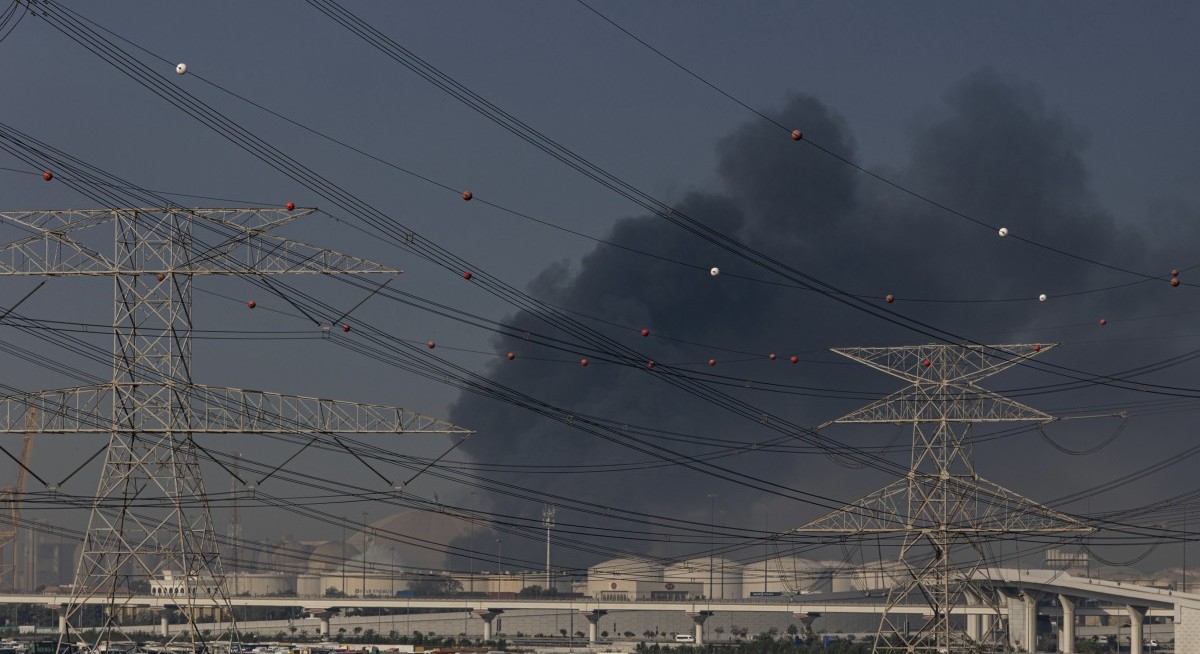


“For these reasons, the United States military is undertaking a massive and ongoing operation to prevent this very wicked, radical dictatorship from threatening America and our core national security interests,” adds Trump. “We’re going to destroy their missiles and raze their missile industry to the ground. It will be totally, again, obliterated. We’re going to annihilate their navy.”
While the strikes began with fire and fury, it remains to be seen how long the battle for Iran will take. Already, Iranian forces have begun retaliating by firing over 400 ballistic missiles and 800 drones at US allies in the Middle East. This includes striking both military and civilian infrastructure in Gulf states like Bahrain, Kuwait, Oman, Qatar, Saudi Arabia and the United Arab Emirates. None of these nations participated in the US and Israel’s attack on Iran.
Ian Bremmer of Eurasia Group expects Iran’s retaliation to continue for some time, though it is likely to run low on missiles first. “They probably have maybe a thousand or below a thousand medium and long-range missiles left that they can actually engage in strikes with,” Bremmer told CNBC in an interview on March 2.
“They’re running out. It’s probably at most a few more days of the Iranians being able to engage in significant missile strikes in the region, most of which get intercepted. But then it is the drones and the drone war they will be able to engage in for a much longer period of time,” Bremmer adds.
See also: We are not at the peak of the AI cycle: Eastspring
Alexandre Tavazzi, Pictet Wealth Management’s head of CIO office and macro research, told The Edge Singapore in an interview on March 2 that it is “too early to say” if the war in Iran will be a brief or protracted conflict. “The initial strike was quite massive in very targeted places, but it’s basically everyone’s guess to try to imagine what happens next,” he adds.
This is no Venezuela
Striking Iran is less surprising given the assertive stance Trump has taken in his second term. A recent example came in Venezuela, where Trump launched a surprise strike on Jan 3 that resulted in the capture of the country’s president, Nicolas Maduro, who now faces drug trafficking charges in the US.
See also: World Cup: Not just a major sporting spectacle, but also a growing investing theme
Still, the attack on Iran could inflict far greater damage on the global economy than the events in Venezuela earlier this year. “There’s a huge difference in terms of oil supply,” says Pictet’s Tavazzi. “What we see in Iran is the Strait of Hormuz, which is not officially closed, but of course, a lot of ships do not want to go there just because the insurance cost can move up dramatically in a short period of time.”
According to Tavazzi, insurance companies would usually cancel their previous contracts during such periods of uncertainty. Instead, customers will have to sign new contracts with prices that can be as high as 50% of the value of their vessels.
On March 3, Trump announced on Truth Social that he has ordered the US Development Finance Corporation to provide “political risk insurance and guarantees” for all maritime trade passing through the Persian Gulf. “This will be available to all shipping lines. If necessary, the United States Navy will begin escorting tankers through the Strait of Hormuz as soon as possible.”
Iran is the fourth largest producer of oil in OPEC and produces around 3% of the world’s output. Any move by Iran to shut down the Strait of Hormuz will disrupt the global oil trade significantly, given that about one-fifth of global crude oil and LNG goes through there.
“If you look at the effect of Venezuela on oil prices, it had basically no effect,” Tavazzi says. “When you see what happens now, because it’s concentrated in the Middle East and because you have seen strikes of Iran’s missiles around the neighbouring countries then I would imagine this is what we see in oil prices: The effect could be bigger because the transmission mechanism is through higher oil prices, higher energy prices, which is negative in terms of the global economic cycle.”
Oil prices have made their biggest gains since June 2025 following the strikes in Iran. On March 3, Brent futures closed at above US$80 ($102) and are up by over 35% year to date.
Such volatility in prices is likely to persist given the unpredictability of both the Trump administration and the Iranian forces. The president told the New York Post in a March 2 interview that he would not rule out sending in US military troops to Iran “if they were necessary.”
For more stories about where money flows, click here for Capital Section
“First, this is not a pre-emptive war. It is a war that started with the intent of regime change. Second, unlike past major conflicts, this military campaign is carried out unilaterally by the US-Israel and without the traditional backing of European allies,” writes DBS’s chief investment officer Hou Wey Fook and senior investment strategist Dylan Cheang in their CIO Market Pulse report on March 2.
Hou and Cheang say that there is no “clear strategic endgame for the US” when it comes to Iran. “The initial justification by the administration in starting this campaign was about preventing Iran from developing a nuclear weapon. But the focus has now seemingly shifted to regime change. The lack of strategic vision and clarity heightened the risk of the US embroiling in another ‘forever war.’”
Crude oil prices to go up to as high as US$100 to US$150 per barrel “in the extreme scenario of full blockage for the Strait of Hormuz,” adds Hou and Cheang.
Trump’s interest in Iran stretches back to his first term. In 2020, toward the end of his presidency, he ordered a US military strike that killed Qasem Soleimani — the commander of Iran’s Revolutionary Guard’s Quds Force — a figure US officials said was involved in planning attacks against American personnel and interests in the Middle East.
“Since his death, Iran has been unable to recover the coherence and purpose of General Suleimani’s proxy operations,” writes Kenneth F. McKenzie Jr., a former commander of the US Central Command, in an op-ed for The New York Times.
“Equally important, the strike established Mr Trump’s credentials as someone who would not be in thrall to Iran. The president is the unique advantage we have in the region. For the first time in decades, American military power in the Middle East deployed against Iran is coupled with a commander in chief who isn’t afraid to use it.”
JPMorgan analysts Joseph Lupton, Bruce Kasman and Jahangir Aziz say in their March 1 note that the war in Iran will bear greater resemblance to Russia’s invasion of Ukraine than the strike on Venezuela.
“Through its potential to disrupt global energy markets and supply chains, it connects more closely to the 2022 Russian invasion of Ukraine,” the analysts write. “It is also similar to the Russian invasion in that it looks likely to have material, lasting political and economic consequences at the regional level.”
When risks strike
When it comes to investing during a geopolitical crisis, investors cannot go wrong by opting for a flight to safety. “Like we have seen in many other events, you see that kind of safe haven assets tend to do fine in this environment,” says Pictet’s Tavazzi.
“On our side, we have been advocating and advising our clients to hold some portion of their portfolios in gold,” he adds. “We also allocated most of our clients’ money into their reference currency, so mostly on the domestic side. The Swiss franc can be kind of a safe haven in the currency front.”
This, however, is subject to whether oil prices continue to remain elevated, says Tavazzi. “If oil prices stay where they are for a long period of time, then you will have to change the whole economic scenario, and then the asset allocation changes. As things stand for now, having these kinds of safe haven assets like Swiss franc or gold tends to protect the initial shock that you see in the portfolios.”
RHB’s group chief economist and head of market research, Barnabas Gan, says in a report on March 2 that gold could move toward US$6,000 per ounce “depending on the severity and duration of disruptions” in Iran. Gold spot prices closed at US$5,089 on March 3. He also expects a 5% to 10% decline in global equities if tensions in the Middle East continue to escalate further.
“However, Singapore remains a safe haven darling in Asean — we like Singapore government bonds on the back of its investment grade status, reinforced by a relatively stable SGD on the back of potential S$NEER (Singapore dollar nominal effective exchange rate) tightening against inflationary pressures into 2H2026,” RHB’s Gan writes.
On March 2, the Monetary Authority of Singapore released a statement saying it was closely monitoring the developments in the Middle East. “The Singapore dollar nominal effective exchange rate remains within its appreciating policy band, which will continue to dampen imported inflationary pressures.”
Investors hoping to make a gain on silver, however, may want to reconsider their options. Carsten Menke, Julius Baer’s head of next generation research, says in a March 2 note that he is maintaining a constructive view on gold and a neutral position on silver.
“Today’s oil market is very well supplied and should be capable of dealing with limited disruptions. This should cap the upside for gold and silver from the conflict, not least as prices already rose in anticipation of an escalation – in line with the historical geopolitics playbook,” Menke writes.
He notes that investing in gold and silver during a geopolitical crisis is usually not very profitable. “One month later, the median return is –1% for gold and –0.4% for silver. Three months later, it is –3.5% and –4.7% respectively. The most notable exception is the 1979 and 1980 oil crisis.”
Markets on the clock
Ultimately, the longer the war lasts, the greater the impact on the markets. “The whole thing is about trying to determine how long ships are going to be prevented from going into the region,” says Pictet’s Tavazzi.
“What we hear is that in terms of inventories, you have about 20 days of inventories on a global basis, which means the economy can continue to function for about two to three weeks. Should the blockade last longer than we will have an issue.”
In terms of stock picks, OCBC Group Research’s Ada Lim says in her note on March 3 that she prefers local counters like SIA
Engineering (fair value: $3.68) and ST Engineering (fair value: $12.50). For Lim, both these stocks are “levered to long-term maintenance, repair and overhaul and defence upcycles.”
In addition, Lim has a buy call on airport gateway services provider Sats (fair value: $3.94), adding that this is a counter that investors can “consider accumulating on weakness.” Lim says Sats may benefit from a shift from sea to air cargo if there is a prolonged closure of the Strait of Hormuz.
“While Sats is unlikely to benefit directly from such increases, we maintain that trade flows are likely to be redirected rather than disrupted entirely. The company’s geographically diversified footprint and extensive network should allow it to capture re-routed trade flows,” Lim writes.
Mathieu Racheter, Julius Baer’s head of equity research, shares a similar view to Lim. In a note on March 2, Racheter called on investors to adopt a more conservative and prudent approach when picking counters.
“Chasing short-term moves appears less attractive than maintaining discipline: a tilt towards quality companies with robust balance sheets, pricing power and resilient cash flows should offer relative protection, and overall, a defensive bias remains warranted until greater clarity on the trajectory of the conflict emerges,” Racheter writes.
Some developments could shorten, rather than prolong, the war. Afdhal Rahman, OCBC’s executive director for wealth advisory, points to two that could limit the conflict’s fallout. “First, this attack is unfolding against the backdrop of a US midterm election year and an electorate fatigued and sceptical of ‘forever wars.’ In that sense, the Trump administration has an incentive to keep the conflict contained and brief,” he continues.
“Second, oil prices may remain well-behaved with a supply backstop from OPEC+, which has indicated it could increase production at its upcoming meeting,” he adds.
In the end, investors should maintain a level head and not let the immediate uncertainty cloud their judgment. “As we’ve seen in many previous geopolitical episodes, this too shall pass. For perspective, the Russia‑Ukraine war remains unresolved after more than three years, yet markets still soared many times over despite periods of volatility,” says Afdhal.




