


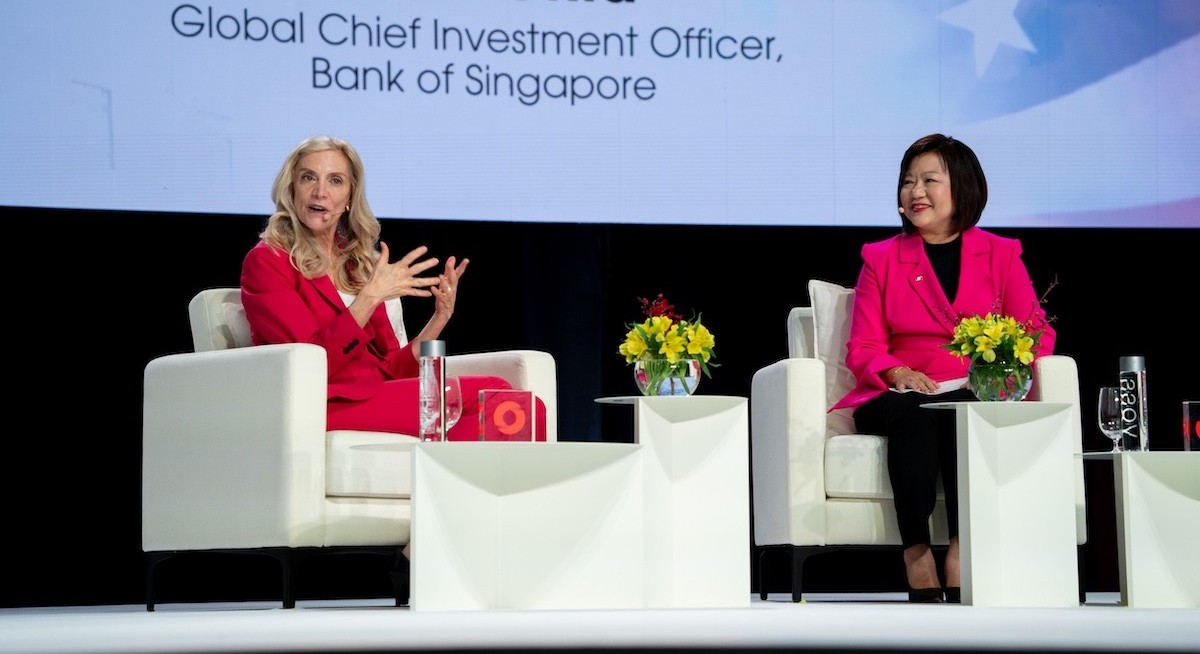


Speaking at the BOS’s 2026 Outlook conference at Marina Bay Sands Convention Centre on Jan 8, Lee shared that the bank is neutral on US equities.
“Why neutral? As you can see, US equity valuations now reflect a negative equity risk premium, which in other words means valuations are actually quite full considering where bond yields are,” Lee says.
“That said, we know that the earnings outlook is solid and the fact that the relatively high P/E looks quite reasonable if you account for earnings growth as well. Our judgment is that the risk reward for US equities is mostly balanced at this point.”
Instead, BOS prefers Asia ex-Japan equities, with a particular focus on markets in Hong Kong, China, Singapore and Malaysia. These markets will benefit from multiple factors such as a weaker US dollar, AI-led economic growth as well as expansionary fiscal and monetary policies.
See also: Local firms powering Singapore’s strong green revenues
“We believe Asia ex-Japan equities are offering remarkably attractive risk-reward right now versus other regions, with an 18% forward earnings growth, with a monthly funding valuation of only 14 times P/E even after the rally last year,” Lee says.
“In terms of our global sector view, we continue to favour tech, i.e. communications services and IT, in addition to materials and utilities, and we are underweight on the consumer discretionary sector,” he adds.
Aside from Lee’s presentation, the conference featured a keynote dialogue between Chee Hong Tat, minister for national development and deputy chairman of the Monetary Authority of Singapore, and BOS CEO Jason Moo. Jean Chia, global chief investment officer for BOS, moderated a dialogue with US economist Lael Brainard. The latter served as vice-chair of the Federal Reserve from 2022 to 2023 and director of the National Economic Council for the Biden administration from 2023 to 2025.
See also: ‘Generational’ investment opportunity in green economy: LSEG
During their 30-minute dialogue session, Brainard covered a wide variety of topics, ranging from the potential ramifications of the US Supreme Court’s ruling on President Donald Trump’s tariffs to the AI boom.
Tariffs not ‘going to come off’ even if court rules against Trump
According to Brainard, a ruling against the Trump administration’s “Liberation Day” tariffs will not result in their removal entirely. “If the Supreme Court rules that the administration has overstepped its executive authority, [and] that Congress really is the authority on raising revenues, it doesn’t mean those tariffs are all going to come off.”
Instead, what the ruling will be able to do is to limit Trump’s discretion in imposing tariffs. That will not stop the president from imposing tariffs based on other laws at his disposal, though those laws would be “more transparent and less arbitrary,” she adds.
For 2026, Brainard expects the US economy to experience a “real uplift in the first quarter” thanks to Trump’s tax and spending cut bill, also known as the “One Big Beautiful Bill”, as well as the investments being made in AI. “That should carry through into the middle and back half of the year,” she says.
AI has been a huge driver of the US’s GDP. In fact, investments into technology have outpaced consumption as a component of GDP. This has drawn commentary from analysts, including BlackRock’s Asia-Pacific head of global fixed income, Navin Saigal. In a media roundtable on Dec 3, 2025, Saigal told reporters that this can result in a situation where “investment can continue to drive aggregate GDP growth even when consumption and employment continues to moderate”.
Brainard made a similar observation in her dialogue with BOS’s Chia, when she pointed out that the AI boom has resulted in growth that is robust but relatively job-poor. “That’s partly because the manufacturing sector has taken it on the chin between the tariffs and the competition for capital with the AI sector. It’s partly because AI infrastructure is not very job-rich,” she says.
For more stories about where money flows, click here for Capital Section
“What we are seeing in the private sector is a number of very exciting developments in the US but an unbalanced economy,” she continues.
According to the latest employment figures released on Jan 9 from the US Bureau of Labour Statistics, non-farm payrolls rose by 50,000, lower than the 70,000 that was expected. Brainard believes that the Fed will be inclined to cut rates in either January or March to “guard against higher unemployment”. The Fed last reduced interest rates by 25 basis points to between 3.5% and 3.75% in December 2025.
Clients see AI as both biggest macro surprise and economic driver for 2026
Most of BOS’s clients recognise the disruptive impact AI will have on the economy. In a straw poll conducted at the conference, nearly 43% of clients expect AI to be the biggest source of macro surprises in 2026 while over 57% of them believe AI will be the largest economic driver for Asia over the next five years.
BOS’s Lee took a more sanguine view on whether there was an AI bubble. “Given our estimates of economic value creation and also benchmarking AI investments today versus previous major tech cycles as a share of GDP, we do not see widespread open investments in the AI space, especially for the hyperscalers.”
In fact, Lee believes the rise of AI will create investment opportunities into areas such as energy and quantum computing. According to Lee, demand for chips will only grow because the need for AI compute in data centres will outpace any chip efficiency gains.
“This is not a linear phenomenon. This is an exponential phenomenon and so it is not hard to see how at some point soon, AI energy consumption will become a key bottleneck for humanity, which is why quantum computing is a key critical part of our technology roadmap going forward,” Lee says.
Lee is not the only one who is optimistic about the longevity of AI chip demand. Goldman Sachs Asset Management noted in its 2026 investment outlook that analysts have been underestimating AI capex every quarter for the past two years. This suggests that there is “continued upside risk to the broader AI trade’s durability heading into year-end”, it says.
Western hemisphere may become world’s new oil bloc post-Venezuela
Mansoor Mohi-uddin, BOS’s chief macro strategist, told clients that global volatility will become the norm rather than the exception in the new world order. It can also result in countries and regions trading places among one another.
“If you think about this year’s dramatic events in Venezuela, it’s now possible to imagine in the Americas, the US could lead a bloc of oil producers, including Canada, Mexico, Brazil, Argentina [and] now of course Venezuela and the Western Hemisphere dominate oil production,” Mohi-uddin says, thus displacing the Middle East and Opec as the centre of oil prices.
On Jan 3, the US launched a military strike on Venezuela and captured the country’s president, Nicolas Maduro, as well as his wife. They now face drug trafficking charges in the US. Trump says Venezuela will be run by the US until a “safe, proper and judicious” leadership transition can take place.
“Now, despite all the uncertainty in the new world order, my concerns about volatility [and] inflation, we do think that this year, the macroeconomic outlook is actually very supportive of financial markets,” says Mohi-uddin, adding that he expects the US dollar to continue to fall as investors reassess their exposure to the currency.
That said, Mohi-uddin did cite the investment risks that could be posed by Trump’s tariffs and political uncertainty from the upcoming US midterm elections. During her dialogue with Chia, Brainard said the second Trump administration is a lot different from the first one in terms of their tariff policies.
“The first Trump administration really targeted its sights on China and the bilateral deficit and China’s mercantilist policies. The second Trump administration is really very different,” Brainard says, adding that the White House has been pitching its tariffs as a means of raising fiscal revenue to offset the losses from tax cuts.
“The result of that is that tariffs have been applied across the board to American allies and friends, sometimes at higher rates than against strategic competitors,” she says.
While Trump might see value in the trade deals he can strike with countries such as South Korea, that may not really resonate with American voters as they head to the polls later this year for the midterm elections.
“They really are voting on whether their lives are financially more secure, whether they have more confidence in their ability to afford things that matter to their families,” says Brainard.
“So the midterms could bring a change in control at the House and it would be important because that would be one chamber of Congress that would hold the administration more accountable than is currently the case.”




