


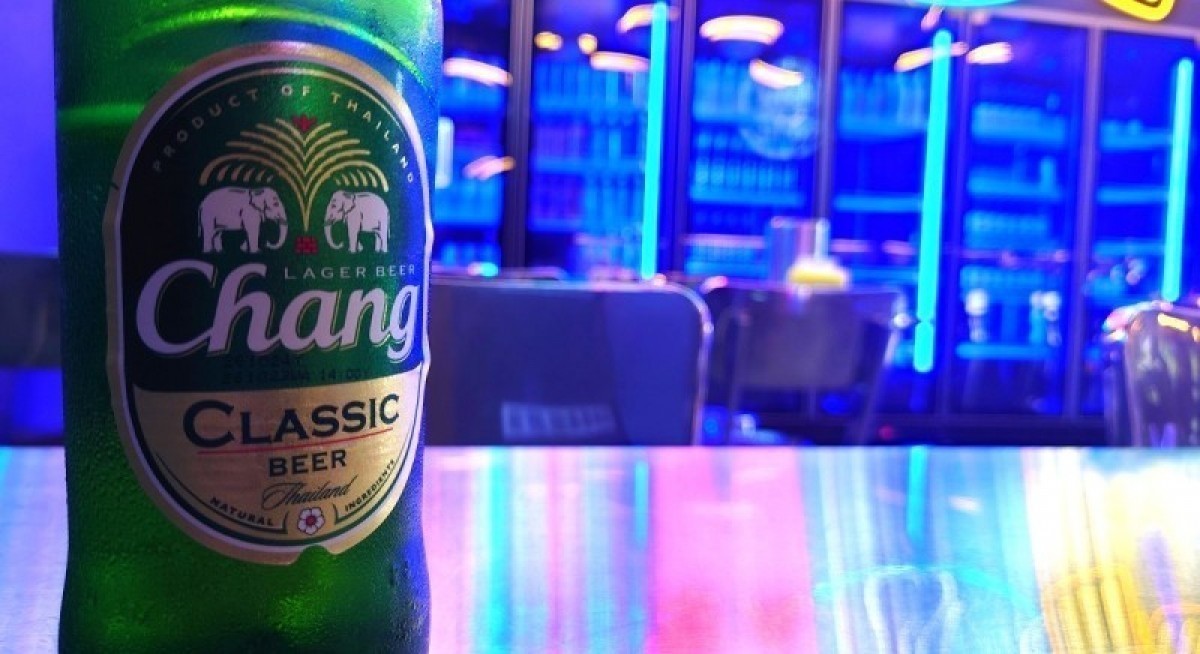


Alfie Yeo of RHB Bank Singapore has maintained his “buy” call on ThaiBev, with a reduced target price of 62 cents from 65 cents, despite lower-than-expected FY2025 earnings. “We stay positive on ThaiBev due to its strong market leadership position in Thailand and Vietnam. ThaiBev offers long-term growth exposure and is a consumption recovery play that rides on Thailand and Vietnam’s positive 2026 GDP growth,” says Yeo in his Nov 27 note.
Yeo sees the stock priced at an attractive 10 times FY2026 P/E, or around 1.5 standard deviations below the historical mean of 16 times, with a dividend yield of 5%–6%.
Yeo notes that ThaiBev’s business was affected by weak consumption. “However, we see FY2026’s consumption strengthening ahead of Thailand’s general elections,” he says, as he raised his FY2026 and FY2027 revenue and gross margin projections, due to a faster-growing economy and also better raw material prices.
However, Yeo has also factored in more conservative operating margins and higher net interest costs at the current effective interest rates, thereby leading him to trim his FY2026 earnings by 7% and FY2027’s by 3%. A potential catalyst for the stock is the revival of the spin-off listing of the beer business, says Yeo.
See also: Sats’ rally to above pre-war levels prompts divergent views
Similar to Yeo, OCBC Investment Research has kept its “buy” call, but it does not seem overly upbeat about the company’s growth prospects. “Going into FY2026, we expect subdued consumption to continue weighing on ThaiBev’s topline growth.”
OCBC, in its Nov 28 note, warns that margin pressure is also likely to persist. “That said, raw material input costs, including molasses, resin, malt and sugar, are expected to be favourable in FY2026, which could help partially offset the negative impact from softer margin and revenue growth,” adds OCBC. To reflect weaker volumes and higher costs, OCBC has cut its fair value estimate from 60 cents to 55 cents.
Paul Chew of PhillipCapital, too, has trimmed his target price from 56 cents to 53 cents, as he projects lower revenue, although he is hopeful earnings will grow in FY2026 thanks to cost controls.
See also: SGX enjoys higher target prices again with volume surge
Meghana Kande and Lim Siew Khee of CGS International sound more upbeat. In their Nov 27 note, they have slightly raised their target price from 56 cents. However, the new target price of 58 cents remains below that of peers who were more optimistic, such as DBS.
For Kande and Lim, ThaiBev’s FY2025 patmi was in line at 96% of their estimates but behind at 89% of Bloomberg consensus forecasts. Revenue, at THB333 billion, was in line despite the weakness seen in 2HFY2025 ended Sept 30.
They observe that despite softer consumer demand in the home market of Thailand, ThaiBev’s beer and non-alcoholic beverages saw a “strong” 50 basis points (bps) to 170 bps y-o-y rise in 2HFY2025 ebitda margins.
Kande and Lim’s optimism towards this stock stems partly from the expectation that ebitda margins can be further improved by 50 basis points (bps) in FY2026. The company is seeing about 20%–40% y-o-y lower costs for agricultural inputs, including molasses, malt, rice and sugar, which Kande and Lim think should lift gross margins by 60 bps in FY2026. “We expect this to be slightly offset by an elevated level of promotions, likely to normalise after FY2026.”
Also, Kande and Lim expect spirits volumes to stay muted in the current FY2026, but ongoing portfolio premiumisation could drive higher average selling prices. As for beer, new markets such as Myanmar and Cambodia could cushion challenges in legacy markets. For one, Myanmar’s revenue, which contributed 6% to the beer segment, rose 50% y-o-y in FY2025, even amid the baht’s appreciation, thanks to market share gains.
In early FY2026, the company’s brewery in Cambodia will be ready for production, thereby better supporting beer volumes. Last but not least, a likely ramp-up of new dairy facilities in Malaysia and Cambodia will help drive growth in the non-alcoholic beverage segment over FY2026 to FY2028, amid competitive pressures in Thailand.
Based on favourable valuation and margin improvement over FY2025–FY2028, Kande and Lim have maintained their “add” call. They are also rolling forward their sum-of-the-parts-based target price to 58 cents from 56 cents, based on an implied forward P/E of 12 times. “While 1QFY26F results could be soft due to adverse weather in Vietnam and Thailand, we view any near-term share price weakness as a buying opportunity,” the analysts add.
For more stories about where money flows, click here for Capital Section
For them, re-rating catalysts would include stronger-than-expected volume growth and a potential spin-off IPO of the beer business. On the other hand, downside risks include macroeconomic weakness impacting sales volumes and higher costs leading to lower margins.
Chee Zheng Feng of DBS Group Research has slightly trimmed his target price from 63 cents to 62 cents, which is pegged to 14 times earnings. “We are cautiously optimistic of a strong earnings recovery supported by low base effect and significant input cost declines across the board,” he says.
ThaiBev has not given any visibility on the IPO of its beer business, which has been on and off again for years. “We believe the performance of the beer segment will be critical to the realisation of the Beer Co IPO. With disappointing performance in Vietnam and potential slower beer consumption due to ongoing macroeconomic headwinds, we believe Beer Co IPO will likely be delayed but not derailed,” says Chee.




