


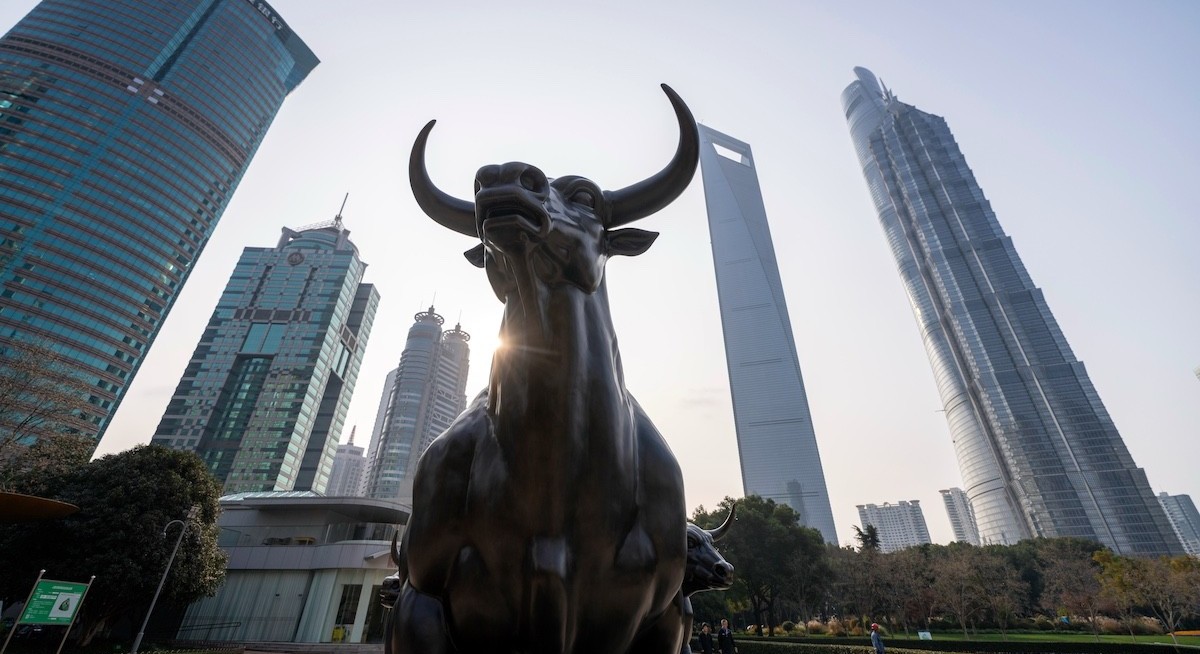


That helps explain why authorities leaned on a state-backed “national team” to influence trading during January’s strong rally, which stirred fears of speculative excess. It’s a reminder of how closely share prices are intertwined with China’s broader economic and political objectives.
Why does the government want to control China’s stock market?
Beijing sees a stable, steadily rising stock market as essential to China’s economic transition. A so-called “slow bull” market, long desired by regulators, would advance several state goals at once. It would provide returns for local governments, which are major stakeholders in listed companies; provide funding for tech companies without overburdening banks; boost consumer confidence; and create a wealth effect as the property market plummets and investors look for alternative assets. In short, equities are an important piece of the puzzle if China wants to rewire growth towards new economic drivers.
In order for this strategy to work, however, China must prevent the boom-bust cycles that have plagued its stock market. The epic crashes of 2007 and 2015 have since deterred many retail investors from the market. Their contribution and behaviour are important; with 240 million retail traders in China, they make up around 60% of daily trading. Goldman Sachs estimates that as of mid-2025, around 11% of household wealth lies in equities and mutual funds.
See also: Korean stocks tumble 10% as extreme volatility rattles investors
Beijing also wants to entice institutional investors — such as pension funds and insurers — and their long-term capital into the market. For these reasons, authorities are willing to cushion losses during periods of market panic and temper excess during rallies, using their so-called national team to intervene.
What is China’s national team?
The term refers to state-linked institutions that authorities can mobilise to buy or sell stocks during times of market volatility. It’s widely referenced by state media and institutional investors, even though it rarely appears in official Communist Party language.
See also: Tech sell-off drags Asian stocks lower from record, oil down
Goldman Sachs estimates the national team owned about RMB6 trillion ($1.09 trillion) worth of Chinese stocks — roughly 6% of the onshore equity market’s total capitalisation — as of the end of September 2025.
Since 2023, most intervention has been led by Central Huijin Investment, a unit of China’s sovereign wealth fund, which is ultimately backed by the Ministry of Finance. Huijin has become one of the largest holders of domestic exchange-traded funds; Bloomberg Intelligence estimates it had amassed about US$180 billion ($228 billion) worth of ETFs as of the end of August. Active since 2008, it has pledged to act decisively to smooth out “abnormal fluctuations” in the stock market.
Other state entities, including China Reform Holdings Corp and China Chengtong Holdings Group, both overseen by the State-owned Assets Supervision and Administration Commission — a Chinese government body that manages the state’s biggest companies — are also tasked with deploying state resources, though their direct ETF activity appears to be limited.
There’s no official list of national team entities, but other institutions commonly cited include:
- China Securities Finance: Founded in 2011 to provide funding for brokerages’ margin-trading businesses. It played a central role in the 2015 market rescue.
- State Administration of Foreign Exchange: China’s foreign-exchange regulator, which can channel capital into domestic assets through state-controlled accounts. Three of its investment platforms were involved in stabilising the market in 2015, but they have since exited the market.
- The National Social Security Fund: The country’s public pension fund, which invests in equities as part of its long-term mandate and can increase allocations in periods of volatility.
- National Integrated Circuit Industry Investment Fund: A state-backed industrial fund that can sell holdings after early-stage investments to recycle capital and stabilise the market.
- State-backed brokerages, insurance firms and mutual funds: They may align the timing of their trades with regulatory guidance. They are considered part of the national team in a broader sense.
How do they intervene?
Intervention typically comes in bursts lasting for days or weeks, often coinciding with market panic or sensitive political moments. Recent examples include the market meltdown in early 2024 as a result of economic malaise and US tariff-related turbulence in April 2025. In January, the national team worked to rein in exuberance in the market — a reality check for investors that it actively trades both ways.
For more stories about where money flows, click here for Capital Section
The approach is straightforward: they trade ETFs in the cash market. Targets include funds tracking the blue-chip CSI 300 Index, the tech-dominant ChiNext Index, small-cap gauges such as the CSI 500 and CSI 1000, as well as sector-specific products.
Activity is obvious through unusually large turnover and synchronised money flows across multiple ETFs. While precise figures are only made public every quarter, Bloomberg Intelligence estimates the national team sold at least US$123 billion worth of ETFs in January 2026 to cool the heated market.
Sometimes disclosure itself acts as a powerful tool to change the trajectory of the market. Huijin is typically discreet, so when it does publicly confirm its trading activity — or signals that there’s more to come — it can discourage speculative moves.
Does intervention work?
It depends on the time frame. Huijin’s ETF trades often have an immediate impact on the day, quickly reversing losses or capping gains. But those effects are usually short-lived, sometimes fading within minutes. It often takes days or weeks of activity by the national team to create a sustained change in the market, and it rarely happens with intervention alone.
If the objective is to simply curb volatility, then intervention can be effective. In early 2026, for example, swings in the Shanghai Composite narrowed sharply after state buying began, with short-term volatility dropping to near-record lows.
For long-term impact, however, policy — not trading — dictates the trajectory of the market. Although the national team bought equities multiple times in 2023 and 2024, it was Beijing’s broader policy pivot toward supporting growth and elevating the role of the stock market that ultimately put an end to the slump.
That doesn’t make intervention meaningless. Rather, it works most effectively as part of a broader policy strategy, reinforcing official intent and buying time until policy shifts take effect.
Do other countries prop up their stock markets?
Yes. Japan’s central bank spent JPY2.4 trillion ($19.5 billion) on bank stocks to stabilise the financial system in 2002–2004 and again in 2009–2010, according to the Asian Development Bank Institute. More recently, it purchased ETFs as part of its stimulus program. In 1998, Hong Kong’s government bought billions of dollars’ worth of equities to stem a market rout. Taiwan and South Korea have also deployed state funds to support stocks.
What sets China apart is scale. China reportedly had access to as much as RMB3 trillion of borrowed funds in 2015 to avert a meltdown at the time. In April 2025, the government suggested that it could tap into unlimited liquidity from the People’s Bank of China and other sources of funding. As equities take on a larger role in household balance sheets — and in the tech rivalry against the US — the influence of the national team is expected to grow rather than fade. — John Liu, April Ma, Jack Wang / Bloomberg Quicktake




