


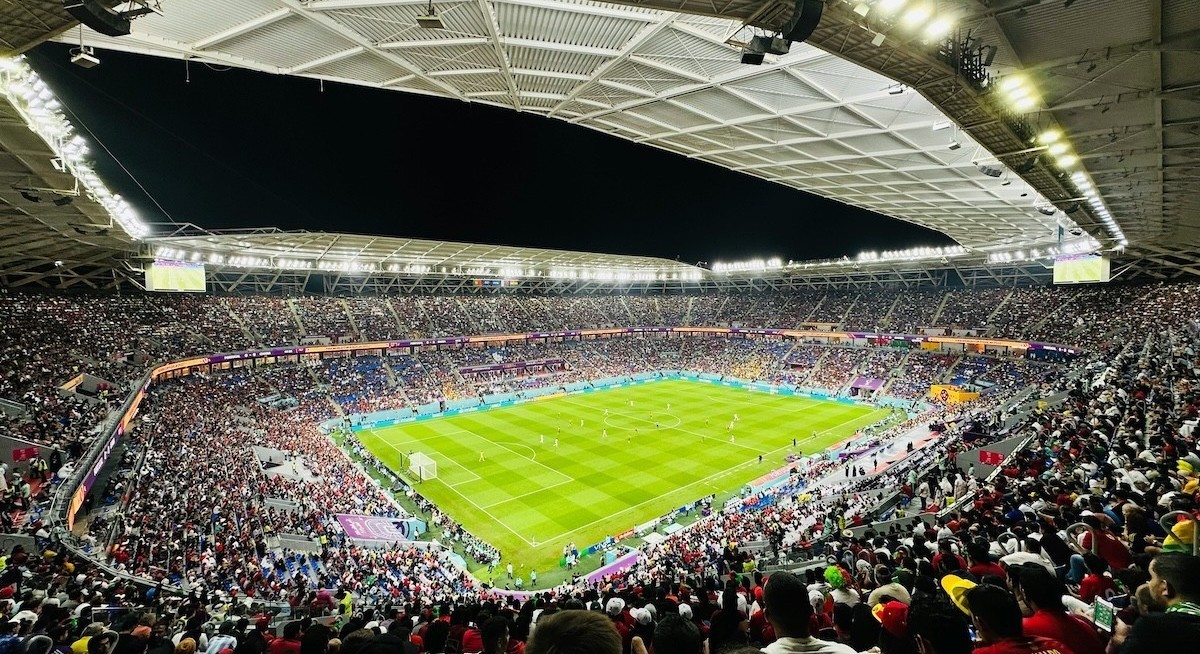


It has not been without controversy. A Somali referee was refused entry and the Iranian team was hurried back to its Mexican base after drawing its first match on American soil. But the focus has been overwhelmingly on the football, most of which, contrary to the direst predictions, has been thrilling. The stadiums have been full and the atmosphere at most games has been electric.
Dubbed “entertainment machines”, many venues are architectural and technological wonders. With their Jumbotron screens and Oculus roofs, they provide an atmosphere waiting to happen. And the evidence so far is that these engineering marvels are not just for Instagram; they actually inspire fans who then inspire the teams. It’s a knock-on effect that the sceptics — and perhaps even the engineers — may have underestimated.
Other essential ingredients for tournament success have also been in abundance. The hosts — all three of them — have started well, with the vibrant US team the first to be confirmed to reach the knockout stage. This has not only got the crowds behind them, but their nations, with both Mexico and Canada, also enjoying positive openings.
The stars — and finally Ronaldo — have shone, with Lionel Messi surpassing himself with an historic hat-trick in his first game. So much for him being reduced to cameo roles. There were also opening game doubles for Kylian Mbappé of France, Harry Kane of England and Norway’s Erling Haaland.
See also: Texas investigating StubHub by over cancellation of Fifa World Cup tickets
Shocks are another crucial component, and we’ve had those, too. Congo, wracked by the Ebola virus, returned after 52 years to hold highly fancied Portugal. Cape Verde held both Spain and Uruguay. Iran drew with New Zealand and Belgium, and could progress, with all that that may entail. Against all odds, it has so far been the tournament of the underdog.
Even though Curaçao got a hammering by Germany, they managed to score. It was a goal that had the whole country in delirium and their Dutch coach in tears. Amid the showbiz superstars and corporate glitz, there have been heartwarming stories. And two tiny archipelagos had goalkeeper heroes. Cape Verde’s Vozinha is 40 years old, and Curaçao’s Eloy Room made a World Cup record 15 saves to hold Ecuador to a draw. He spent last year without a club and trained on his own.
Importantly, it has seen nations from Africa and Asia look more like contenders than pretenders. Morocco held five-time winners Brazil, and are out to show their semi-final appearance in Qatar was no fluke. Japan, many people’s dark horses, became the first Asian country to score four goals in the World Cup with a win over Tunisia.
See also: Football’s Asian Century is still on hold
Another surprise is that almost all the matches have been played in full stadiums. Following the furore over extortionate ticket prices, it was feared that there would be swathes of empty seats. A “Middle East client” is said to have paid US$4 million ($5.18 million) for six final tickets, but thousands of “average fans”, having travelled and become caught up in the atmosphere, have admitted to paying well over the odds for seats.
Norwegian Morten Oftedal owned up to spending an “insane” US$4,000 to fly himself and his 82-year-old father to watch his country play one match in Boston, explaining it was a “once-in-a-lifetime” occasion. Mexican Aaron Vieyra paid a similar amount, which he called “three months’ rent”, to see his country play. Thousands have not even attended any games, saying the tournament buzz makes their excursions worthwhile.
The costs are prohibitive. It’s US$16 for a beer inside the New Jersey stadium, which will host the final and US$5 for a bottle of water (590ml). A train ticket from New York City’s Penn Station for a World Cup match costs US$98. Normally, it is just US$12.90. In short, the World Cup is a rip-off, but fans are prepared to pay, regardless of the consequences when they get home. “Once in a lifetime” is an irresistible sales pitch.
All this begs the question of whether this grossly inflated tournament, with its sky-high prices and spaceship stadiums, will come back to earth in four years. Or has the “people’s game” officially entered a new phase, where everything is prefixed by “mega”, “corporate” and “geopolitical”? It already appears to have been hijacked by a different sort of people.
The worry is that North America, predominantly the US, may be the only place with the infrastructure capable of handling an event of this magnitude. That the 2030 World Cup is to be staged on three continents, may initially confirm fans’ worst fears, although the reality is not quite so grandiose.
The tournament will start in South America, where Uruguay will commemorate the centenary of the inaugural World Cup in 1930. To give CONMEBOL, the South American Confederation, more face, two more games will be played in Paraguay and Argentina. Then the main show gets underway in Spain, Portugal and Morocco, which are close but straddle two more Confederations, Europe and Africa.
This conveniently meant that it was Asia’s turn next and, amid allegations of a stitch-up, Saudi Arabia, the only candidate with a bid prepared, was granted the 2034 version by a show of hands. So, for 2030, there will be six countries in all. And there is already a dispute about which one gets to stage the final.
Sink your teeth into in-depth insights from our contributors, and dive into financial and economic trends
Spain wants it to be in Real Madrid’s recently refurbished, 83,000-capacity Bernabeu Stadium. But Morocco, which has bid to be the sole host five times since 1994, demands that it be held in its still under-construction stadium in Casablanca. At 115,000, the Grand Stade Hassan II will be half as big again as the Bernabeu, which should appeal to Fifa’s money men.
But even though the fixture load will again be shared, there are doubts about the hosts’ ability to stage an event that has now moved from mega to giga. There will be no appetite to reduce it to 32 teams when Fifa tots up its estimated US$9 billion loot from the current, unashamed heist. Nor will the corporate world, when it considers the US$80 billion total global sales it is expected to engender, based on an Open Economics study.
They have found the formula and know the fans’ weakness. But will the 2030 hosts have stadiums and other infrastructure to match the US? Based on the gross domestic product of the main trio, they will not come near. And will even Saudi Arabia, which has recently slashed its spending on sport, be able to handle it alone?
The 2026 World Cup may defy the doomsayers, but it doesn’t mean that it hasn’t become a monster. Football should be more careful about how it is being fed.
Bob Holmes is a long-time sportswriter specialising in football




