


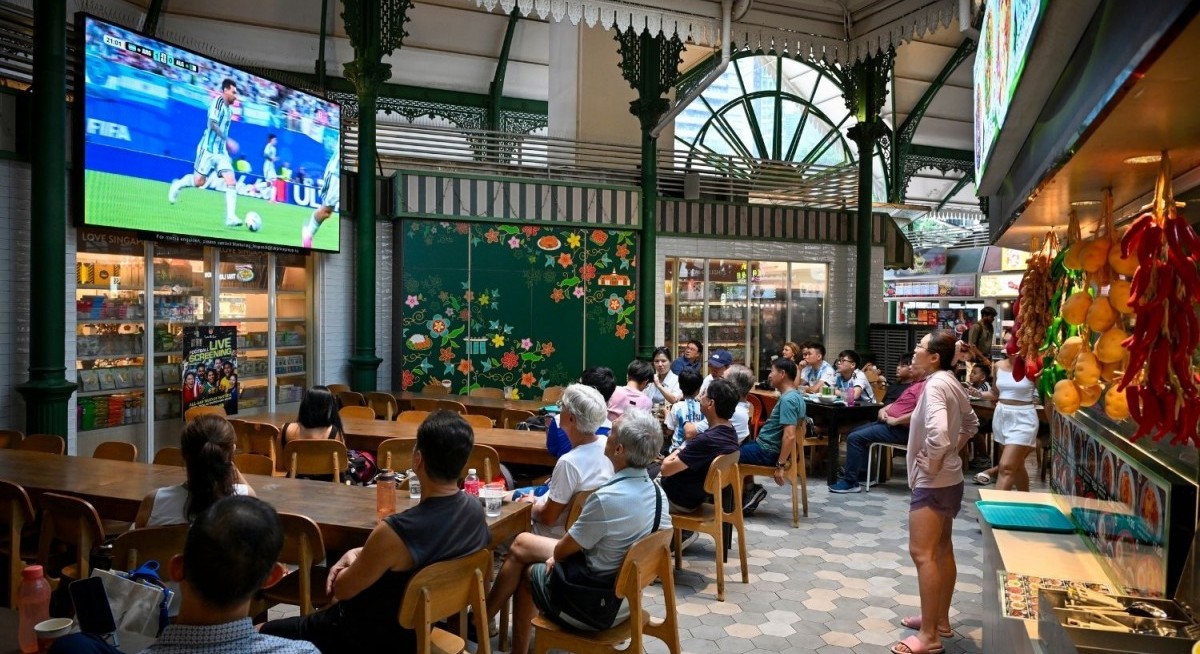


“This has implications for revenue mix, visibility and the ability to measure engagement across channels. Football offers a particularly clear lens through which to observe this transition,” they add.
Drawing on historical patterns, various analysts here have taken a stab at predicting the potential beneficiaries from this quadrennial spectacle and suggesting the tactical moves investors in the Singapore market should make.
In its June 4 report, DBS Group Research counsels waiting for the June lull to pass as the tournament saps trading activity here, creating an opening to buy cheaply before a July rebound. Maybank Securities, on the other hand, argues in its June 9 report that the Straits Times Index (STI) tends to beat global markets during World Cup years, so the time to act is now.
The two calls mainly differ in terms of the time windows they are looking at. DBS is focusing on the tournament month when trading thins, while Maybank is looking at the full calendar year.
See also: We are not at the peak of the AI cycle: Eastspring
DBS: Buy the lull
DBS analysts Yeo Kee Yan and Foo Fang Boon foresee a “quiet June due to the Fifa World Cup distraction”, compounded by the US summer holidays and the school break in Singapore. The pair say the lull is “a tactical opportunity to accumulate ahead of a July rebound”, driven by returning market participation, seasonal tailwinds and a possible reopening of the Strait of Hormuz.
Across the previous five tournaments held from 2002 to 2018 that fell in the June-July window, the value of shares traded on the Singapore Exchange dropped every time by between 5% and 48% from the month before. The STI also ended lower over the tournament in three of those years. But the two weakest, 2002 and 2018, came amid the dotcom hangover and the US-China trade war respectively, forces far larger than football.
See also: Valuing companies using discounted assets
For DBS, the lull is not so much a warning but an entry point: accumulate while volumes are thin, then position for July, when ex-dividend dates and second-half catalysts should lift the market.
Yeo and Foo, who are keeping their year-end STI target of 5,250, have named nine stocks that fall into three buckets.
Firstly, for dividends and resilience, they prefer Oversea-Chinese Banking Corp (target price: $25.50), which they see as a safe haven in an inflationary but non-recessionary backdrop; Singapore Telecommunications ($5.46), on a potential Indian tariff hike as a second-half catalyst; Venture Corp ($21.80) as a balanced growth-and-yield play with building artificial intelligence (AI) momentum; and Sembcorp Industries ($7.30) as beneficiary of higher gas prices.
Secondly, for value unlocking later in the year, they like City Developments ($12), whose strategic review could surface value across its asset base, and UOL Group ($13), where an update on the Marina Square redevelopment is expected.
Thirdly, for the S-REITs, which DBS says much of the sector’s de-rating is already priced in, they prefer CapitaLand Integrated Commercial Trust ($2.80) for its resilient Singapore portfolio, CapitaLand Ascendas REIT ($3.20) as a beneficiary of AI and cloud demand, and Mapletree Logistics Trust ($1.55), which trades at around book value with a yield above 6%.
Maybank: Look at the year, not the month
While DBS sees the World Cup as a drag, Maybank sees it as a stimulus instead. Thilan Wickramasinghe, head of research at Maybank Securities, expects “a broad, but uneven, consumption lift” across travel, hospitality, F&B, media, e-commerce, healthcare and beverages.
For more stories about where money flows, click here for Capital Section
Wickramasinghe’s case rests on looking at the whole year rather than the tournament month alone. Over the past six World Cup years from 2002 to 2022, the STI returned an average of 3%, against a drop of 1.9% for the S&P 500 and down 3.4% for the MSCI World Index, finishing positive four of the six. The effect is strongest, he notes, when a European team wins: STI returns averaged 9% in those years, against –8% when a South American side took the trophy. Maybank’s own AI model and prediction markets such as Kalshi currently favour a European winner, with Spain and France being the front-runners. Among sub-sectors, REITs and financials have historically led the index during these years, according to Maybank’s report.

Rather than timing the market, the 10 “Stock Champions” identified by Maybank are built around the spending the tournament generates. Maybank picks DBS Group Holdings ($65.31), the same lender whose own research desk is preaching the June lull, as a credit-card play, with cards generating 5.3% of its FY2025 income. Maybank has a hold recommendation for United Overseas Bank ($38.86), which has even greater leverage to the theme, with its credit-card business generating 8.6% of its FY2025 income.
Thai Beverage (48 cents) anchors the consumption case. Its beer volume rose 14% y-o-y in the quarter covering the 2022 World Cup, and management views a similar catalyst for 2026. Singapore Airlines ($6.70, hold) should see firmer long-haul and premium demand, while Sea’s ecommerce unit, Shopee, which operates in Brazil as well, could enjoy higher sales volumes through electronics, apparel and merchandise. Maybank’s target price for Sea is US$127. Singtel ($5) and Raffles Medical Group ($1.20) round out the names — the former on broadband and TV subscriptions, the latter on the expectation that late-night parties will send some fans to the doctor. Other names flagged by Maybank include StarHub ($1), Acrophyte Hospitality Trust, which operates a chain of hotels in the US, and City Developments.
OCBC: Scoring from various angles
OCBC Investment Research analyst Andy Wong says in his June 11 report that there will be four groups of beneficiaries from the World Cup regardless of who lifts the trophy. They span travel and hospitality; consumption plays from sportswear to F&B, media, broadcasting and advertising; and payment enablers.
Citing Tourism Economics, Wong notes projections of 1.24 million international visitors to the US during the tournament, of whom some 742,000 would not otherwise have gone, plus roughly US$900 million in incremental hotel revenue, the equivalent of about 10 Super Bowls squeezed into six weeks. Even the mandatory water breaks earn a mention as extra advertising inventory for broadcaster Fox. Wong’s preferred picks are accordingly global: Airbnb, Wyndham Hotels & Resorts, Booking Holdings, Nike, PepsiCo, McDonald’s, Alphabet, Meta Platforms and Mastercard.
Most of OCBC’s preferred names are US-listed, though there are some Singapore-listed counters as well. They include: Sats ($4.20), a ground-handling and in-flight catering operator exposed to inbound US travel, and CapitaLand Ascott Trust (95 cents) on the strength of its US hotels. It is more cautious on Singapore Airlines ($6.65) and flags ThaiBev (55 cents).
Notably, all three houses have different key views on why they are positive on Singtel. DBS sees further gains to be enjoyed by Singtel’s associate in India; Maybank expects subscription growth, and OCBC eyes advertising and broadcasting demand, with the trio landing at target prices of $5.46, $5 and $5.75 respectively. OCBC, the most bullish of the three, notes that Singtel is selling a one-time package to stream all 104 matches for $118.
OCBC is not alone in casting its net abroad. Billy Toh of CGS International has reached a similar conclusion that the surest World Cup money is in the “picks and shovels” — the payments networks, advertising platforms and booking sites that take a cut of every ticket, jersey and hotel night.
In his June 15 edition of Trading Lens, Toh’s top names include Visa, Mastercard, Meta Platforms, Alphabet, Booking Holdings and Airbnb — picks that overlap heavily with OCBC’s.
A different ball game in 2026
Investors should treat the historical playbook with caution. The STI is already trading above 5,000, close to the top of its range, leaving less obvious room for a seasonal pop.
DBS’s year-end 5,250 target rests on the assumption that the Strait of Hormuz reopens by end-June and Brent crude settles back towards US$85 to US$90 a barrel. This baseline has grown more tangible following a June 14 framework agreement announced by US President Donald Trump. A memorandum of understanding was signed on June 15, sending oil prices below US$80 on optimism over the reopening. A formal peace treaty is scheduled for signing on June 19, in Switzerland, allowing the Strait to officially reopen to international shipping. However, should the 60-day truce unravel during technical talks, DBS warns of a fragile recovery as Brent could surge past US$110 and drag the index into a bear case.
The bigger swing factor falls mid-tournament. The US Federal Reserve held its benchmark interest rate at 3.5% to 3.75% for a fourth consecutive time during Kevin Warsh’s debut meeting as chairman on June 16–17, but signalled a hawkish turn. The central bank dropped its easing bias from the policy statement, with nine of 18 officials now projecting at least one hike by year-end and six predicting two increases. The reversal from March’s implied rate cut caused US stocks to fall and the Treasury yields to climb, bearing out the “buy banks, sell REITs” setup that DBS flags. Banks earn more net interest income in a higher-for-longer regime, while rate-sensitive REITs face valuation pressure. That is partly why DBS’s lone bank pick and its three REIT picks pull in different directions.
For all their disagreements on names and timing, the World Cup has given every house a reason to position around it. For DBS, the message is simple: Use June’s lull to build, then wait for July. DBS analysts Yeo and Foo see the chance to “gradually accumulate positions ahead of a potential pick-up in market activity following the tournament”.




