




Demand for smaller vessels, including tugs, barges and offshore support vessels, has proved more resilient. Usage of these vessels hinges less on global trade cycles and more on port activity, marine construction, energy services and infrastructure spending, all of which are holding up well.
Asia’s ship repair business also stands out. Driven by ageing fleets, high utilisation and tighter environmental rules, demand for repair and vessel conversion services has held firm, keeping yards busy despite capacity and cost pressures.
Together, vessel chartering and ship repair and conversion tell a story of an industry no longer chasing excess returns but settling into a more resilient, cash-focused and structurally healthier footing than before the pandemic.
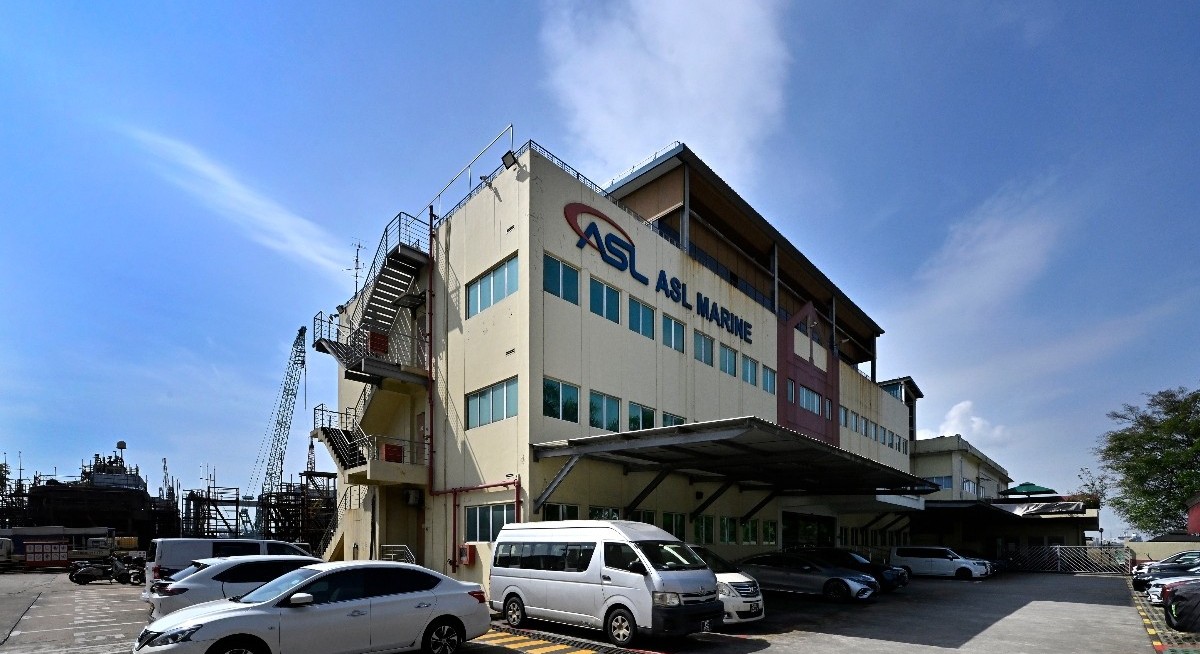
For Singapore-listed ASL Marine (SGX:A04 ) , this shift in industry dynamics could hardly have come at a better time. The company builds tugs, barges and workboats for sale worldwide. It also provides ship repair and conversion services, and charters out its own vessels to marine contractors. It has a shipyard in Singapore and another in Batam, Indonesia.
See also: GuocoLand secures $634.7 mil green financing from OCBC, ICBC to develop Lentor Central site
After years of financial strain, ASL has emerged with clearer earnings momentum and an improved balance sheet. Revenue for the financial year ended June 30, 2025 (FY2025) came in at $350 million, the highest since FY2016. Ship repair and conversion accounted for 49% of its FY2025 revenue, while chartering contributed 27% and shipbuilding 24%.
ASL has been profitable for three consecutive years now, a decisive break from the six straight years of losses before that. Earnings for FY2025 rose to $14.6 million from $3.9 million the year before, as operating leverage kicked in and finance costs eased. For FY2023, it reported earnings of $3.5 million. It even declared a dividend, paid out from its FY2025 profit, for the first time in years.
Broker initiations over the past year have framed ASL’s recovery as more than a cyclical bounce.
See also: A rojak isn’t great just because you’ve thrown the pieces together
Lim & Tan Securities, in its initiation report dated Oct 14, pointed to stronger yard utilisation, a healthier mix of shorter-cycle projects, and growing contributions from ship repair as key drivers underpinning the rebound. It raised its initial target price of 30 cents to 33 cents in December after increasing its profit forecasts for the next two years to account for ASL’s better-than-expected financial performance for the first quarter ended Sept 30, 2025.
UOB Kay Hian, which initiated coverage in November with a buy call, highlighted the group’s improved earnings visibility and the structural repair of its balance sheet following a series of refinancing exercises. It also upgraded its target price recently, from 33 cents to 35 cents.
Deleveraging
That balance-sheet repair has been central to ASL’s revival. In the years leading up to the collapse of oil prices in 2014, the group invested aggressively in offshore and specialised vessel projects that were capital-intensive and exposed to sharp swings in oil prices and customer sentiment.
The oil market downturn rippled through the offshore and marine sector from 2015, as project cancellations and deep spending cuts by oil majors left the industry depressed for years. Just as conditions began to stabilise, the Covid pandemic delivered another blow, disrupting execution and cash flows.
In that environment, leverage became a huge problem for ASL, which found itself dealing with not just the three Singapore banks but also more than 100 retail and institutional investors of its bonds issued in prior years. The company responded by embarking on a drawn-out restructuring, convincing the banks and bondholders to give it more time to pay them back in full.
“We started selling some vessels in 2024. Every time we sold a vessel, we would pay back the banks,” Ang Kok Tian, ASL’s chairman and CEO, tells The Edge Singapore. “The money from these sales was so much better than what we would have gotten if we sold them in 2019.”
Sink your teeth into in-depth insights from our contributors, and dive into financial and economic trends
ASL’s net gearing fell to 1.32 times in FY2025 from 2.15 times the year before and as high as 4.18 times in FY2022. As at June 30, 2025, its total debt amounted to $156.4 million, the bulk of which is not due within 12 months. That was down from $210.3 million a year earlier.
Finance costs for FY2025 eased to $21.4 million from $26.5 million for the previous year. As legacy high-cost borrowings roll off, the company expects interest expenses to fall further. It is aiming to bring net debt down to about half the level of its equity, according to Ang.
While working on further reducing its debts, he has re-anchored ASL around business segments with steadier cash flows, in line with industry trends that favour ship repair and smaller work vessels for their structural resilience. These businesses may not offer huge pricing power, but utilisation and cash conversion matter more, aligning better with a company emerging from financial stress.
Safety: The unfinished chapter
But even as the numbers point to a credible turnaround, ASL’s operational track record invites closer scrutiny. Workplace safety, in particular, has become a growing concern. Between its two shipyards, safety issues have been more pronounced at Batam.
Spanning 46ha, slightly more than half the size of Singapore’s Botanic Gardens, the Batam yard focuses on retrofits, conversions and ship repairs. It has 4km of berthing space and over 300,000 tonnes of dry-docking capacity. As at end-FY2025, the facility had 636 workers, nearly three-quarters of whom were contract staff, with the rest on permanent payrolls.
A tanker undergoing repairs at the Batam yard caught fire on June 24, 2025, killing four workers and injuring another five. Less than four months later, the same vessel was again struck by fire at the yard. The incident on Oct 15 claimed 13 lives and injured 18 others.
The first publicly disclosed safety incident at the Batam facility was in 2017, according to ASL’s regulatory filings. Five subcontractor workers died and another was injured after a fire broke out on Sept 7 that year on board a vessel undergoing repairs. By the end of that financial year, FY2018, ASL had five fatalities and 16 injury cases.
Over the last six years, with the exception of FY2024, ASL has reported at least one fatality every year. Workplace-related deaths totalled six in FY2025. There were 16 injury cases that year. The statistics for FY2026, which ends on June 30 this year, will be worse because of the Oct 15 incident.
In terms of injuries over the past six years, FY2023 had the highest tally at 36. In each of the other five years, annual workplace injuries were also in double digits. ASL’s sustainability reports do not break down the number of deaths and injuries by geography.
How do its peers fare?
Set against ASL’s financial turnaround, the contrast is stark. While leverage has fallen and profitability has strengthened, safety outcomes have yet to show the same degree of sustained improvement. That gap becomes more apparent when stacked up against its peers listed on the Singapore Exchange.
Within the mandatory sustainability reporting framework for Singapore-listed companies, Nam Cheong (SGX:1MZ) , which operates primarily in Malaysia, has recorded no fatalities or lost-time injuries.
Marco Polo Marine (SGX:5LY) , which has a shipyard in Batam, has also reported no workplace-related deaths over the years, although it did encounter a few fire incidents, the locations of which were not disclosed.
Beng Kuang Marine (SGX:BEZ) , which also has operations in Batam, has recorded no workplace fatalities, based on its sustainability disclosures dating back to 2017. Like Marco Polo Marine, it has seen only episodic injury incidents, all far fewer than ASL’s in any given year.
The comparison is not meant to suggest that shipyard work can ever be risk-free. Marine construction and repair are inherently hazardous, particularly in high-utilisation environments. But it shows that companies operating in broadly comparable conditions have avoided the kind of repeated fatal incidents and seemingly higher-than-average injury counts seen at ASL’s Batam facility.
The next test
Workplace safety should never be an afterthought, and it’s not as if ASL is treating it as such. But the company clearly needs to do more. Following the Oct 15 incident, it said it was undertaking a comprehensive review of its safety management procedures.
Findings of police investigations into the cause of the Oct 15 event have yet to be disclosed by the Indonesian authorities, but ASL is putting in place additional measures and safeguards to prevent any repeat occurrences, according to Ang.
“Training is important. Most shipyards employ subcontractors. The turnover of such workers is very high. Sometimes, one guy comes and works for one month and the day after he may be somewhere else. Training then becomes a big issue. You have to tighten the frequency of training.”
The reason for the high staff turnover is the abundance of work in Batam’s shipyards, says Ang. “Batam has more than a hundred shipyards, big and small. All the shipyards in Indonesia are concentrated in Batam.”
ASL has engaged external expatriate consultants to help implement new training programmes for its yard workers, he says, adding that it is also looking at expanding its team of safety personnel from 40 currently to more than 50.
The company has already invested about $1 million in new hardware to improve workplace safety, he lets on. These include gas detectors, cherry pickers, safety monitoring systems, body cameras and fire-fighting equipment.
“It’s very sad. We cannot bring back the people who have died, but it’s certainly very, very important that such things cannot happen again,” says Ang, his emphasis unmistakable.
ASL’s recovery to date is not in doubt. After years of losses and elevated leverage, the company has a cleaner balance sheet, returned to the black and refocused on businesses that are more resilient. Broker initiations over the past year reflect growing confidence that the turnaround is anchored in more than a cyclical upswing.
At the same time, its safety record remains an unresolved variable in this recovery story. The persistence of double-digit injury counts and the severity of the recent incidents at the Batam yard sit uneasily alongside the narrative of operational discipline and balance-sheet repair.
ASL’s peers have shown that strong safety outcomes and commercial performance are not mutually exclusive. Its next phase should therefore entail not just sustaining its earnings momentum but also ensuring that the uptick in business is matched by equally durable progress on workplace safety.




