


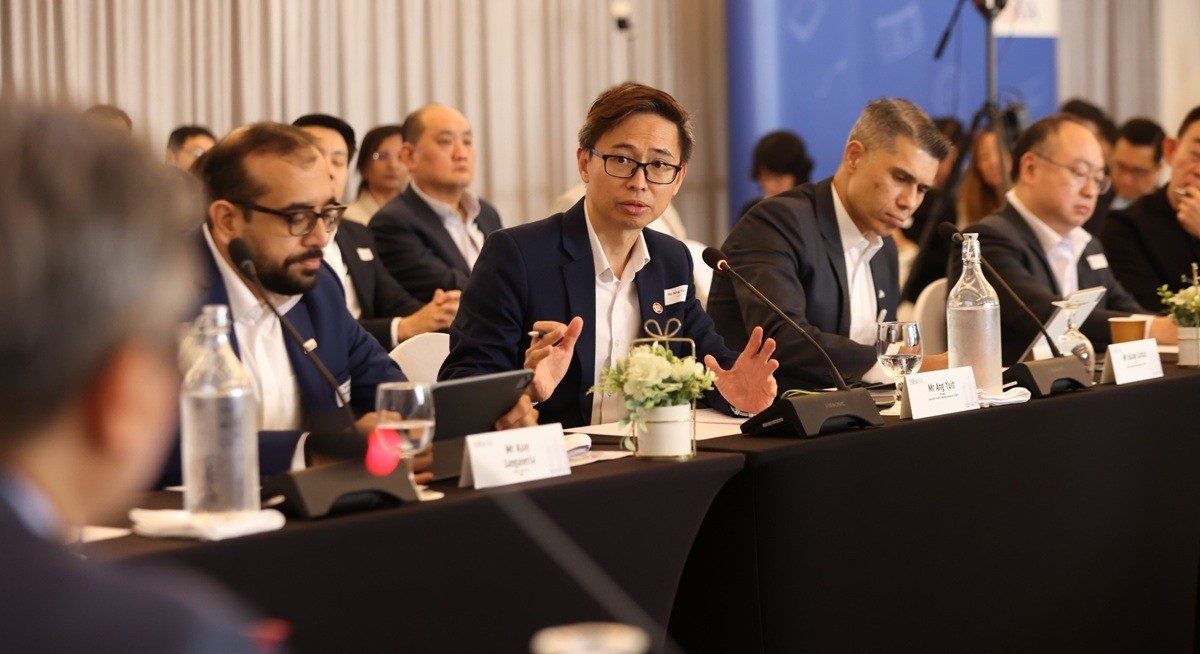


“If you look at a lot of the MNCs from the west who have established a presence here, they have also brought with them their ecosystem and network of suppliers to set up in Singapore,” Tan told The Edge Singapore after the roundtable.
“If I could use an analogy, be the bigger brother, the bigger sister, in terms of their own journey and what has their experience been, and what to be able to share to others, to look out for and be aware of,” adds Tan who believes that the larger local entities, whether public or private sector, could also contribute by sharing knowledge and experiences.
Tan acknowledges that while other countries may not have the equivalent of Singapore’s Economic Development Board (EDB) which facilitates foreign direct investment, it should not stop local businesses from venturing overseas. “It may be a bit harder, but not impossible, because I think a lot of countries are today also trying to attract investments,” says Tan. “So from that standpoint, I think we can certainly be able to push that.”
Echoing a similar view at the roundtable, Ang Yuit, president of the Association of Small and Medium Enterprises (ASME), suggests “signaling” to “much more resource-capable” GLCs to help smaller local businesses grow abroad. “We have to start signaling to all our businesses and economy and country that we have to collaborate,” says Ang. “We as a nation [now], don't collaborate.”
See also: JTC unveils Kampong AI, Singapore’s first integrated start-up community
Ang reiterates that businesses can band together to explore overseas opportunities as it is “not business as usual anymore”. He adds, “If we can incentivise with even higher support, it makes a lot of sense, because we are pooling resources together.”
Speaking to The Edge Singapore after the event, Ang says that for GLCs which are seeking to internationalise or which already have a foothold in overseas markets, they can actively call for SMEs to join them for market expansion. Ang believes ASME can play a role by preparing a network of SMEs who can support GLCs and establishing partnerships.
Besides helping SMEs scale up, Ang thinks that this could have downstream benefits for Singapore workers. “But if you look at it in the context of team Singapore, then you [GLC] help our economy,” he says, adding that SMEs could provide Singapore workers with overseas opportunities should internationalisation succeed.
See also: How Budget 2026 is leading through change in a time of structural shifts
In addition, Ang believes that by encouraging local enterprises to grow, Singapore is also de-risking itself from the whims of foreign capital flows. He explains that larger local enterprises can contribute to a bigger share of the economy and could potentially step in when any MNC decides to pull out of Singapore.
Sharing a trend it has noticed, the Singapore Manufacturing Federation says that SMEs tend to expand overseas into areas already established by large players such as the GLCs. “When they [GLCs] start to have industrial estate and a more secure way of going into a country, then our SMEs will go,” says SMF president Lennon Tan.
Holding an alternative view on “pack-hunting” for overseas expansion, Ernie Koh, council member of the Singapore Chinese Chamber of Commerce and Industry, suggests that businesses should be cautious when venturing overseas. SGListCos’ Tan acknowledges Koh’s concern and points out that not all businesses will succeed. “Some will die together, but I think that's the nature of entrepreneurship,” adds Tan. “You need to be able to take that risk.”
Sustainability matters
On sustainability, Koh believes that the typical SME mindset to ESG needs to be reshaped — from viewing sustainability as a form of compliance to embracing it as an opportunity for their business. “How can we bring it down to say, sustainability may make you money,” shares Koh. “Sustainability, start step by step, is going to bring you strength as a business, bring you income as a business.”
Agreeing with Koh, SG ListCos' Tan believes that businesses are “creative enough” to turn sustainability compliance into commercial viability and competitive advantage.
On another note, the costs of sustainability was brought up by the Singapore Business Federation (SBF), which shares two areas of concern — costs associated with the carbon transition and energy costs.
Sink your teeth into in-depth insights from our contributors, and dive into financial and economic trends
Firstly, SBF chief policy and operating officer Musa Fazal points out the planned increase for the carbon tax to the $50-$80 range is “very wide” and says that businesses hope for more clarity on the final number and for it to be at the lower end.
Musa also shares that SBF simulations have projected energy prices to increase by 10%-12% and this would affect a broad range of companies. He suggests that Singapore “does not need to be top of the class” in carbon taxes, pointing out that the rate of Singapore’s carbon tax increase exceeds any other country in the region. “We really need to think about what are the implications on competitiveness for businesses,” he adds.
Proposing a potential solution, Ajay Sangenaria, head of tax of KPMG in Singapore, suggests making it a progressive tax rate rather than a flat rate for all polluters. “It's all about the polluter pays principle, rather than anybody paying a flat rate,” he says.




