


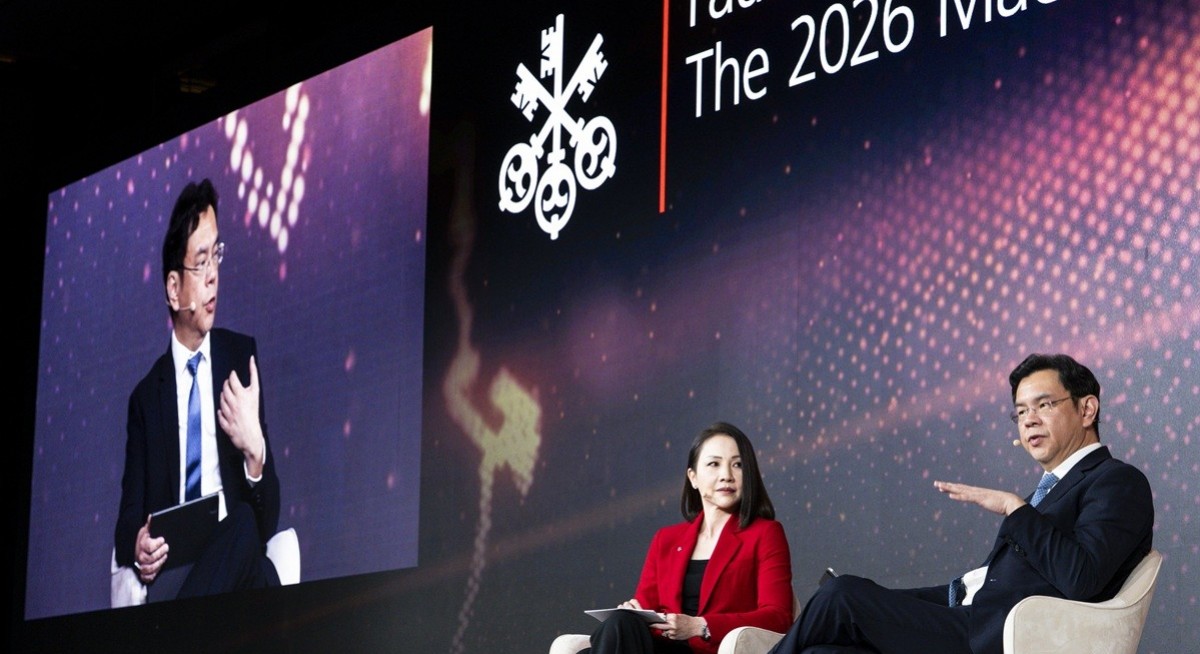


This in turn has established Singapore as a “trusted” base for businesses and investors which they can invest in and leverage as a platform to tap regional opportunities. Furthermore, AI adoption, innovative fintechs, wealth management, banking and insurance services add dynamism to Singapore’s financial centre, says Chia.
On strengthening the core foundations that support the financial centre, Chia includes upskilling the financial sector workforce and AI adoption as key planks. He also highlights that the central bank takes a balanced approach to regulation. “MAS also takes a risk-proportionate regulatory approach that provides protection and transparency to investors but avoids undue regulatory burden on financial institutions,” says Chia.
The way he sees it, collaboration is another area which is essential, stressing that the regulator works closely with industry to shape the ecosystem. “Partnerships between MAS and the industry enable better-targeted risk-proportionate regulation,” he says. “Partnership also enables the co-development of industry standards or good practices that the industry needs and welcomes for new activities and functions.”
Accelerating opening of private banking accounts
See also: Trump insists ‘nothing wrong’ with big crypto gains
Chia also announced a successful outcome of a MAS-industry partnership, sharing that MAS , in collaboration with the Private Banking Industry Group (PBIG), have developed the means to shorten the median time to open a private banking account to within a month, down from the current median duration of six weeks or even longer for complex cases.
“More efficient account opening will improve the competitiveness of the wealth management industry while maintaining high standards,” says Chia.
In 2025, PBIG established a working group, co-led by MAS and industry, to identify ways to make client onboarding more efficient while maintaining sound regulatory standards. This working group identified industry practices that go beyond the requirements of MAS and international standards required, as well as evaluating the re-alignment of these practices with a “risk proportionate” approach.
See also: Hong Kong wealth, fund assets reach record US$5.4 tril on inflows
The outcome was MAS issuing a circular to guide financial institutions to establish a client’s source of wealth in a risk proportionate way and PBIG issuing a set of process enhancement tips that offers practical ways to address common account opening challenges, both of which would potentially accelerate private banking account opening for the wealthy.
Facilitating capital
Faster account opening is just one of the many ways MAS facilitates and supports the capital ecosystem. Chia says that recent measures, such as the equity market development programme and the SGX-Nasdaq dual-listing board are aimed at providing a pipeline of companies into public markets and enable capital recycling.
“With a thriving public market, it will provide the exit needed for a healthy growth capital ecosystem, and also potentially reinvest that capital and recycle that capital,” says Chia. “We see this as a virtuous cycle of the ecosystem that we need to develop, and we are consulting widely on this again to try to find feasible solutions in this area, and we will look to strengthen across all the key segments, from the venture capital to private equity and growth capital and also private credit.”
Global uncertainty, regional potential
Sharing his insights on the global macro economic outlook amid the evolving geopolitical landscape, Chia highlights IMF’s revised growth forecast of 3.1% and other signs of resilience in the global economy.
Yet, he is cautious, pointing out possible uncertainties and risks that could derail growth. These include a prolonged energy shock, the uncertainty surrounding the sustainability of the AI investment boom and uneven growth across society driven by AI.
To stay ahead of Singapore and the region’s corporate and economic trends, click here for Latest Section
“Each country will navigate the current challenges and the uncertainties ahead, and hopefully continue to see that there are advantages to cooperation,” says Chia. “Policy responses matter, and there will be a need for strategies to develop resilience to shocks, strengthen the adaptive capacity of the workforce, cushions for more vulnerable segments, and building more diversified sources and channels of growth with gains shared broadly.”
Regionally, Chia says Asean has been a beneficiary of expanding trade groups despite increasing protectionism from tariffs. “The good news about this is that trade has not collapsed. In fact, global merchandise trade is up,” says Chia in a fireside chat with UBS Singapore country head Young Jin Yee.
“Asean trade with every major region has expanded [and] intra-Asean trade has also been expanding over the past five years, reflecting more economic integration,” explains Chia. “This does not mean that tariffs have not had an effect; it does mean that there is less efficient trade, but comparative advantage is still a major determinant of trade growth and is a major determinant of expanding global trade.”
On foreign direct investment (FDI), Chia also strikes an upbeat tone, pointing out that Asean continues to be a major recipient of FDI, mainly from US, European, and Chinese corporates. He says: “Key sectors growing in investment are manufacturing, semiconductors, electric vehicles, solar, data centres and green energy. So these are indicative of Asean growing in sophistication in global value chains.”
Meanwhile, Young, who is also co-head of UBS global wealth management Asia Pacific, sees opportunities not only in Asean, but more broadly in the Asia Pacific. “As investors prioritise resilience in a world of fast-changing narratives, Asia Pacific remains a key investment destination, particularly for family offices seeking to diversify regional exposure,” says Young.
Young also shares that UBS saw net new asset inflows of US$18.6 billion, with a record number of new clients from APAC. “We are going through a time of profound change, shifting markets, technological advances, and geopolitics,” she remarks.
“It is precisely times like this that clarity, discipline and trusted partnership matters. With three in five billionaires in Asia banking with UBS, we remain focused on being their long-term wealth partner, providing the insight and clarity they need to cut through rising complexity and change.”




