


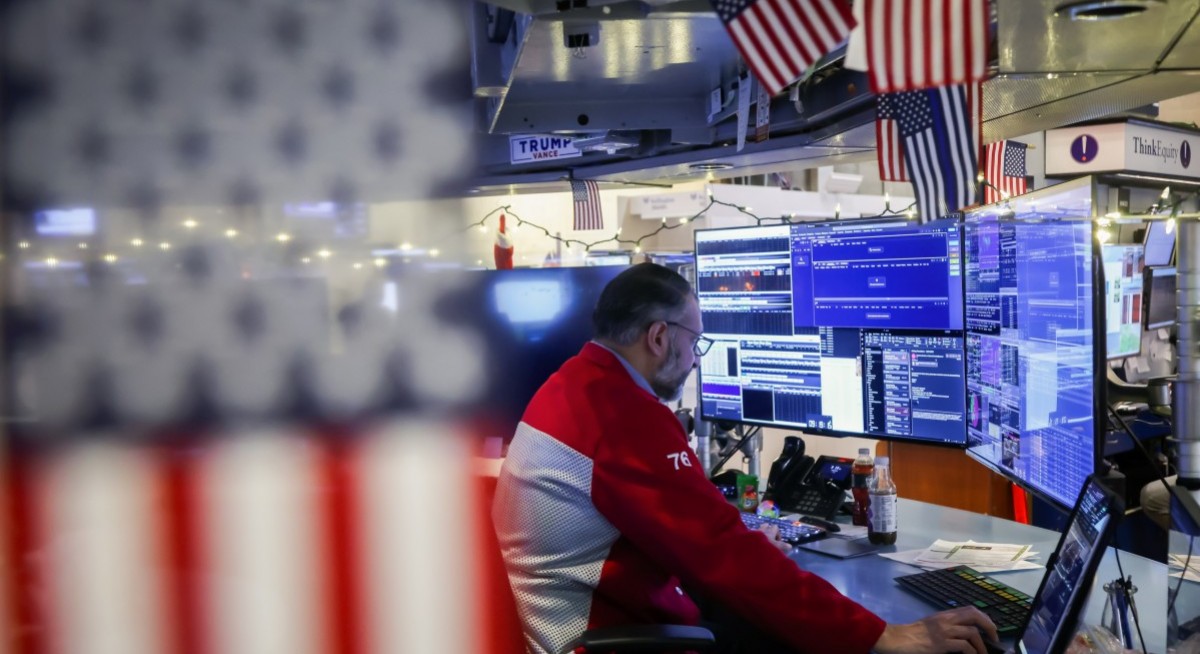


(Jan 30): Wall Street saw a sharp bounce from session lows as dip buyers stepped in following a slide driven by concerns over whether the unprecedented spending on artificial-intelligence will justify all that capital. Big moves in commodities saw gold plunging as oil soared. Bitcoin dipped below US$85,000.
Gains in economically sensitive shares almost wiped out the drop in the S&P 500, which earlier sank as much as 1.5%. Meta Platforms Inc’s solid outlook eased worries about its spending plans. Microsoft Corp tumbled the most since 2020 on concern it could take a while for AI investments to pay off. In late hours, Apple Inc posted solid results, driving gains in late hours.
“This appears to be a classic buying opportunity,” said Louis Navellier at Navellier & Associates. “We’re already seeing a bounce off the bottom in all the major indices. Volatility is clearly higher, but the trend is nevertheless still positive.”
Wall Street is gearing up for a borrowing bonanza to bankroll AI projects that could push February corporate bond sales to a record, despite complacency warnings. International Business Machines Corp sold dollar and euro bonds, kicking off what’s expected to be a flood of borrowing from the tech sector in 2026.
The “Magnificent Seven” tech giants have led the stock market higher for much of the past three years. But that reversed at the end of 2025 as Wall Street grew sceptical of the hundreds of billions of dollars the companies are spending to develop AI and when the returns on those investments will materialise.
“The one-way bet on AI leadership is now starting to look overcrowded,” said Fawad Razaqzada at Forex.com. “There is now some fear creeping into investors’ minds that the AI theme may not be as immediately lucrative as hoped.”
See also: Lockheed shares hit new high on missile deal, upbeat outlook
Still, all is not lost, he noted. The fact that the Nasdaq is easing back from elevated levels is a clear sign “it is far too early to talk about the peak in tech,” Razaqzada said.
The day after the Federal Reserve decided to stand pat saw an uneventful batch of economic data. President Donald Trump said he would announce his nominee to chair the Fed “next week,” and reiterated his expectation that the central bank’s new leader will lower interest rates.
The S&P 500 fell 0.1%. The Nasdaq 100 slipped 0.5%. The Russell 2000 was little changed. The yield on 10-year Treasuries slid one basis point to 4.23%. The dollar barely budged while still heading for its worst month since the April tariff-fueled meltdown.
See also: Tech stocks fall as traders weigh billions in AI spending plans
Gold reversed an earlier rally that took the precious metal to a record above US$5,500. Brent crude settled above US$70 as Trump warned Iran to make a nuclear deal or face military strikes.
As earnings season kicks into high gear, investors are looking beyond the headline and guidance numbers. They seek clarity on the impacts of the evolving trade landscape as well as clues regarding the trajectory of AI capital investments, according to Rob Anderson and Thanh Nguyen at Ned Davis Research.
“Earnings could help solidify the rotation away from growth to value if growth rates and revision trends continue to suggest a broadening beyond the tech megacaps later this year,” they said. “Conversely, a strong quarter from the megacaps could help growth sectors regain leadership status.”
While earnings growth for the “Magnificent Seven” is expected to continue to outpace the remaining S&P 500 shares in each quarter in 2026, the gap is seen narrowing throughout the year, they noted.
Wall Street’s record-setting stock rally loading high profit expectations into share prices, investors are punishing companies heavily for disappointments, with the average post-results stock move relative to the benchmark index showing a drop of half a percentage point — the first negative reading in two years.
Meta will double capital spending to as much as US$135 billion this year, an all-in bet on AI. Tesla Inc. will spend US$20 billion this year on pursuits including AI, self-driving vehicles and robotics — almost double Wall Street estimates — and plow another US$2 billion into chief executive officer Elon Musk’s xAI startup.
Meantime, Microsoft’s spending surged to a record high and cloud sales growth slowed, triggering investor concerns that it could take longer than expected for the company’s AI investments to pay off.
To stay ahead of Singapore and the region’s corporate and economic trends, click here for Latest Section
During the analyst call, Microsoft chief executive officer Satya Nadella said companies are now paying for 15 million subscriptions to the M365 Copilot, Microsoft’s main AI tool for office workers. Adoption is growing among the company’s enormous base of corporate users, Nadella said.
“In addition to measuring AI monetisation via cloud revenue growth, we are increasingly seeing evidence of productivity gains due to AI adoption,” said Ulrike Hoffmann-Burchardi at UBS Global Wealth Management. “As in any innovation cycle in the past, we expect to see a performance handover from the enablers to the users, and companies that leverage AI to improve business outcomes should see tangible financial benefits.”
That means AI beneficiaries are likely to “broaden” not only to the intelligence and application layers of the value chain, but also to other sectors such as financials and health care, she said.
“So, we maintain our conviction that AI innovation will continue to drive equity returns in the coming years, and investors should broaden their exposure across the value chain,” Hoffmann-Burchardi concluded.
The group of big techs is expected to post 20% profit growth for the fourth quarter, which would be the slowest pace since early 2023, according to data compiled by Bloomberg Intelligence.
“If revision trends continue to suggest earnings will broaden throughout 2026, it could support the case for the value rotation that began at the end of October to persist in 2026,” said Anderson and Nguyen.
After years that saw a handful of megacap AI firms do the heavy lifting, traders are questioning the durability of the trade, prompting money managers to diversify away from the bull market’s longtime winners.
“The AI theme is overcrowded, and investors are revaluing the AI trade, so they are re-weighting big-tech stocks in their portfolios,” said Matt Maley at Miller Tabak & Co.
This week brought the first wave of major tech earnings, and a clear theme is emerging, according to Angelo Kourkafas at Edward Jones.
“Companies are ramping up AI‑related infrastructure spending, and markets are rewarding those that can turn these investments into earnings,” he said. “Firms without a clear monetization strategy are facing more scrutiny.”
More broadly, Kourkafas says the tech sector is still expected to deliver strong profit growth in the S&P 500, with AI remaining an important catalyst.
“However, that growth is slowing from earlier quarters even as other sectors accelerate, supporting what we see as this year’s key theme: a broadening of market leadership,” he concluded.
Investors appear a little more willing at the start of the year to rebalance at least some of their positioning away from the AI trade, for valid reasons, and toward asset categories, sectors, industries, and companies that are more exposed to the “real” economy, accorrding to Anthony Saglimbene at Ameriprise.
“Unless reports from Mag Seven companies materially reset the earnings outlook (which we believe will not be the case), the early-year preference for small caps and non-tech cyclicals could remain intact as investors seek a wider base of earnings contributors and index performance participants,” he said earlier this week.
After three consecutive years of double-digit returns, the equity markets have proven to be incredibly resilient. However, the outlook for 2026 is for a “bull market with a lowercase ‘b’”— defined by episodic volatility, aggressive sector rotations, P/E multiple contraction, and outperformance by small- and mid- cap stocks, according to Craig Johnson at Piper Sandler.
“Under the surface, a true stock-picker’s market is emerging with more constructive charts setting up across many sectors,” Johnson said. “We reiterate our S&P year-end price objective of 7,150 — a modest single-digit gain — but note that the real opportunity this year lies in stock picking, not at the index level.”
The gauge closed at 6,969.01 Thursday.
While some investors are raising alarms of a looming bubble in AI, Blackstone Inc president Jon Gray is focused on what happens when industries change overnight, like what happened to “the Yellow Pages back in the ‘90s when the internet came along,” he said Thursday in a Bloomberg Television interview.
Grantham argues that when investor confidence eventually reaches its limits, “the deflating of the AI bubble will lead to a major stumble for the economy, a plunge in profits, and a severe decline in valuations.” He notes that AI reversed a developing bear in late 2022 “like a multi-stage rocket,” reigniting speculation around a narrow group of market leaders even as valuations moved further away from long-term norms.
Uploaded by Isabelle Francis




