


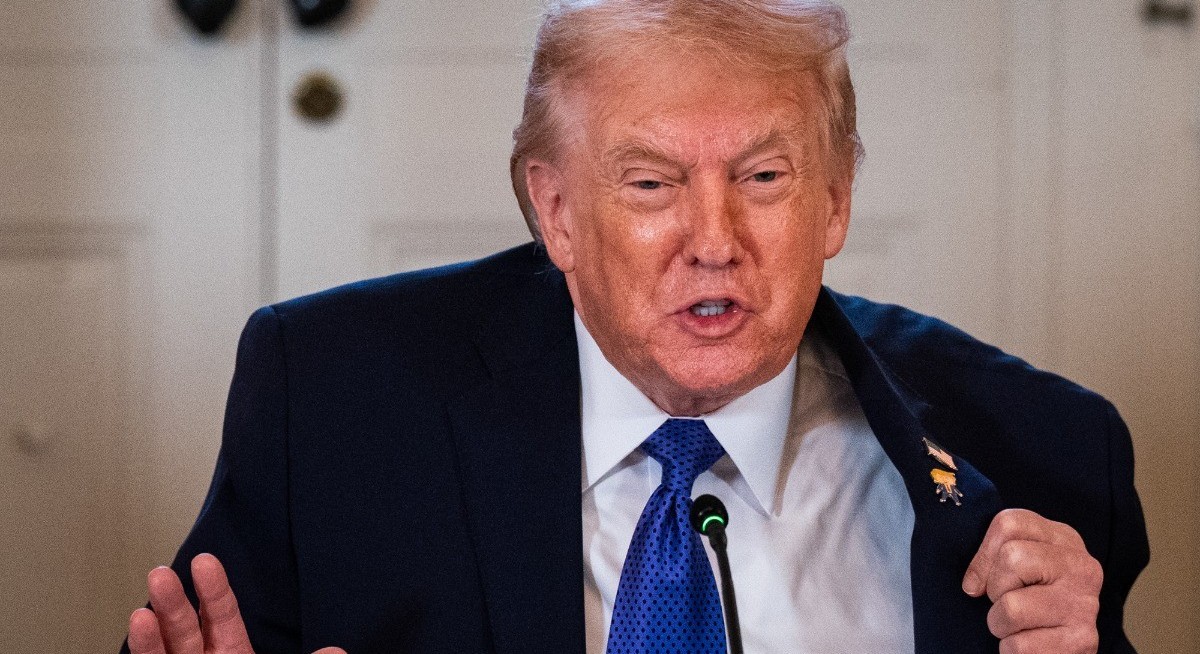


(Jan 13): US President Donald Trump’s announcement of new tariffs on goods from countries trading with Iran risks derailing his one-year trade truce with China, the world’s top buyer of Iranian oil.
“Any country doing business with the Islamic Republic of Iran will pay a tariff of 25% on any and all business being done with the United States of America,” Trump posted on social media on Monday. The levy is “effective immediately,” he added, without elaborating on the scope or implementation of the charges.
Trump’s threat comes months after he clinched a pact with Chinese President Xi Jinping at a summit in South Korea that paused tariffs and gave the US access to rare earths. China dominates production of those minerals critical to making high-tech goods and military weapons, and had imposed export curbs during their trade spat.
The average US tariff rate on Chinese goods dropped to 30.8% from 40.8% after the truce in October, according to Bloomberg Economics. Fresh tariffs could upend that agreement and cast doubt over Trump’s plans for an April visit to Beijing.
It’s unclear if Trump will stack the latest tariffs on top of existing rates or announce carve-outs for China, after his administration previously signalled higher fees could inflict domestic pain. White House adviser Peter Navarro last August downplayed the idea of hitting China over its buying of Russian oil. “We have over 50% tariffs on China,” Navarro said at the time. “We don’t want to get to a point where we hurt ourselves.”
If the US doesn’t respect its deal with China, Beijing has the right to take “appropriate action,” said Zhou Mi, a senior researcher at a think tank affiliated with the Ministry of Commerce.
See also: Fed governor Stephen Miran steps down from White House CEA role
“Previously, the US justified reciprocal tariffs by citing long-term trade deficits as a threat to national security,” added Zhou, of the Chinese Academy of International Trade and Economic Cooperation. “But now, what connection does trade between other countries and Iran have with US security?”

China’s Foreign Ministry and Commerce Ministry didn’t respond to a request for comment. China’s embassy in Washington slammed Trump’s threats as “coercion” in a statement given to the South China Morning Post, adding that Beijing would “take all necessary measures to safeguard its legitimate rights”.
See also: Trump sues IRS, Treasury for US$10 bil for tax-return leak
“The market does not care about Trump’s capricious tariff threats,” said Vey-Sern Ling, managing director at Union Bancaire Privee in Singapore. “It is unlikely that he can afford to upset the trade truce with China just to pressure Iran.”
Oil markets will only react if the US intercepts or seizes an Iranian crude-laden tanker, which could hint at a potential escalation similar to Venezuela’s situation, said Emma Li, lead China market analyst for analyst firm Vortexa Ltd.
Iran has long been a flashpoint in US-China relations, with the two countries taking opposite sides in the Middle East conflict. While Washington has long backed Israel and Saudi Arabia, Beijing has moved closer to Iran, acting as a lifeline for Tehran’s economy by taking close to 90% of the country’s oil shipments. In September, Xi met with Iranian President Masoud Pezeshkian in Beijing and pledged to strengthen trade and investment ties.
While China hasn’t officially purchased Iranian crude since June 2022, third-party data providers and traders signal flows have been resilient despite US sanctions. That’s because the Chinese have built a supply chain outside of Western control that supports imports of more than one million barrels a day.
Iranian oil sold at a steep discount is vital for China’s private refining sector and a crucial source of fuel for its economy. The crude is typically held in offshore storage when it arrives. As of late December, those volumes were at a two-and-a-half year high of more than 50 million barrels, according to data from analytics and ship-tracking firm Kpler Ltd.
The Trump administration has renewed its “maximum pressure” campaign on Iran, threatening sanctions on buyers of Iran oil and petrochemical products.
But in June the US president also gave China the green light to continuing buying Iranian oil. That announcement surprised both oil traders and officials in his own government as the president appeared to undermine Washington’s Iran policy under multiple administrations, which sought to cut the regime’s main source of revenue by making its top export off limits.
To stay ahead of Singapore and the region’s corporate and economic trends, click here for Latest Section
China’s imports from Iran fell almost 28% year on-year in the first 11 months of 2025 to US$2.86 billion, according to the latest data from the Chinese customs. Top goods imported include plastic materials like polyethylene, metals such as iron ores and zinc ores, and chemicals like acyclic alcohols widely used as industrial solvents in paints and cleaning products.
Beyond trade, Iran is a strategically important partner for China, said Dexter Roberts, a non-resident senior fellow at the Atlantic Council’s Global China Hub.
“The question I have is whether Trump will actually follow through,” he added. “I wouldn’t be surprised if he suddenly announced China is not impacted. Who knows what might happen?”
Uploaded by Evelyn Chan




