


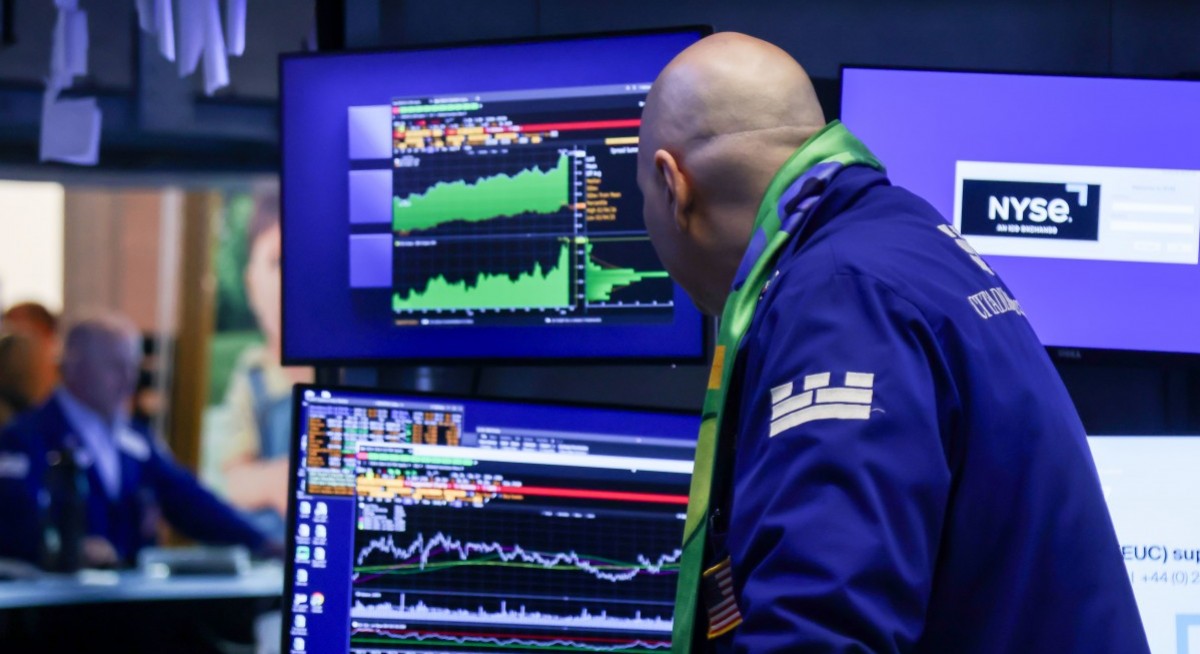


(Feb 12): A stronger-than-anticipated US jobs report spurred a slide in Treasuries as traders pared bets on Federal Reserve rate cuts in 2026. An initial rally in major stock benchmarks waned. Cryptocurrencies slumped.
Short-dated Treasuries were hit the hardest, with two-year yields hovering near 3.5%. Money markets priced in the Fed’s next cut in July, from June previously. Almost 300 shares in the S&P 500 rose on hopes economic growth will fuel earnings, but the gauge was little changed as most megacaps fell. An ETF tracking software firms slid 2.6%. Bitcoin sank to about US$67,500.
US payrolls rose in January by the most in more than a year and the unemployment rate unexpectedly fell, suggesting the labour market continued to stabilise.
Employers added 130,000 jobs last month and the unemployment rate slid to 4.3%. That followed revisions to the prior year, which showed a marked slowdown in hiring. Job gains averaged just 15,000 a month last year, down from the initially reported 49,000 pace.
“Markets may have been expecting a downshift in today’s numbers after last week’s soft data, but the jobs market hit the gas pedal instead,” said Ellen Zentner at Morgan Stanley Wealth Management.
This is the kind of report investors should welcome — even if it gives the Fed more room to stay put, said Bret Kenwell at eToro.
See also: Real estate services stocks sink in latest ‘AI scare trade’
“If the labour market is indeed stabilising, that would be constructive for both the economy and the market,” he noted.
President Donald Trump praised the numbers in a social media post on Wednesday, saying the US should have the lowest interest rates globally. “Great jobs numbers, far greater than expected!” he wrote.
The S&P 500 hovered near 6,940. In late hours, Cisco Systems Inc gave a tepid margin forecast, overshadowing a generally positive outlook fuelled by artificial-intelligence gains. McDonald’s Corp.’s US sales grew at the fastest pace in more than two years.
See also: S&P 500 heads for record after strong jobs report allays consumer fears
The yield on two-year Treasuries climbed six basis points to 3.51% while that on 10-year bonds rose three basis points to 4.17%. The dollar wavered. Oil gained as geopolitical risks outweighed concerns that there’s a supply glut building in the market.
Worries about rising unemployment that prompted three rate cuts at the end of 2025, before a pause in January, were likely eased by numbers out Wednesday. Fed officials at last month’s policy meeting had already cited signs of stabilization as a reason to hold rates steady.
A relevant aspect of Wednesday’s data was that employment at US factories increased for the first time since late 2024 — a nascent sign that American manufacturing may be starting to emerge from years of malaise. In a statement titled “This is the Trump economy”, the White House highlighted manufacturing as a sign that industrial policies are starting to bear fruit.
“While employment growth remains concentrated in the healthcare sector, manufacturing showed encouraging signs of improvement with a return to positive growth,” said Kevin O’Neil at Brandywine Global.
The revisions were expected to reflect a notable markdown in last year’s hiring pace, but economists were pleasantly surprised by how the labour market rebounded in January. Payrolls growth last month exceeded nearly all forecasts.
“Don’t let the revisions fool you,” said Mike Reid at RBC Capital Markets. “The January employment report showed continued improvement in the US labour market. Looking ahead, this print solidifies our view that the Fed will go on a long pause in 2026.”
Still, Reid warns about reading too much into one month of data.
To stay ahead of Singapore and the region’s corporate and economic trends, click here for Latest Section
The material surprise in January’s jobs report spells stabilization in the labour market — not reacceleration, according to Oscar Munoz and Gennadiy Goldberg at TD Securities.
“More evidence is necessary to make that assessment leap,” they said. “All told, a more constructive outlook for employment should allow the Fed to be more patient and shift its attention toward the inflation mandate.”
They still expect the Fed to cut rates by 75 basis points this year while saying easing won’t be the result of worsening economic conditions, but rather the continued normalization of policy as inflation gradually makes inroads toward the 2% objective.
The release provides ammunition to the “Fed hawks” to maintain a patient approach to rate cuts, reinforcing the narrative of a stabilising labour market, according to Angelo Kourkafas at Edward Jones.
“From a portfolio standpoint, we expect the 10‑year yield to drift back toward the middle of its 4%-4.5% range, and we believe the rotation toward ‘old economy’ and pro‑cyclical sectors should continue,” he said.
The report pours cold water on the idea the Fed could cut rates again before mid-year and will fuel internal debate as to how restrictive policy is and how much slack there is in the labour market, according to Krishna Guha at Evercore.
“If January labour strength turns out to be noisy, we could still get to three cuts, but if it is sustained, getting the old Committee to three will be very hard,” he said.
Interest-rate swaps after the data showed traders see less than a 5% chance that policymakers lower rates when they meet in March. A total of 52 basis points of easing were priced in by December, compared with 59 basis points on Tuesday.
The stronger-than-anticipated January labour-market data, however, is inviting speculation into how Kevin Warsh, Trump’s nominee as the next Fed chair, will handle policy.
“For now, we are holding onto our forecast of two cuts under his leadership,” said Shruti Mishra and Aditya Bhave at Bank of America Corp. “However, we’ve argued that the key risk to his call for significant cuts is a decline in the u-rate. If the u-rate is stable or down even further by June, Warsh might be stuck on hold for the rest of the year.”
Fed Bank of Kansas City president Jeff Schmid said the US central bank should hold rates at a “somewhat restrictive” level, as he expressed continued concerns over inflation that remains too high.
Despite labour-market softening observed last year, economic strength is likely coming out of 2025 and carrying into this year — and that should leave companies reluctant to fire, while tight labour supply should keep a lid on the unemployment rate, noted Jennifer Timmerman at Wells Fargo Investment Institute.
Overall, this still looks like “low-hire, low-fire” labour market rather than a broad-based reacceleration, said Mark Hamrick at Bankrate. “For the Federal Reserve, a steadier jobs picture reduces the urgency to rush into rate cuts, assuming inflation behaves,” he noted.
The relatively healthy state of the labour market suggests that rate cuts are not imminently needed, which allows the Fed some time to digest incoming data before determining the appropriate course of action moving forward, noted Jason Pride at Glenmede.
“Investors should expect a base case of around two rate cuts in 2026, which are more likely to come under the leadership of the next Fed chair,” he said.
If the recent jitters in the stock market are due to concerns of a weakening labour market and/or economy that is headed toward a recession, this report should alleviate those concerns in the short run, according to Chris Zaccarelli at Northlight Asset Management.
“Until we see significant weakness in the labour market, the economy or corporate profits, we believe this is still a market where dips can be bought,” he said.
Investors are shifting from trading headlines to focusing on earnings durability, balance-sheet strength, and selective growth, knowing volatility and rotation are likely as 2026 unfolds, according to Gina Bolvin at Bolvin Wealth Management Group.
“A stronger job market will support the ‘broadening trade’,” said Brad Conger at Hirtle Callaghan. “We like homebuilders, REITs and luxury goods as potentially under-appreciated beneficiaries of stronger growth.”
Worst-case scenarios didn’t play out thanks to a private-sector rebound, according to David Russell at TradeStation. Today’s numbers seem to confirm the manufacturing rebound we’ve recently seen, he said.
“It’s good news for people worried about an imminent slowdown, but it also reduces the urgency to cut interest rates,” he noted.
Looking through the noise, today’s print is a positive for risk assets given it shows a solid labour backdrop that can fuel further upside in consumption, said Jeff Schulze at ClearBridge Investment.
“The market got the jobs report it needed,” said Brad Smith at Janus Henderson Investors. “Despite tight spreads and elevated multiples, we view this as a favorable backdrop for risk assets.”
The labour market is showing some tentative signs of re-tightening, although there remains a way to go, according to Kay Haigh, at Goldman Sachs Asset Management. The Fed’s gaze instead will turn to the inflation picture with the economy continuing to perform above expectations, he said.
“We still see room for two more cuts this year. However, an upside surprise in the CPI on Friday could tilt the balance of risks in a hawkish direction,” Haigh added.
While a stronger rebound in payrolls and a lower unemployment rate lessen chances of any near term cut, reductions will depend on “disinflation,” noted Michael Gapen at Morgan Stanley.
If the US core consumer price index is close to or below estimates on Friday, JPMorgan’s trading desk has placed a 70% probability the S&P 500 will rise; with a potential rally of 1.75% if the measure ebbs significantly more than projections. The median of economists surveyed by Bloomberg expects the core CPI to have risen by 0.3% from the prior month.
A hot report — where core inflation rises by 0.4% or more month over month — could trigger a drop as deep as 2.5%, depending on the extent that it surpasses expectations. But the probability of such a scenario is low, according to the firm.
Uploaded by Isabelle Francis




