


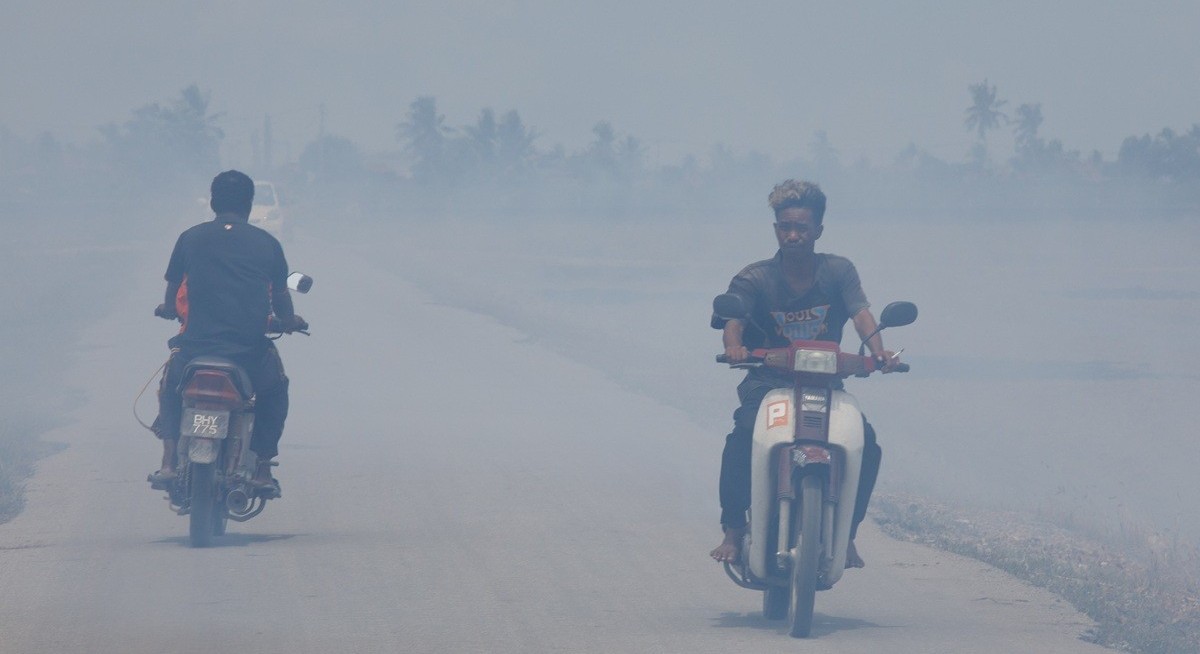


Brunei, Indonesia, Malaysia and Singapore have to prepare themselves for “severe” transboundary haze that could result in multi-billion economic loss, suggests the Singapore Institute of International Affairs (SIIA).
In its Haze Outlook 2026 report, the SIIA issued a “red” alert which indicates “high” risk of regional haze across Southeast Asia. This is the second time a “red” alert was announced since the first report published in 2019. The previous “red” alert was issued in 2023.
The report identifies a convergence of weather, policy and market factors that could heighten the risk of fires and haze across the region.
Weather-wise, concerns are mounting over the return of El Nino conditions in 2026 and the possibility of a stronger and more prolonged dry season. Some meteorologists have also warned of a potential positive Indian Ocean Dipole (IOD), which could further intensify hot and dry weather conditions and increase fire risks across Southeast Asia.
SIIA senior assistant director for special projects and sustainability Aaron Choo explains that the most severe haze has occurred in years with both a strong El Nino and “positive” IOD, citing 1997 and 2015 as examples. “The 1997 to 1998 haze caused US$9.3 billion ($12 billion) in economic losses across Southeast Asia, while the 2015 haze resulted in some US$16.1 billion of losses in Indonesia alone,” says Choo. “Policymakers and the private sector are aware of the need to prevent damage to ecosystems, and to avoid business closures and human health impacts.”
Beyond the weather, the report notes that governments, companies and communities face a significant stress test in maintaining fire prevention and sustainable land management efforts amid economic uncertainty and financing concerns.
See also: Singapore offers Indonesia help to combat 'scourge' of haze
In particular, with Indonesia striving to keep the national deficit below 3% of GDP, its Ministry of Forestry and provincial governments have warned that budgets for fire management are under pressure amid cuts to public spending. The report hints that the country’s announced weather modification operations may be at risk, noting that such initiatives are costly with experts dubious about their effectiveness.
Business concerns
At the same time, rising demand for agricultural commodities and biofuels could place additional pressure on land-use sectors if not managed sustainably.
See also: Hazy skies have little impact on healthcare providers, says CGS-CIMB
In principle, national-level and international industry-level commitments on fire and land management are comprehensive, notes the report which adds that large businesses should have the necessary resources to uphold their mandatory and voluntary commitments, especially those that have profited from high commodity prices in recent years.
However, the report flags concerns about whether rules are being followed across the supply chain, especially among small or medium-sized enterprises that are running on tighter margins. While each of these firms is relatively small, they can cumulatively impact outcomes for better or worse.
At present, there is no conclusive evidence that companies are cutting back on their fire prevention and sustainability commitments amid current economic conditions, states the report.
However, fertiliser shortages arising from disruptions to shipping via the Strait of Hormuz have resulted in new cost pressures on the agricultural sector.
For context, approximately one-third of the world’s globally traded nitrogen fertilizers like urea and ammonia pass through the Strait, along with liquefied natural gas (LNG) used to make nitrogen fertilisers, and large volumes of sulphur similarly used as an input for phosphate fertilisers.
While growers in relatively cash-rich industries like palm oil should be able to bear the increased costs for the time being, other producers like fruit and vegetable growers have slimmer margins and are facing greater difficulties.
Furthermore, operations in the agricultural sector may be disrupted and reduced due to fertiliser or diesel shortages. Rising costs and lack of inputs may also trigger unsustainable activity, such as the use of fire rather than machinery to clear land and dispose of waste, notes the report.
“The forecasts warn of a severe dry season, but we must not be fatalistic,” says SIIA chairman Simon Tay. “The challenge is to ensure that sustainable practices are maintained across entire supply chains, including by small and medium-sized enterprises that may be operating under tighter economic pressures.”
Urging for closer Asean collaboration, Tay adds: “Asean needs to take greater ownership of this challenge as the region enters a potentially severe dry season and faces the longer-term impacts of climate change. Supporting solutions with adequate funding will be critical.”




