


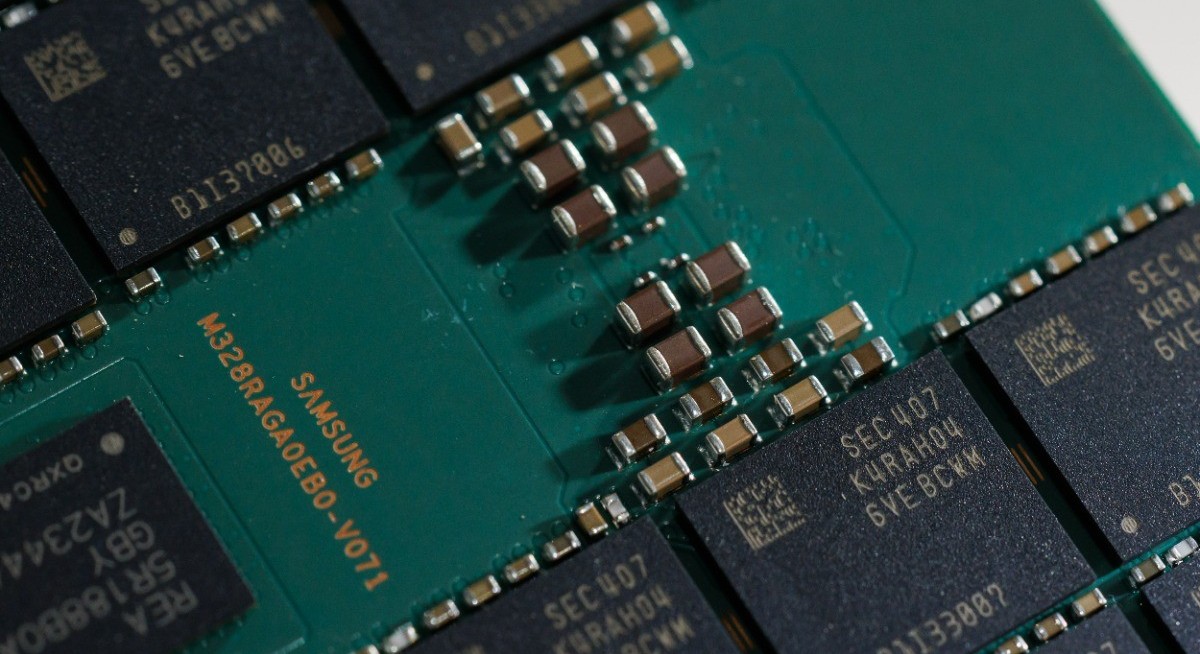


(June 29): South Korea is orchestrating investments of at least 1,350 trillion won (US$880 billion or $1.13 trillion) from companies including Samsung Electronics Co and SK Hynix Inc into chips and data centres, a giant outlay in artificial intelligence (AI) infrastructure it called essential to surviving the AI era.
Samsung Group and SK Group said they plan to build two chipmaking plants apiece in the southwest for 800 trillion won, to rapidly expand production capacity to meet increasing demand. South Korea also announced 550 trillion won of investment from companies including home-grown internet giant Naver Corp to build 8.4 gigawatts of AI data-centre capacity by 2029.
South Korea must move faster than its global rivals to secure leadership in chips, AI data centres and physical AI, President Lee Jae Myung said at a briefing where he called the Samsung and SK Hynix leaders “national heroes”. “We’re entering an era where the page turns in the blink of an eye,” he said, pledging government support to build an AI ecosystem quickly. “Speed is the only way to survive.”
The scale of Korean tech spending underscores the government’s urgent desire to maintain the nation’s lead in memory chips crucial for AI, while ensuring longer-term national security. It’s also a big boost to the economy if sustained: at about US$880 billion, the envisioned collective investment represents about 5% of South Korea’s 2024 GDP, according to World Bank data. The Kospi erased losses of as much as 3.4% to trade higher in the afternoon.
For 2026, Samsung has already announced plans to spend over US$70 billion in production capacity expansion and research. But if sustained over the long term, the cumulative sum would approach the eye-watering amounts budgeted by hyperscalers such as Microsoft Corp as well as neighbour China, which is drafting its own five-year, US$295 billion investment blueprint.
The Korea Economic Daily reported earlier that the companies together were poised to announce as much as 2,000 trillion won in fresh investments over a 10-year period.
See also: Panasonic targets further AI growth to build on record valuation
Shares of Samsung fell nearly 5% at close, while SK Hynix ended down 1.7%, extending Friday’s slide. While AI’s voracious demand for memory chips has pushed up the two chipmakers’ shares, questions persist about the sustainability of profits as competition heats up and chipmakers ratchet up supply.
South Korea has emerged as one of the biggest beneficiaries of the global AI boom, but concerns have been growing that the spoils have not been shared evenly across the country. President Lee’s approval rating has fallen to its lowest level since he took office a year ago, according to a Gallup Korea poll that pointed to growing disapproval of Lee’s handling of the economy, the weak won and housing policy.
Samsung and SK Hynix — the world’s two biggest memory makers — have been speeding up investment to keep pace with demand. Samsung intends to also speed up construction of fabs in the Seoul metropolitan area, Samsung Electronics executive chairman Jay Y Lee said at the briefing. “It’s a race against time,” he said. Gwangju in the southwest will be developed as a new memory manufacturing hub, while Cheonan and Onyang will serve as centres for HBM packaging, he said. The company also plans to invest in humanoid robot deployment at its fabs in Gumi, North Gyeongsang Province.
See also: WhatsApp opens username reservations to three billion users

President Lee has been seeking to direct strategic investment outside of the capital Seoul to foster new growth engines and high-paying jobs in the regional economy.
“The history of South Korea’s development is one of dazzling achievements and, at the same time, a process of accumulating severe imbalances and discrimination,” Lee said in a post on X on Sunday. “Now is the time for everyone to cooperate and pool their wisdom on a grand scale to achieve the national survival goals of easing the concentration in the capital region and promoting balanced national development.”
Governments around the world are pouring unprecedented support for their domestic chip industries, citing national security concerns. The US has committed tens of billions of dollars through the CHIPS and Science Act to expand semiconductor manufacturing, while China has continued to pour state-backed funding into building a self-sufficient chip ecosystem amid escalating technology restrictions. Japan has also dramatically increased subsidies to revive its semiconductor sector, supporting investments by domestic companies and foreign manufacturers including Taiwan Semiconductor Manufacturing Co.
Citigroup said in a note that the massive investment led by the Korean government should boost growth of the country’s semiconductor supply chain, including its chip gear sector. The company is bullish on Korean chipmaking equipment names, helped by “the promising AI demand outlook and accelerated green-field capacity expansion plans”, it said.
Uploaded by Chng Shear Lane




