




A national movement, Green 100, brings together large enterprises, or “queen bees”, who will each encourage and mobilise 100 SMEs within their supply chains and business networks to start sustainability reporting and capability-building. This approach can encourage large companies to strengthen sustainability engagement across their value chains and enable their SME partners to enhance their environmental competitiveness and resilience.
A total of 22 queen bees have signed up for Green 100, including Singapore-listed companies City Developments (CDL), Hong Leong Finance, IHH Healthcare, Keppel, OCBC and Singpost. Of these, CDL, Keppel and OCBC are constituents of the Straits Times Index, which comprises the 30 largest companies by market capitalisation.
Monitoring and potentially decarbonising value chains
From FY2026 onwards, constituents of the STI must report Scope 3 greenhouse gas (GHG) emissions while remaining voluntary for other companies until “further notice”, according to SGX. Scope 3 emissions refer to indirect greenhouse gas emissions that occur in a company’s entire value chain, excluding the company’s indirect emissions from purchased electricity, which are categorised under Scope 2.
See also: US$800 million commitment achieved by FAST-P initiative Green Investments Partnership
With Green 100 enabling emissions reporting across the value chain, this could offer large companies, including STI constituents (and presumably other issuers in the future), a way to monitor, report and reduce emissions across their value chains.
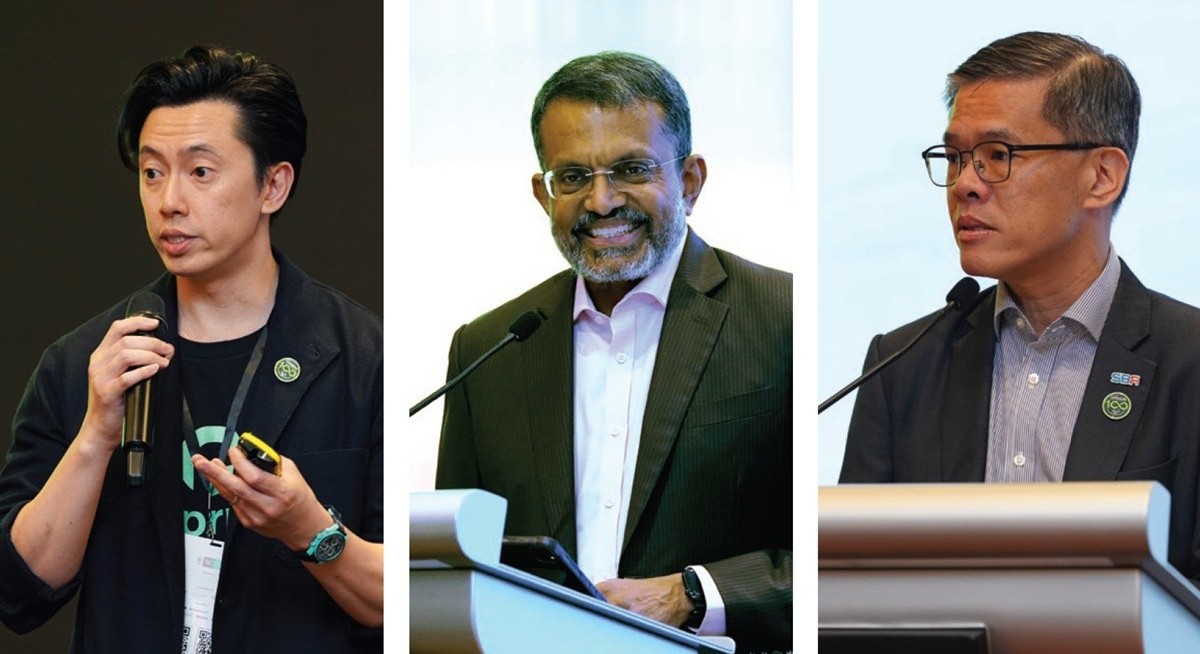
“Large companies, especially those that have a global footprint, are very aware that their supply chains need to become green eventually and it is in their interest to engage with their suppliers,” says Lionel Wong, CEO of Gprnt, which provides the technology for Green 100 and is a partner of the initiative.
Gprnt is a digital platform launched by the Monetary Authority of Singapore (MAS). It harnesses technology to make sustainability reporting accessible and to support businesses in measuring and acting on their sustainability efforts at scale.
See also: New coalition to mobilise demand and financing for carbon credits
Wong was a regulator and policymaker at MAS for 15 years, the last three of which were devoted to developing Gprnt in its previous iteration, MAS’s Project Greenprint. He was tasked by MAS with leading Gprnt following its spinoff from the central bank in November 2023 and he oversaw Gprnt’s successful integration into Singapore’s national digital infrastructure.
Speaking to The Edge Singapore on the sidelines of the launch of Green 100, Wong shares that queen bees were invited to participate in the national initiative. He also suggests that Green 100 can facilitate Scope 3 emissions calculation for large companies at a lower cost.
The way Wong sees it, offering disclosure capacity at no cost to smaller businesses alters the cost structure of sustainability reporting. “Today, large companies pay six or seven digits [for sustainability reporting],” he says. “But if we were able to mobilise smaller businesses to get started with Scope 1 and Scope 2 at scale, then it shouldn’t cost that much and the fact that we provide that disclosure capability to the small businesses for free here in Singapore, it’s already breaking the cost dynamic.”
So far, 33 SMEs have joined Green 100. In Wong’s view, in addition to enjoying simplified, zero-cost sustainability reporting capabilities, these firms will gain a competitive advantage, as their customers — large companies, including listed companies — may favour sustainable supply chains to meet compliance and regulatory requirements.
Climate transition is ‘central’
Green 100 is the brainchild of the Council for a Competitive Climate Transition (C3T), which is co-chaired by Menon and Kok Ping Soon, CEO of the Singapore Business Federation (SBF).
“When margins are tight, supply chains disrupted, and markets volatile, sustainability can feel like one more requirement, one more report, one more form to fill, one more cost,” says Menon at the launch event.
To stay ahead of Singapore and the region’s corporate and economic trends, click here for Latest Section
While acknowledging SME concerns, Menon argues that the climate transition is increasingly a condition for business success in a climate-impacted, carbon-constrained world. “Climate transition is not a distraction from business priorities. It is central to them.”
As such, C3T was established to help Singapore businesses stay resilient and competitive and Green 100 is designed to make it simpler and more rewarding for SMEs to take the sustainability journey, says Menon.
Not a ‘cost centre’ but an opportunity
For Menon, Green 100 makes SMEs’ climate action commercially meaningful, adding that the initiative aims to change the perception that sustainability is a “cost centre”.
“It [climate action] is increasingly shaping markets, financing, procurement, and competitiveness itself, not to mention the implementation of CBAM in the EU, and possibly elsewhere,” reiterates Menon. “First movers who make this transition will be better positioned.”
C3T and Green 100 seek to help businesses make the climate transition with “greater clarity, confidence, and support”, adds Menon. “Not sustainability as compliance, but sustainability as competitiveness; not climate action as a burden, but climate action as enterprise value; and not acting alone, but together as an ecosystem.”
Firms may sign up directly on the Green 100 website or respond to email invitations from queen bees. SMEs that complete their essential disclosure will receive a digital Green 100 badge issued by the Singapore Environmental Council on the platform.
The Green 100 badge comes with a unique digital identifier to support third-party verification and gives SMEs access to opportunities. Badge holders will be listed on the Green 100 supplier registry, improving visibility for buyers looking for sustainability-ready suppliers and providing access to the Green 100 network, which will share alerts on green procurement tenders and sustainable financing opportunities.
The badge is also a stepping stone for SMEs to work towards more advanced sustainability qualifications, such as the Singapore Manufacturing Federation’s Green Excellence for Business (GEB) mark, the Green Excellence for Manufacturing (GEM) mark, and the SEC’s Eco-Spaces certification, based on their needs and business context.
TR 149: A business enabler
“Businesses are not resisting the transition, but are struggling with the pathway,” says SBF’s Kok at the launch. He reveals that businesses have provided feedback that the sustainability reporting landscape can be “fragmented” and “confusing”.
To address these concerns and support SMEs, a national standard was introduced alongside Green 100, as Kok explained. “It [Green 100] is a national movement that gives businesses a more consistent and practical way to start their sustainability journey with TR 149 as a common standard.”
TR 149, or Technical Reference (TR) 149:2026 Specification for Organisations to Progress towards Environmental Sustainability Excellence, is designed to be accessible to companies of all sizes.
Offering a practical, step-by-step approach that is especially useful for SMEs beginning their sustainability journey or seeking to build on existing efforts progressively, TR 149 provides a structured approach that could enable businesses to translate their sustainability commitments into a tangible competitive edge that attracts investors, wins customers and retains talent.
As global supply chain sustainability requirements become stricter, TR 149 is particularly relevant for SMEs as it offers a practical way for them to demonstrate their environmental performance to larger partners and customers.
TR 149 is set by Enterprise Singapore (EnterpriseSG) through the Singapore Standards Council (SSC), in partnership with the A*STAR Singapore Institute of Manufacturing Technology (A*Star SIMTech) and the Singapore Manufacturing Federation (SMF). It is built on A*Star SIMTech’s Green Compass framework, which supports companies’ sustainability transformation efforts by bringing together key sustainability considerations into a single, coherent framework applicable across industries.
Companies that aspire to improve their maturity levels can use the TR 149 to identify areas for improvement across five dimensions – people readiness, structure, operations, supply network, and product life cycle. Under the operations dimension, companies can improve the management of environmental impacts relating to greenhouse gas emissions, energy, water and material consumption.
“Instead of navigating an alphabet soup of standards and customer requirements, SMEs can now follow one practical, nationally recognised pathway,” says Kok. “Instead of every large company asking for something different, we now have a national basis for consistency.
“That matters, because if we want adoption at scale, the process cannot be designed only for large firms with dedicated sustainability teams; it must also work for smaller businesses with limited time and limited manpower.”




