


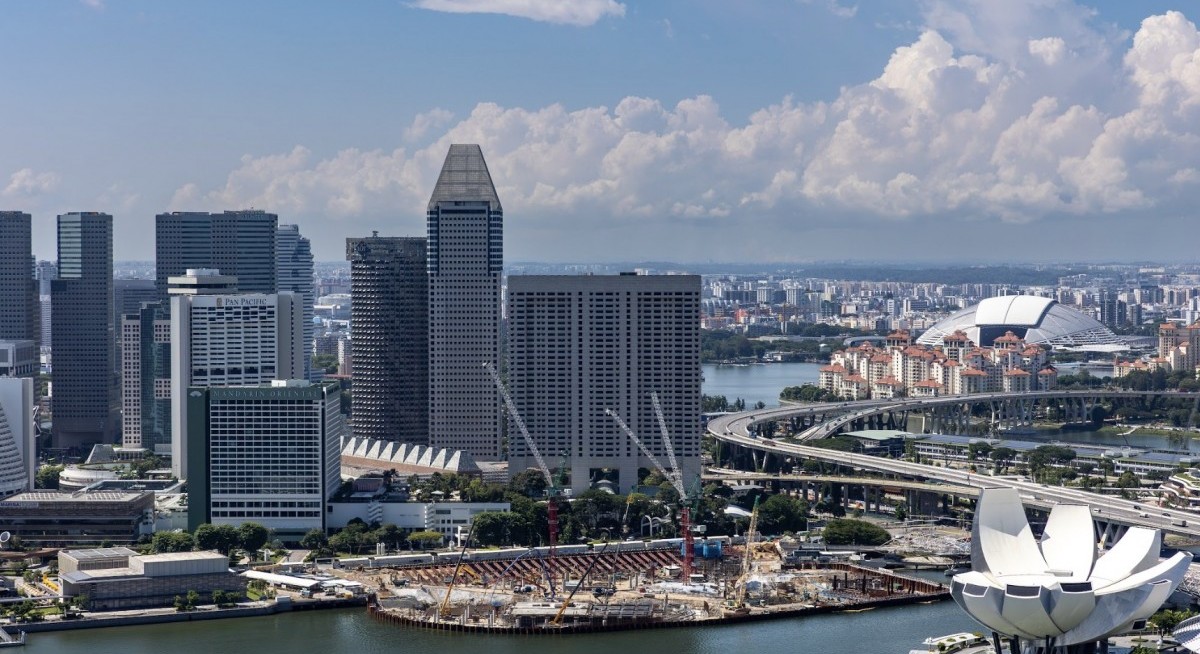


One of the most interesting announcements has been the redevelopment of Marina Square. At present, details are scarce. According to DBS Group Research, Marina Square is valued on the books at “just” $1,050 million, or $490 psf, on a gross floor area (GFA) basis. DBS believes the potential value uplift for a redevelopment could be as high as 4.8 times, translating to $5.08 billion.
First off, though, DBS believes that a privatised SingLand would make the entire exercise neater. SingLand has two major shareholders. JG Summit Holdings is the second-largest shareholder, with a 37.05% stake. Together, UOL and JG Summit own more than 87%. Market watchers have long wondered if SingLand could be taken private.
“A key question we frequently receive is whether the second-largest shareholder may eventually seek an exit. While there is no guidance at this point, we do note that they are represented on the board of SingLand. The exit of this partner will one day enable more flexibility for UOL to manage the company and drive more synergies with UOL,” DBS says.
In DBS’s view, UOL would be a natural and logical buyer, particularly given the strategic importance of SingLand in unlocking value from the Marina Square redevelopment. SingLand holds a 77% stake in Marina Square and Pan Pacific Singapore, a 58% stake in ParkRoyal Collection Marina Bay and a 39% stake in Mandarin Oriental Singapore.
See also: Large caps lead active value realisation in February
DBS assumes two different redevelopment schemes. In the first, an additional 10% of GFA for a new residential tower will be developed. The second scenario involves a full redevelopment of Marina Square with a 30% uplfift in GFA, which would include residential and office components.
Redevelopment costs would range from $2.6 billion to $3.4 billion, depending on the amount of additional GFA approved by the URA. Since the site is a 99-year leasehold, an additional lease-top-up cost is likely, which is not included in DBS’s estimates.
In December last year, SingLand announced plans to acquire 43,000 sq ft of land at 6 Raffles Boulevard for $99.1 milllion. “This transaction consolidates the ownership of the Marina Square complex. As part of the announcement, it was also reported that SingLand submitted a revised development proposal for a new mega-development, with the addition of three buildings comprising a residential tower, a serviced apartment block and a mixed-use tower with hospitality, office and performing arts spaces,” DBS notes.
See also: An ‘Irrational’ Year of the Fire Horse and ‘DBS at $80’
The second scenario appears more likely and would require capital. “Based on the latest reported net debt-to-equity ratios of 0.06 times and 0.25 times for SingLand and UOL, respectively, we believe that the group would have sufficient capacity to undertake a fully debt-funded deal, especially when the capital expenditure to be incurred will be phased out over several years,” DBS observes.
It estimates that the debt-to-equity ratio would rise to 0.5 times for both entities. Clearly, the burden on SingLand would be greater. “These levels, while not high, will limit the group’s overall financial flexibility, in our opinion. Given the group’s active pipeline of residential developments and its continued involvement in residential land bids in the GLS and en bloc space, we believe it is prudent to keep net debt-to-equity levels closer to 0.3–0.4 times,” DBS says.
Since UOL announced the sale of Pan Pacific Tianjin on Jan 30 for RMB238 million ($43.5 million), the next step could be SingLand divesting the Westin Tianjin, which was valued at around $142 million.
Based on UOL’s last traded price of $11.20, it is trading at a Price/Net asset value (P/NAV) of 0.82, compared with SingLand’s P/NAV of 0.66 based on its last traded price of $3.88.




