


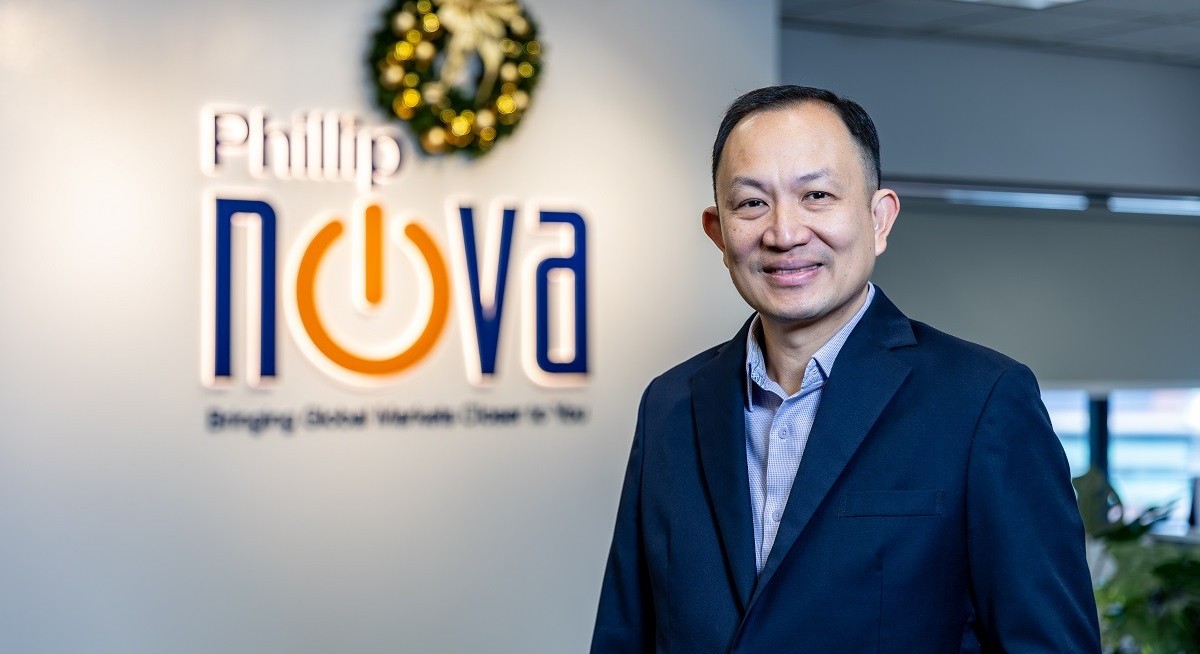


One reason why Phillip Futures was renamed Phillip Nova in 2022, was to reflect how the brokerage has expanded its offerings from trading futures, as it has done so for decades, to also trading of securities in Singapore too. The rebranding was also another marker of how the firm, under CEO Teyu Che Chern, has been constantly innovating, learning, adapting, so that it can meet the diverse needs of clients as market conditions evolve.
For Teyu, the timing of the rebranding is just right. With well-coordinated efforts by the Monetary Authority of Singapore, the Singapore Exchange and the wider market ecosystem, the Singapore stock market has finally chalked up a new high after17 years, along with consistently stronger trading volume.
With specific boosts, ranging from $5 billion in MAS funding, streamlined regulations to encourage more IPOs, plus a series of other measures, the excitement seems set to continue - and along with it, the growth of Phillip Nova. “In a way, we are riding on the momentum,” says Teyu, in an interview with The Edge Singapore.
To be sure, trading of securities remains a relatively small proportion of Nova’s total business. Trading of futures, for now, remains the bread and butter, given the decades of track record with the firm. Nonetheless, Teyu believes that as Phillip Nova grows bigger, the proportion of securities trading will become bigger as well, given the overall difference in depth and breadth. “We are not surprised if one day stocks will be the same as futures, so that probably explains the aspiration.”
Besides tapping a livelier market, Phillip Nova is chalking up new growth in its own ways. Earlier this year, it won regulatory approval to offer financing of shares and has started introducing this to clients. This arrangement means its clients with a bigger appetite can borrow from Phillip Nova and take bigger positions, presumably generating better returns, amid better market momentum.
Teyu explains that for certain types of investors, share financing facilities are their way of capital management as well. For now, Teyu has no specific targets how much of a volume jump Nova is aiming for by offering share financing. Rather, the key aim is more geared towards broadening the range of services Phillip Nova clients can enjoy.
Teyu is “thankful” that he has a pool of $100 million that Phillip Nova can lend out. Phillip Nova’s shareholders’ funds is around $300 million, which means it can comfortably support this new growth lever, with plenty to spare and as a cushion against any issues markets might encounter. “It is always good to be sufficiently buffered, and at this moment, we certainly are,” he says.
However, he is quick to qualify that Phillip Nova is adopting a measured stance and will make sure if it is up to mark with the required risk management before increasing the book further. As a veteran of the industry, Teyu can clearly recall how some brokers were badly burnt from the 2013 penny stock manipulation saga when the music stopped. “Let's go slow, learn as we move along. If you do share financing wrongly, it can be disastrous,” he says.
Teyu has a systematic approach to risk management based on a set of parameters and other considerations, instead of just looking at the amount extended. For example, is the client holding very concentrated positions? Are the stocks held enjoying a certain level of liquidity? If not, the brokerage will naturally find it harder to liquidate those positions if push comes to shove. “In this business, we spend a lot of time on stress testing, asking ‘what ifs’,” he says.
Just to be sure, share financing is not only applicable to retail clients. Share financing can be a way for institutional clients or high net worth individuals to better manage their capital. For example, they may be astutely building an arbitrage between their own financing costs and what they can earn from dividends or interests from investments made using borrowed funding.
Tapping on the broad range of instruments that its clients trade, Phillip Nova has also introduced a service where institutional customers can use shares as collateral for their positions in futures, as part of a more efficient use of their capital. Phillip Nova sees this as a way of doing things differently by providing a one-stop shop for clients who are keen to trade across asset classes, across various markets. Instead of toggling between brokers and accounts, Phillip Nova clients can trade and enjoy financing while having full visibility via one account and one ledger. They do not need to transfer funds from one account to another and can be more efficient. “Our key theme is to make investing easy,” says Teyu.
Risk management
Making it easier for clients to trade is but just one part of the equation. Running a brokerage means the need for proper risk management is especially key as numerous markets, numerous asset classes ranging from stocks to gold are trading at all-time-highs. A growing number of commentators believe that market corrections should not be ruled out. For Teyu running this brokerage business, his preference is to focus on the long term and less on the direction of the markets. He believes that the fundamental remains risk management. “How do we make sure we have a product that we can manage, be it good times or bad?”
Teyu believes that leverage, when used carefully by the investors, can build a sound portfolio more quickly. Of course, the converse is true as well. He recalls back in 1998, when the region was swept up by the Asian Financial Crisis. As a young executive who just joined PhillipCapital, he was involved in force-selling shares held by clients, who struggled to make good on the payments. “Every day, your job was to sell, sell, sell. It is painful. Leverage, if you use it wrongly, can be dangerous,” he says.
Having said so, as any investor worth his or her salt, some fundamentals apply: opportunities to make gains are underpinned by willingness to take some risks, plus conviction to stay invested – especially in times of major dislocations. For example, local banks’ shares were trading at single digits in the 1998 crisis. “These are the defining moments of the industry,” says Teyu.
New ETF, fractional shares
Major market episodes make headlines but there are always other activities underneath that goes towards making the whole investment ecosystem richer and more diversified. For one, Phillip Nova is constantly broadening its offerings where it makes sense for its clients and for the market. In September, as part of its focus on ETFs, Phillip Nova launched its first pair of Exchange-Traded Funds (ETFs) to carry the Phillip Nova brand. They are the Phillip-Nova MSCI Singapore Daily (2×) Leveraged Product and the Phillip-Nova MSCI Singapore Daily (-1×) Inverse Product. Phillip Nova says these ETFs are designed to track the daily performance of the MSCI Singapore Index, which tracks Singapore’s largest and most liquid companies.
Another way Phillip Nova’s trying to grow its addressable market is to offer fractional shares trading. Teyu reasons that with a lower minimum cost, this will help encourage a newer generation of investors to take an interest in the markets, and lead toa larger ecosystem of investors that he can win over. He is upbeat about this. While visiting the Singapore Fintech Festival held recently, he observed many students who look as young as 16, or 17 years old. Drawing from his own experience, people will have different priorities at different points in time, but the aspiration to generate more wealth for a more comfortable future by investing is something that permeates across the ecosystem. “I look forward to partnering with every investor across all age groups,” he says.
In a way, having a broader range of clients goes hand in hand with how Phillip Nova has built up this spread of products and services. “The future is towards multi exchanges, multi assets. The lines are blurring and markets converging,” says Teyu.
To better serve its clients and to make itself more efficient, Phillip Nova has made it a point to deploy a technological edge. Following a period of in-house development, Phillip Nova has incorporated AI that clients can tap on when doing research, getting information, or making investment decisions. The development took numerous months, but Nova AI, as the brokerage’s AI offering is called, is now ready for prime time and is being deployed for clients across the region.
Teyu says he is not jumping on the hype, but is aligning with a trend – and clearly that is towards AI. Nova AI is to make investing easy for clients, which is in the spirit of making constant improvements in their user experience. The multi-asset class trading access, the single accounts, single ledgers and soon, are but part of Phillip Nova’s mantra to keep improving, keep innovating, as it keeps building. “I think these are some of the things that we have done right that could be really matching up to the market, or even be ahead of the market,” he says.




