


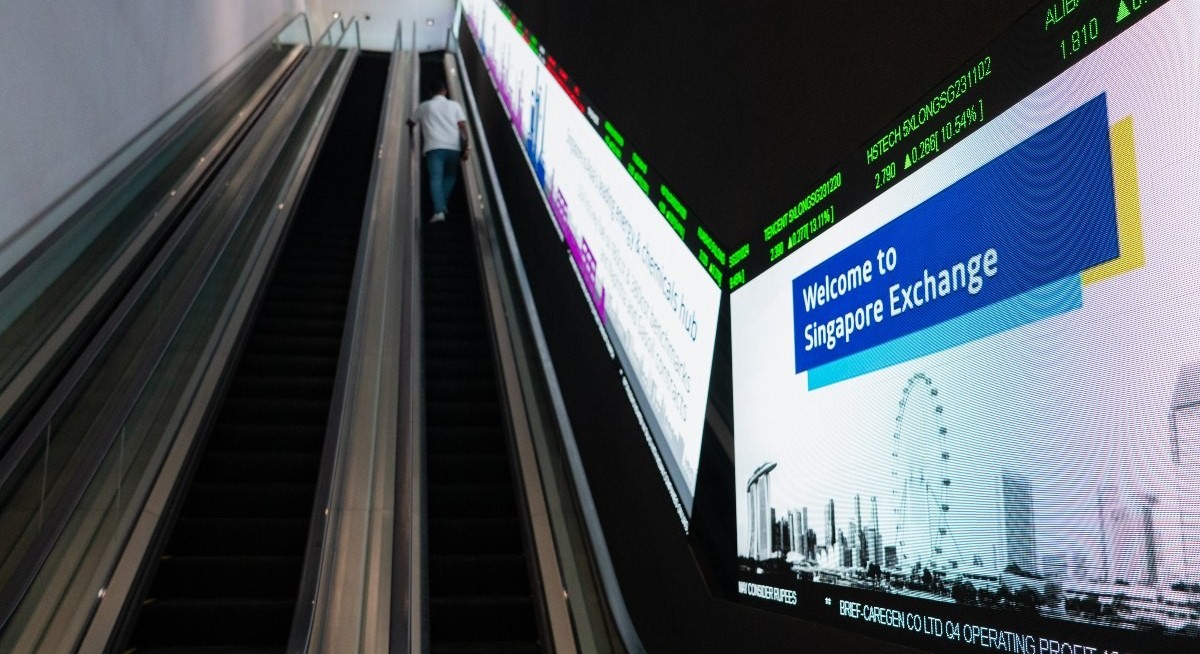


“In the past, I thought that having more information and more news meant I could do better,” says Guan Siong, who focuses on undervalued small- and mid-cap stocks. “But over time, I realised that the more we know, the more noise we receive, and this noise actually corrupts our investment process.”
“With the STI being so skewed, it doesn’t reflect the broad market. If one follows the STI, it won’t help much. It will give even more noise than ever,” Guan Siong says, adding that indices like the STI are more relevant for institutional investors who can use them as a benchmark to measure their portfolios against.
Guan Siong isn’t the only investor who thinks that way. With around half of its market capitalisation tied to the three big banks, DBS Group Holdings, Oversea-Chinese Banking Corporation (OCBC) and United Overseas Bank (UOB), it is fair to say that the STI’s record gains are really the Singaporean banking sector’s record gains.
A rising STI — as imperfect a barometer as it might be — is still an overall plus for the local market. The city-state’s push to revitalise its local bourse began in August 2024 when the Monetary Authority of Singapore (MAS) convened the Equities Market Review Group.
See also: The one price Singapore has decided not to manage
The review group completed its work in November 2025. It came up with a variety of measures, ranging from a $6.5 billion Equities Market Development Programme (EQDP) fund to channel capital into local equities to a $30 million “Value Unlock” package that will push companies to step up their investor relations and corporate strategy efforts. In that sense, an STI on the uptrend will help to drive investor confidence and keep the momentum going.
Since 2024, the STI has been steadily growing. On Feb 12, the flagship index passed the 5,000-point mark, less than a year after it crossed 4,000 points on March 28, 2025. In fact, the ongoing turmoil from the war in the Middle East has barely halted the STI’s climb. As of July 15, the STI closed at 5,559.72 points, up, with all three banks reaching new highs. DBS closed at $72.98, generating headlines as the first Singapore company to hit a $200 billion market cap, having crossed the $100 billion mark in November 2024. OCBC, meanwhile, closed at $28.36 with a market cap of $127.33 billion, while UOB closed at $44.95 with a market cap of $74.24 billion.
On July 13, Singapore Exchange Group (SGX) reported a securities market turnover of $455.7 billion, 35% higher y-o-y for the FY2026 ended June 30. During the year, securities daily average value grew by 35% y-o-y to $1.8 billion, the highest in 18 years. The month of June also saw continued gains from the STI, with total returns over 12 months at 36.4% on the back of “supportive growth” and “structural investment themes”.
See also: Singapore on track to beat cautious official forecast on AI boom
On July 15, Macquarie Equity Research analysts Jayden Vantarakis, Foo Zhiwei, Rachel Tan and Amanda Foo raised their 12-month target for the STI to 6,000. The analysts originally had a year-end target of 4,500 points in January. They argued then that Singapore’s banks would end up being a drag to the STI’s performance due to falling interest rates. Now, they are forecasting a total market return of 14% for the index, inclusive of a 4.1% dividend yield.
“Despite strong performance over the past year, we see a healthy cocktail of tailwinds for the Singapore market,” the analysts write, citing drivers such as the EQDP, the country’s strong economic growth, as well as the possibility of rate increases down the line. “Stronger USD conditions, and US Fed rate hikes, provide a backdrop for SGD rate increases, which is supportive of index heavy-weights, the three banks.”
In a July 16 note, a team of HSBC analysts led by Herald van der Linde issued a more bullish call, raising their target from 5,300 to 6,100. They point out that there is not much that really jumps out about Singapore. Market earnings momentum is still anaemic, with consensus 2026 earnings growth of just 2%, down from 5% in March. Singapore remains the most widely held market in Asean and thus positioning also does not look especially light. Valuations are not exactly cheap either, with FTSE Singapore on a 17 times 12-month forward P/E multiple. “Even so, we still think Singapore equities can continue to perform, mainly because the market offers quality exposure, solid yield and defensive characteristics, particularly while the macro backdrop across the rest of Asean remains fairly lacklustre,” says HSBC.
Investors and analysts that The Edge Singapore spoke to say that while the STI’s 5,000 milestone is an achievement worth celebrating, Singapore has got to find new growth drivers beyond its usual stalwarts DBS, OCBC, and UOB.
From industrials to finance
Created in 1966, the STI began its life as the Straits Times Industrials Index or STII. As its name suggests, the STII was composed mostly of industrial stocks and was very much a reflection of the Republic’s young, labour-intensive economy.
Later, in 1998, the STII was renamed to the STI. Aside from the name change, the STI featured an expanded roster of 55 stocks — up from 30. Unlike the STII, which was price-weighted, the STI was market cap-weighted.
To stay ahead of Singapore and the region’s corporate and economic trends, click here for Latest Section
The STI constituents were put together by Singapore Press Holdings (SPH), SGX and their consultant, economist Tse Yiu Kuen. Notably, this was also when DBS, OCBC and UOB made their first appearance in the STI.
A decade later, in 2008, the STI reduced its constituents to 30 again. The changes were part of an overhaul of the STI after SGX and SPH entered into a new strategic partnership with FTSE Russell.
As part of the joint venture, FTSE Russell took over the calculation and management of the index. The reduction of the constituents, however, meant that the STI was dominated by large-cap stocks. Aside from the three big banks, eight other constituents have been a part of the STI since 1998. They include government-linked companies such as Singapore Telecommunications (Singtel), Singapore Technologies Engineering (ST Engineering), Singapore Airlines (SIA), Keppel, and Sembcorp Industries, as well as leading private-sector names such as City Developments (CDL), Venture Corporation, and even foreign companies like Jardine Matheson and Hongkong Land.
“When you look at the STI, it’s really historically served as Singapore’s primary equity market indicator,” FTSE Russell CEO Fiona Bassett told The Edge Singapore during an interview in Singapore in January. Bassett’s visit to the city-state had coincided with the 60th anniversary celebrations for the STI.
Gains boosted by the EQDP or the banks?
While the gains from the STI are welcome, market watchers are split over the reasons behind its surge.
Sherman Lim, portfolio manager, equities at Avanda, sees the EQDP as a “big catalyst” that sparked the rally. “Whether or not it’s more structural, I think we still have to wait and see, but hopefully it is,” says Lim, one of the managers — along with Richard Chan, partner and head of equities — to manage the Avanda Singapore Discovery Fund.
The STI, Lim notes, took about 17 years to “crawl back” to its previous peak last seen in 2007. It was only in 2025 that it finally broke “significantly above” 4,000, reaching 5,000 points.
“This time around, we are really very hopeful that it could be a longer-term, more sustainable rally,” he says, citing several initiatives, including the “Value Unlock” strategic initiative to help listcos address valuation gaps. In addition, Singapore is in a “good space now”, as it stands to benefit from its safe-haven status, attracting more institutional and retail flows into the country and into Singapore dollars.
S Nallakaruppan, president of The Society of Remisiers (Singapore), believes the STI’s rally is both cyclical and structural.
While it is easy to attribute the increase to the EQDP initiatives, they don’t fundamentally alter the index’s earnings growth trajectory, sector competition or innovation pipeline, he says.

"Singapore needs new growth sectors, not just better market plumbing," says S Nallakaruppan, president of The Society of Remisiers (Singapore). Photo: S Nallakaruppan
Instead, deeper drivers include sustained high return on equity (ROE) and capital returns from banks, Singapore’s role as a regional capital hub, and rising demand for yield and stability in a volatile world. That said, Nallakaruppan attributes 60% to 70% to cyclical factors and 30% to 40% to structural factors.
“To flip that ratio, Singapore needs new growth sectors, not just better market plumbing,” says the veteran market watcher who joined the industry in 1994.
Goh Jing Rong, an assistant professor at Singapore Management University’s (SMU) School of Economics, says the STI’s rally from 2024 to 2025 is not entirely attributable to government measures to stimulate the local bourse.
“The review group was only set up in August 2024, so at most it may have contributed some late-year anticipation effect in 2024. It was not the main engine of 2024’s rally. Instead, the STI’s 2024 rally was primarily bank-led, driven by strong earnings, dividends and a higher-rate environment,” Jing Rong says.
Instead, the announced measures had a greater impact on the 2025 rally. Jing Rong says measures such as the EQDP fund were an “accelerant” rather than the main cause of the index’s rally last year.
“Whether the impact proves temporary or structural really depends on how successful the other policies are in deepening market liquidity and attracting wider, more diversified listings on SGX,” Jing Rong adds.
Going beyond the banks
Depending on who you ask, the bank-centric, dividend-focused nature of the STI can be either a good or a bad thing. For retirees who are not out to risk their capital, the stable returns from the STI are much welcomed. But for the young trying to compound their capital and achieve early retirement, the STI becomes less attractive compared with its international counterparts, such as the S&P 500.
Investing in exchange-traded funds (ETFs) that track the S&P 500 provides exposure to world-beating tech giants like Nvidia and Alphabet, the parent company of Google. Both companies have seen their valuations soar amid the AI boom.
The STI outperformed the S&P 500, recording a total return of 28% last year, compared with the S&P 500’s 17.9% over the same period.
That said, sustainable overall growth of the local market ought to go beyond the banks.
The index, which is currently over 50% weighted on the three banks, is “too heavily concentrated” on these counters, says Nallakaruppan. This means the index is effectively “a leveraged proxy on Southeast Asian banking and dividends” but is not an accurate representation of tech/start-ups, New Economy sectors, small- and medium-sized enterprises (SMEs) and mid-cap growth stories. “It’s a good reflection of capital strength and yield, but not an optimal reflection of economic diversity,” he says.
To Thilan Wickramasinghe of Maybank Securities, the market needs to be broader for the STI to grow. “I think the current mix alone is not enough to get to 10,000 [points].” In its October 2025 report, DBS Group Research painted a 10,000 scenario 15 years out. The analyst lowered his year-end estimate to 5,500 points from 5,600 on July 1, citing concerns that higher energy costs will weigh on earnings.
While the large caps can grow further, given that their ROE is trailing the large caps in other markets such as Japan, South Korea and the US, the market itself needs to be broader, the analyst notes.
“There needs to be more large caps coming and listing in Singapore that allow the broadening of the STI and also broadening of sectors that are higher growth,” he says. “You need to have credible growth in earnings. And the only way you can do that is if you have much higher growth companies coming in [such as] in the tech and new economy spaces.”

“There needs to be more large caps coming and listing in Singapore that allow the broadening of the STI and also broadening of sectors that are higher growth,” says Thilan Wickramasinghe of Maybank Securities. Photo: Albert Chua/The Edge Singapore
In Nallakaruppan’s view, the STI should increase the number of constituents from 30 to 50 or even 100. No individual stock should make up more than 5% of the index composition. In his view, an expanded STI reduces concentration risk, improves global investor perception and reflects “future economy” sectors.
At the same time, he acknowledges that the index is meant to track “market cap reality”, in which the banks are Singapore’s strongest listed champions, and that any artificial diversification may reduce its credibility.
For him, the market needs to attract new IPO listings from a depth and breadth of industries that reflect, to a certain extent, Singapore’s economic composition.
Structural changes are required for the STI to reach 10,000 points eventually. Nallakaruppan believes the index needs new sector leadership in areas such as tech, healthcare, green energy, and digital infrastructure, rather than its current focus on financials and REITs.
Singapore will also have to attract a pipeline of regional unicorns, dual listings and family-owned Asean giants, he opines. The STI, which currently trades like a “safe, high-yield market”, will have to partially become an index that offers both growth and yield. Banks will still be able to anchor the index, but “within limits”.
While they may deliver dividends, provide stability and grow at mid-single digits, they cannot double earnings rapidly and drive index multiples expansion alone. “There is a ceiling,” he says.
Avanda’s Lim believes that for the rally to sustain, the rest of the market — not just the banks — also has to catch up. “The index is what it is, but as long as the market moves in the right direction, market breadth improves; naturally, the weight of the three banks will come off,” says Lim.
To Avanda’s Chan, the concentration on the three banks is a “bad thing” for investors, especially institutional investors, who need liquidity and diversification.
“If it’s just the three banks… no one will pay attention to this market as [they can simply buy the three banks],” he says.
“The stock market needs to serve a function — the function of capital raising,” he adds. “You cannot do that overnight if there are no investors [who know] the company.

The market needs to have a “broader representation of various sectors of the economy where capital is needed," says Richard Chan, partner and head of equities, Avanda. Photo: Avanda
As such, Chan believes the market needs to have a “broader representation of various sectors of the economy where capital is needed”. A broader market will also “attract other foreign companies to invest and list in Singapore”.
While Singapore is successful in areas such as foreign exchange (forex), private wealth, infrastructure and private equity, public equity is “falling behind,” Chan points out. “So I think this needs to catch up.”
“In many ways, the composition or weighting to banks is really reflecting the importance of Singapore as the regional financial hub and the role it plays in the overall global ecosystem,” FTSE Russell’s Bassett says. “As the market continues to develop, it’s certainly possible to see how we might expand the index series or create multiple variants that meet the demands of the market.”
Is the STI the economy?
Market watchers are split as to whether there is a direct correlation between the STI’s fortunes and the Singapore economy.
Going by official statistics alone, the link is weak. In 2025, Singapore’s GDP grew by 4.8% y-o-y, while the STI gained 22.7% y-o-y to 4,646.21 points as at Dec 31, 2025. It can also be argued that the STI does not capture economic headwinds such as companies — like QAF, which sells the household bread brand Gardenia and fashion retailer H&M — moving their production lines and/or regional headquarters from Singapore to Malaysia.
However, based on fundamental principles, there should be a direct link between the STI and Singapore’s GDP, says Chan, because the latter reflects the business environment and value-added production in an economy. “If that translates to profits of companies, then it should lead to higher valuation for stocks.”
That said, he acknowledges other factors in between, such as interest rates, which can cause valuation multiples to decline, and whether the country’s GDP rises or falls.
Unlike countries with larger domestic economies like China or the US, Singapore’s open economy means its GDP is subject to “a lot of external factors”, so it “very narrowly” benefits certain sectors.
“So the link is a lot weaker, but you can’t say that there’s no link. It depends on the degree of the leakages,” he adds.
Another veteran watcher, who prefers to remain unnamed, says Singapore’s GDP will at least have a direct impact on the banks, given that a thriving economy bodes well for loan growth and for wealth management.
It depends on the stock you are looking at, adds the veteran watcher, citing the example of Mainboard-listed Sheng Siong Group. The supermarket operator is “incredibly focused” on Singapore, with 97.1% of its total revenue coming from the city-state in the 1QFY2026 ended March 31.
However, this doesn’t apply to 100% of the market, given that around 40% of the 600 listcos are overseas companies or have businesses abroad, notes Emelia Tan, director, capital market development at SGX.
According to SMU’s Jing Rong, while the STI and Singapore’s GDP generally do move in the same direction, the correlation between them is not exceptionally strong. For one, the STI is meant to be a forward-looking asset-price index. GDP, conversely, is a measure of current economic output.
“The STI is also heavily influenced by factors such as bank earnings, interest rates, capital returns and overseas exposure, so it should not be expected to track domestic GDP perfectly on a year-to-year basis,” he adds.
In Wickramasinghe’s view, the correlation is “not that strong”, given that the constituents of the STI aren’t the biggest driver of Singapore’s economic growth.
“If you look at some of the big components of Singapore’s economy, manufacturing is about 17% of GDP. But if you look at the STI — and I have to really stretch the definitions of companies and what they do here — I can squeeze out that about 9% of the STI market cap comes from manufacturing. So there is a big disparity between where the real economy is and where the STI is,” he says.
“The services sector makes up about 68% of Singapore’s economy, but in the STI, it’s about 85% of market cap,” he adds. Then there are the three banks that account for 56% of market cap, even though financials comprise only about 30% of the economy. “So there is a huge disparity between what the market is reflecting and what the real economy is reflecting.”
Also, major sectors of Singapore’s economy, such as wholesale trade, which accounts for nearly a fifth of the economy, have “hardly any representation” on the STI. Sectors such as transport, professional services and healthcare also have “very little or almost no representation” on the index, he continues.
“When more than half of the index is made up of the three local banks, the STI actually tells us more about the banks than about the rest of SGX,” says Jing Rong. “However, this does not mean that the index is broken; it simply means that the listed market on SGX itself is highly concentrated.”
Jing Rong, however, does not believe that the STI constituents should be tweaked to better reflect the Singapore economy. Engineering the index to create a cosmetic sense of “balance” risks undermining the STI’s true purpose, he says. “The STI remains useful and credible, but it should be understood for what it is: A blue-chip benchmark and not a full map of Singapore’s stock market.”
“As Singapore’s flagship benchmark index, the STI should remain transparent, rules-based and investable,” Jing Rong adds. “The better solution is to deepen the STI’s market, as the review group intends to achieve, so that diversification happens naturally via more listings, stronger liquidity and broader investor participation.”
Success begets success
For years, the Singapore equities market has been trapped in a stupor. A dearth of IPOs, as well as a wave of delistings, made the market a buzzkill compared to rival Hong Kong. The reinvigoration of the Singapore market, and by extension the STI, has helped to revive interest in Singapore as a listing destination.
Jenny Lee, venture capitalist and senior managing partner at Granite Asia, says the STI’s performance has fuelled greater interest among her firm’s portfolio companies to list in Singapore.
“We’re having more conversations with portfolio companies about Singapore as a primary or secondary listing venue than we were 18 months ago,” Lee says. “The sustained uptrend matters. It’s not just the number. It’s the durability of it.”
“Companies that were deferring IPO decisions are now revisiting their timelines. We think 2026 will be a more active year for Singapore listings, particularly in sectors like AI and advanced manufacturing where Asia has genuine competitive depth.”
For Lee and Granite Asia, the STI is a confidence indicator that shapes the broader investment climate. A well-performing STI, Lee says, signals to investors that Singapore’s capital markets are functioning well and that investors here are willing to take on risk.
“The STI is at an inflexion point in terms of what it represents,” Lee says. “If Singapore succeeds in attracting the next generation of technology and deep tech companies, the index composition will shift, and with it the kind of global investor it draws. That is a meaningful prize. The momentum we’re seeing now is encouraging, but the real test is whether it translates into durable listings with long-term institutional ownership, not just IPO pops.”
Whether the STI continues to grow will depend on its constituents, old and new. While the index has a reputation for being staid and boring, that need not continue.
When asked if the STI should be tweaked, Wickramasinghe said changing the index would be akin to “doing a repaint job on a small boat”.
“I would rather SGX focus on getting a bigger boat. It is more about focusing on getting larger, more liquid listings and ensuring that the large listings they get are liquid. So again, it’s not very useful to have a big listing which has a very small free float, for instance,” he says. “I think I would rather SGX focus on those things, which then gives optionality actually to expand or tweak the STI, than actually tweaking the STI.”
Timeline of key milestones
1966: Straits Times Industrials Index (STII) was launched a year after Singapore became independent. The price-weighted index has a base value of 100 and comprises 30 companies, most of which are manufacturing-focused.
1998: The STII was renamed the Straits Times Index (STI). The STI began trading on Aug 31, 1998, at 885.26 points. Singapore Exchange (SGX) dropped the “industrials” category and the three banks, DBS Group Holdings, Oversea-Chinese Banking Corp (OCBC) and United Overseas Bank (UOB), were added.
The STI was also expanded to 55 constituents and became market cap-weighted. The new rules on market cap and liquidity led to the gradual exit of manufacturing stocks such as Chartered Semiconductor and Creative Technology, as well as hotel stocks such as Hotel Properties, Marco Polo Developments, OUE, and Shangri-La.
2008: SGX and the Singapore Press Holdings (SPH) entered into a strategic partnership with FTSE Russell. Previously, the constituents were put together by SPH, SGX and their consultant, economist Tse Yiu Kuen. Now, the STI relies on FTSE Russell’s indexing methodology, and its constituent count has been reduced to 30 stocks.
Over the years, 12 stocks have become mainstays of the index. They are: the three local banks, DBS, OCBC and UOB; government-linked companies such as Singapore Telecommunications, Singapore Technologies Engineering, Singapore Airlines, Keppel and Sembcorp; foreign companies like Jardine Matheson and Hongkong Land; and local companies like City Developments.
Source: FTSE Russell




