


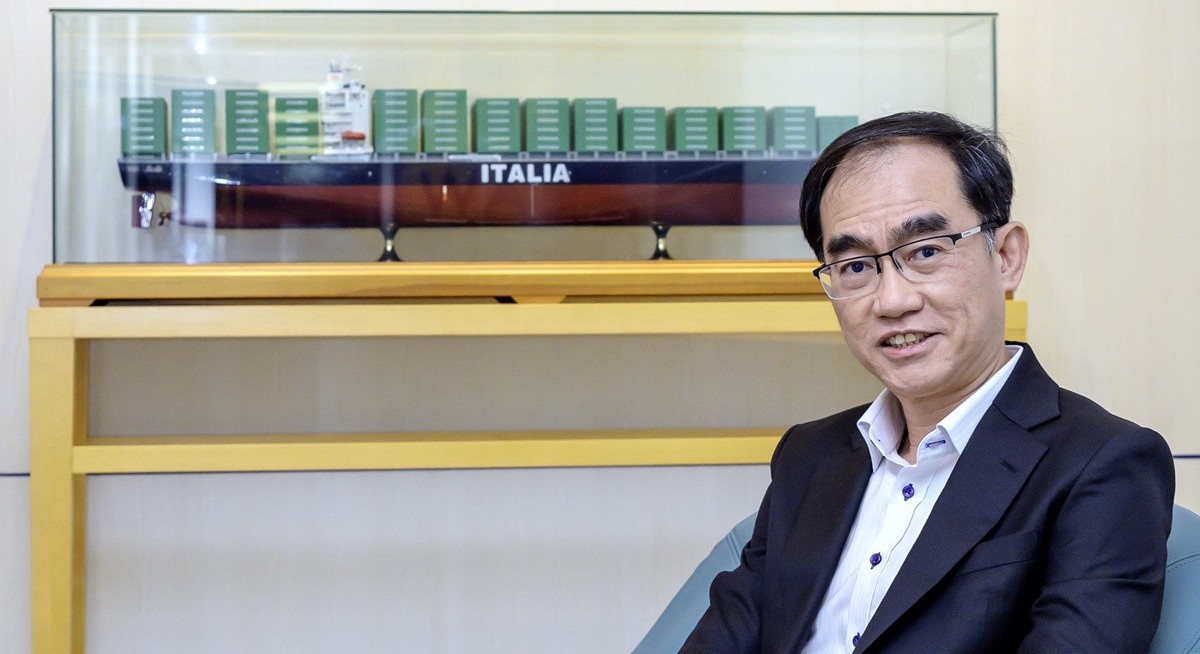


Lim Kai Ching, executive director of Uni-Asia Group, suggests that, based on his observation, shipping seems to be affected “quite positively” when there is volatility. Referring to the Covid-19 pandemic, Lim tells The Edge Singapore that the supply of vessels tightened while demand for shipped goods increased, which in turn propelled shipping charter rates higher.
On global uncertainty arising from recent US actions and policies, Lim says: “It may cause some positive impact, we believe, to the shipping market.” He explains that policy-driven uncertainty, such as tariffs, sanctions and changes to trade lanes, can “increase volatility” in dry bulk demand and freight rates, or even reroute cargoes and increase ton-miles, which can be “supportive” for shipping.
Shipping matters
Established in 1997 by Japanese businessmen, Uni-Asia is an “alternative” investment company with interests in two broad sectors: cargo ships and properties. It describes its business as an integrated “originate-manage-optimise-exit” model. Broadly speaking, this involves acquiring assets at “competitive” prices, managing and/or operating them to enhance asset value and recurring income, and finally unlocking capital and realising gains from asset sales.
See also: Penguin delivers composite superstructure to Singapore navy
According to Lim, both shipping and real estate involve managing cash flows to generate returns and are complementary to some extent. “If one cycle [or sector] is down, at least the other can help support,” explains Lim on why the company is involved in two businesses which are as different as apples are to oranges.
Uni-Asia’s shipping business is classified into three segments — shipowning and chartering, maritime asset management, and maritime services.
Shipowning and chartering, which generate revenue from chartering out wholly owned or joint-venture vessels, is the largest contributor to the shipping business. For the half-year ended June 30, 2025, this segment reported over US$13.5 million ($17.2 million) in turnover, a y-o-y 20% decline. Net profit after tax was US$534,000, a y-o-y decline of 78%. The decrease was attributed to fewer ships in the portfolio and off-hires. It was noted that the off-hires resulting from the M/V Glengyle incident hurt charter income. According to a Jan 29 update, repairs for the vessel are expected to be completed by mid-March.
See also: Men with a vision
For maritime asset management, where the company earns recurring and ad hoc fees by managing ships for third parties and financing arrangements, respectively, turnover was US$2.41 million, a significant jump from the US$210,000 of the previous corresponding period. Net profit after tax exceeded US$1.71 million, a reversal from the previous corresponding period’s net loss of US$462,000.
Lastly, the maritime services segment, which includes brokerage and commercial or technical management solutions, saw a 15% y-o-y drop in revenue to US$846,000 with a net loss of US$302,000.
Renewal for a new world order
In the shipowning and chartering segment, Uni-Asia operates in the dry bulk segment. As part of its business strategy to “future-proof” the business, the company has been building a portfolio of Japanese-built, wholly or majority-owned ships to mitigate the potential impact of policies and regulations by the US Trade Representative on maritime transport services.
Elaborating on its fleet renewal efforts, Uni-Asia has disposed of its older 29k deadweight tonnage (DWT) vessels and has progressively replaced them with newer, more fuel-efficient vessels. Recent acquisitions since 2025 include M/V Kellett Island, M/V Uni Sunshine, M/V Uni Horizon and M/V Trident Star. Uni-Asia says that the acquisitions reflect its practical approach to fleet renewal and improving fuel efficiency.

As part of strategic fleet renewal, Uni-Asia purchased a 75% stake in the M/V Kellett Island, a supramax dry bulk carrier. Photo: Uni-Asia Group
To stay ahead of Singapore and the region’s corporate and economic trends, click here for Latest Section
When asked why the company purchased vessels from the second-hand market instead of ordering newbuilds, Uni-Asia says its decision is typically driven by relative pricing, delivery timelines, shipyard capacity, regulatory requirements, and return/risk considerations.
Lim also provides further strategic insights into Uni-Asia’s strategy of acquiring second-hand assets and entering into joint ownership structures. Firstly, by serving as a minority partner in a secondhand vessel through a joint venture, Uni-Asia presumably gains a first-mover advantage by buying the vessel when the opportunity arises. “That [minority ownership] gives us a certain advantage, rather than just going out to the market and trying to outbid another buyer,” adds Lim.
Next, through the co-investment model, Uni-Asia can build relationships with smaller ship-owning companies. Typically family-owned, these companies are unable to expand their businesses on their own, and Uni-Asia steps in to support their objectives. “So together with us, they can co-invest and also expand their own business to be a more sustainable model,” says Lim. “That actually helps us build up our network for potential new business in the future.”
Most importantly, through joint ventures, Uni-Asia not only reduces risk but also gains more vessels for the same amount of capital. Lim says, “We invite co-investors so that we can get more vessels with the same amount of capital to try to expand our fleet without hurting too much into our capital base.”
As of January 2026, Uni-Asia owns stakes in 12 vessels — five wholly-owned, four with majority interest from 65.1% to 75% and three with 18% stakes. The fleet comprises handysize bulk carriers from 29k to 38k deadweight tonnage (DWT) and two Supramax vessels of around 58k DWT.
Uni-Asia’s focus on the handysize and supramax categories is also by choice. Able to carry a wide variety of cargo types and ply diverse trade routes, the flexibility of the fleet mitigates the risk of sudden downturns on specific trades.
In addition, the fleet is relatively young, with an average age of 10.6 years as of the start of 2026. Uni-Asia says that this represents a “two-fold opportunity” for the business in the uncertain global business environment.
Firstly, its younger fleet offers a competitive advantage over other ageing fleets. Based on data from the Clarksons Dry Bulk Trade Outlook, at least 42% of handysize bulk carriers are 15 years old or older, the highest proportion among vessel sizes. With fewer newbuilds than scrapped vessels, there could be a supply crunch, leading to higher charter rates.
Secondly, Uni-Asia’s younger fleet is more fuel-efficient. Equipped with modern features, such as electronically controlled engines and low-friction hull coatings, these vessels consume an estimated 10%–15% less fuel than standard 15-year-old vessels. Presumably, charterers would be more inclined to use Uni-Asia’s vessels for fuel and regulatory savings.
Prepared for uncertainty
A forward-looking but pragmatic company, Uni-Asia shares that “practical and regulation-led” principles guide its strategic adoption of technology. These include a shift to more efficient tonnage and maintaining strong technical/commercial management to reduce off-hire and improve utilisation. The business also stays up to date on evolving shipping regulations to ensure compliance.
Noting that the International Monetary Fund projects global growth to reach 3.1% in 2026 and world trade volume to grow at an average of 2.9% from 2025 to 2026, Lim believes that the global economy is still strong and Trump’s tariffs seem to have limited impact.
“I think the shipping market is still going to be healthy,” says Lim. “The demand is still there, and it’s still the most efficient way to transport goods.”
This counter does not typically attract heavy trading volume. Nonetheless, in line with the broader market, Uni-Asia’s share price has gained around a fifth over the past year.




