


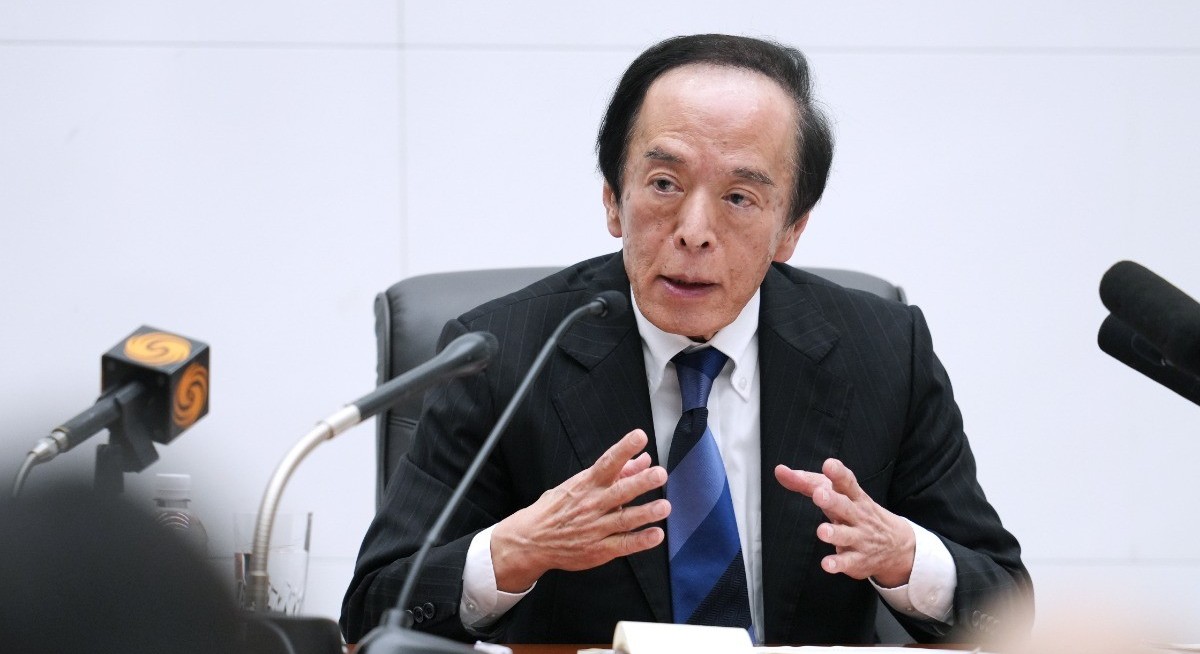


(June 3): The Bank of Japan (BOJ) needs to keep raising interest rates in response to developments in the economy and inflation, governor Kazuo Ueda said in his final scheduled speaking event ahead of a closely watched policy meeting.
Should the economy evolve in line with the BOJ’s forecasts, which see the Mideast turmoil calming and inflation reaching its 2% target, “I think the bank will continue to raise the policy interest rate at an appropriate pace”, Ueda said on Wednesday in a speech at a forum in Tokyo.
“Based on the data and anecdotal information available thus far, the upside risks to prices appear to be greater overall and are likely to emerge sooner,” he said.
Ueda’s remarks indicate there is a good chance of a rate hike this month, though they were not as explicit as comments he made telegraphing the previous two increases.
That suggests the governor wants to preserve some flexibility amid heightened uncertainty over the Middle East situation as well as Prime Minister Sanae Takaichi’s stance on monetary policy.
“While not making a policy decision today, he makes clear that a rate hike this month is firmly up for discussion and signs off by expressing confidence that Japan’s economy will be able withstand the current shock,” said Jane Foley, a senior foreign exchange strategist at Rabobank. “This suggest to me that there is a strong chance that he will be endorsing a rate hike this month.”
See also: Renault reminds Nissan of its clout with ouster of key director
The governor was speaking ahead of a June 15-16 board meeting, with traders assigning a roughly 85% chance as of Wednesday afternoon of a quarter-point hike that would lift the benchmark to the highest since 1995. The board held policy settings steady in April with a 6-3 vote, the biggest split under Ueda’s watch.
Two members who backed a hold at that gathering have since spoken in favour of a near-term hike without specifying a preferred timing, citing upside price risks stemming from the war in Iran.
Data have presented a mixed picture of the economy of late. Consumer inflation in Tokyo decelerated in May to the slowest in four years, and the latest capital spending figures were weaker than expected. At the same time, corporate profits have held up as exports stay robust
See also: BOJ governor Ueda to resume work next week after early discharge
Officials have maintained that even with an increase in borrowing costs, financial conditions will remain accommodative. The assertion means the central bank would still be working hand in hand with Prime Minister Sanae Takaichi’s government to support an economy threatened by rising costs that may squeeze corporate margins while also weighing on domestic demand.
Even if the outlook is unclear but policymakers judge that upside risks to inflation outweigh downside risks to growth, “it will be necessary to thoroughly discuss the pros and cons of raising the policy interest rate”, Ueda said.
The governor used a similar phrase in a December speech, which was followed by a rate hike that month, observed Yusuke Miyairi, a currency strategist at Nomura International plc. “The BOJ appears to be on track for a June hike,” Miyairi said.
The weak yen is also nudging the BOJ towards a rate hike this month. High oil prices stemming from the Middle East conflict have not only weighed on the currency, but have also upended the US Federal Reserve’s policy path, which now points to a rate hike by year end. That is adding pressure on the BOJ to close the gap between the countries’ benchmark rates, which would help support the yen.
Japanese authorities intervened to support the yen between April 28 and May 27, spending JPY11.73 trillion (US$73.50 billion or $94.10 billion) to buy the currency, a record for a one-month period. Those operations helped the yen strengthen from levels just beyond 160 per dollar to around 155, but the gains have gradually evaporated, giving rise to concern that costly imports will continue to drive inflation.

The yen touched 160 on Wednesday, the weakest level since April 30, when Japanese authorities conducted currency intervention for the first time since 2024. It was trading around 159.83 after Ueda’s remarks.
To stay ahead of Singapore and the region’s corporate and economic trends, click here for Latest Section
The BOJ meeting this month comes amid persistent concerns over the possibility authorities might fall behind the curve in fighting inflation. US Treasury Secretary Scott Bessent warned of that possibility back in August, while a former BOJ board member said last week that failure to hike this month would effectively put the board in that position.
“Ueda’s remarks show that the BOJ cares about behind-the-curve risk and suggest a shift away from the bank’s previous cautious stance, as it appears to place greater emphasis on upside risks to inflation than on downside risks to growth,” said Masayuki Nakajima, a senior currency strategist at Mizuho Bank in London.
Japanese companies are already feeling the pain from the geopolitical conflict. Producer prices rose in April at the fastest pace since 2014 compared with the previous month. Food and beverage companies seeking to pass on higher input costs will likely announce price increases on more than 10,000 items this year for a fifth consecutive year, according to Teikoku Databank.
Earlier on Wednesday, Japan’s Cabinet endorsed a JPY3.1 trillion package to fund measures to cushion households with subsidies from inflation tied to Middle East turbulence, putting fiscal policy back in the spotlight for bond investors.
While investors are focusing on Takaichi’s efforts to control the nation’s finances, another market focus is the pace at which the BOJ is reducing its bond purchases. In addition to setting rates this month, authorities will discuss whether to continue paring those purchases by JPY200 billion each quarter next fiscal year.
Uploaded by Tham Yek Lee




