


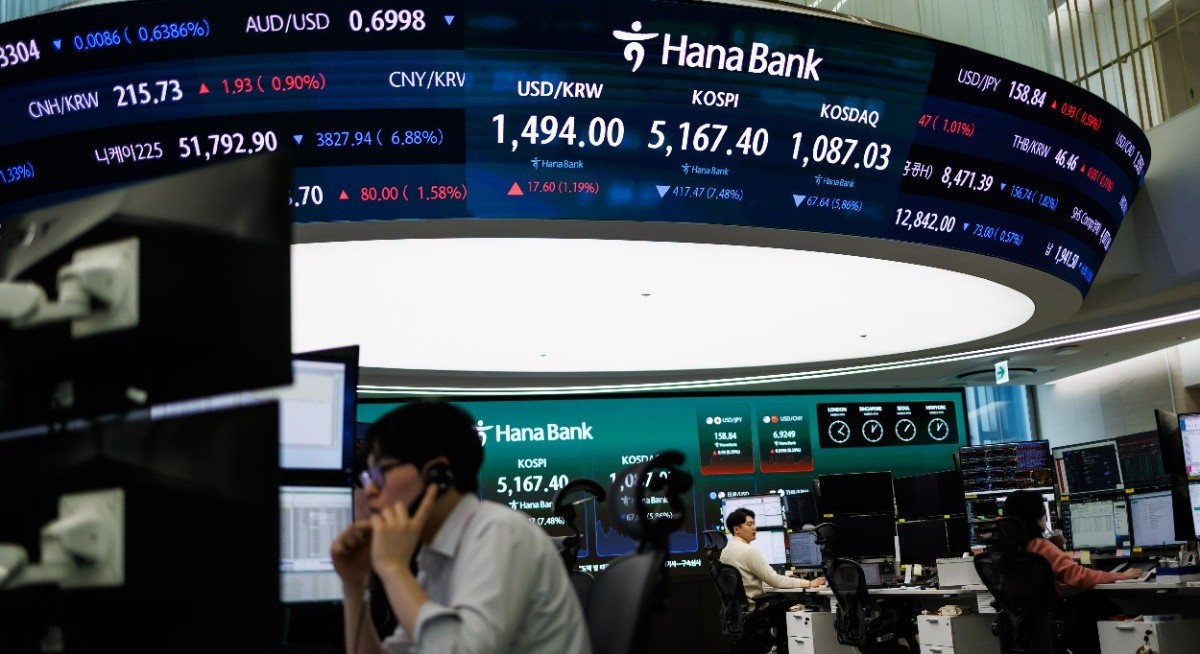


(April 9): A surge in global equities fuelled by the US-Iran ceasefire lost momentum after Tehran said several terms of the agreement had been breached, highlighting lingering uncertainty in markets. Oil climbed.
MSCI’s Asia Pacific equity gauge fell 0.4% after Iranian Parliament Speaker Mohammad-Bagher Ghalibaf said three clauses of the ceasefire proposal have been contravened so far. Stocks had rallied around the world on Wednesday — with the Asian index jumping the most in a year — on optimism the ceasefire deal would help ease the flow of crude oil and support economic growth.
Weighing on sentiment was Brent crude, which rose 2.5% to US$97.12 ($123.91) a barrel — rebounding from its worst plunge in more than six years. Treasuries wiped out an early rally in the US session and Australian government bonds dropped in early Thursday trading.
The whipsaw trading highlights how tentative market confidence remains after a cross-asset relief rally sparked by Washington’s pledge to halt strikes on Iran for two weeks and pursue talks with the Islamic Republic. Israeli attacks in Lebanon threatened to derail the ceasefire in the six-week conflict, which has already roiled energy markets with the effective closure of the Strait of Hormuz, a key artery for oil flows from the Middle East.
“The fragility of the ceasefire is already being tested with reports Iran closed the Strait of Hormuz in response to attacks on Lebanon by Israel,” Peter Dragicevich, an Asia Pacific currency strategist at Corpay Solutions in Sydney, wrote in a note. “The situation in the Middle East has relatively improved, but things remain fluid and given the volatile participants involved it could deteriorate at any time.”
A Bloomberg gauge of the dollar edged up 0.1%, while gold dropped 0.4% to US$4,700 an ounce. Bitcoin was a touch weaker, trading around US$71,000.
See also: US stocks halt rally at end of best week in 2026; oil and gold down
Sporadic fighting continued throughout the Middle East, including in Lebanon, where Israel continued its campaign against the Iran-aligned Hezbollah militia. Iranian officials cast that as violating the terms of the less-than-a-day-old ceasefire.
Meanwhile, a key Saudi oil pipeline to the Red Sea suffered limited damage from an earlier drone strike on one of its pumping stations, and crude flows continued, according to people familiar with the matter.
“Much will depend on adherence to the ceasefire and progress in negotiations, and it will be difficult to return to the pre-conflict status quo,” said Yiping Liao, a portfolio manager at Templeton Global Investments. “While this may mark a floor for further escalation, risks remain elevated.”
See also: In troubled times, remember that investment is a circular game
A wave of optimism had swept through global financial markets Wednesday, boosting stocks and cryptocurrencies while spurring a selloff in oil after the US and Iran reached a ceasefire deal. The rebound in risk appetite drove the S&P 500 Index up 2.5% and revived bets the Federal Reserve will cut interest rates in 2026.
Elsewhere, minutes of the Fed’s March policy meeting published Wednesday showed most officials worried a protracted war could hurt the jobs market and warrant lower rates. Meantime, many policymakers highlighted the risk to inflation.
Traders are still focused on the Strait of Hormuz and whether energy flows will resume through the waterway.
The strait remained largely blocked on Wednesday, as shipowners try to understand if they can safely transit the vital waterway following a fragile ceasefire between the US and Iran that was announced overnight.
Just three ships were observed leaving the region on Wednesday, according to ship-tracking data compiled by Bloomberg. Some had links to Iran, and the country’s media subsequently reported that passage for tankers will remain blocked after attacks on Lebanon. In normal times about 135 ships cross daily, and more than 800 freighters are stuck inside the gulf, mostly waiting to leave.
Reopening the strait will be “exceedingly messy”, with Iran expected to exert control over cargo flows and potentially influence nearly every barrel that leaves the waterway, according to RBC Capital Markets LLC.
“The ceasefire is a clear positive, but it’s not a resolution,” said Mark Hackett at Nationwide. “What stands out is how quickly the market flipped once the pressure eased. When positioning gets this crowded, it doesn’t take much to spark a reversal.”
To stay ahead of Singapore and the region’s corporate and economic trends, click here for Latest Section
Corporate highlights:
- Delta Air Lines Inc expects to incur more than US$2 billion in higher fuel costs through June because of the Iran war, prompting the carrier to tread carefully and stick to its previous full-year profit forecast.
- Exxon Mobil Corp lost 6% of its global production in the first quarter as the Iran war paralysed oil and natural gas operations in the Persian Gulf.
- Meta Platforms Inc debuted its latest artificial intelligence model — its first since chief executive officer Mark Zuckerberg embarked on an overhaul of the company’s AI organisation to keep pace with rivals.
Some of the main moves in markets:
Stocks
- S&P 500 futures fell 0.2% as of 9.47am Tokyo time
- Hang Seng futures fell 0.3%
- Nikkei 225 futures (OSE) fell 0.5%
- Japan’s Topix fell 0.3%
- Australia’s S&P/ASX 200 fell 0.2%
- Euro Stoxx 50 futures rose 0.1%
Currencies
- The Bloomberg Dollar Spot Index rose 0.1%
- The euro was little changed at US$1.1657
- The Japanese yen fell 0.1% to 158.77 per dollar
- The offshore yuan was little changed at 6.8361 per dollar
Cryptocurrencies
- Bitcoin fell 0.9% to US$70,722.24
- Ether fell 1.3% to US$2,180.82
Bonds
- The yield on 10-year Treasuries was little changed at 4.30%
- Japan’s 10-year yield advanced two basis points to 2.385%
- Australia’s 10-year yield advanced eight basis points to 4.94%
Commodities
- West Texas Intermediate crude rose 3.2% to US$97.40 a barrel
- Spot gold fell 0.1% to US$4,714.24 an ounce
Uploaded by Chng Shear Lane




