


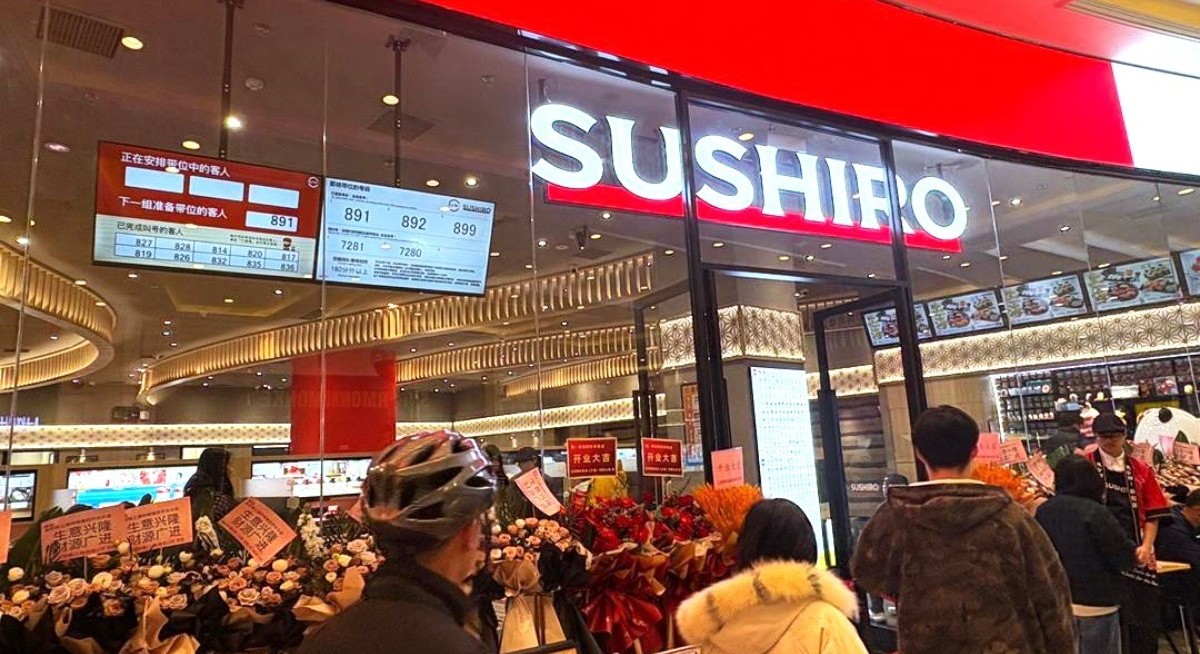


Oscar, a 22-year-old from Fujian province, who gave his English name to discuss sensitive topics, was among its new customers.
Asked about the recent spat over Japanese Prime Minister Sanae Takaichi’s Nov 7 remarks suggesting Tokyo could deploy its military if China attempts to seize Taiwan, he took a balanced view. “I respect our government’s decision. But this is not political. It’s just having a meal,” he added, taking his seat at the buzzing restaurant.


See also: Japan’s economy ekes out growth as Takaichi eyes more spending
Asia’s top economies might be at loggerheads on the world stage, but for China’s 1.4 billion shoppers, it’s largely business as normal. That’s because while Communist Party officials have discouraged travel to Japan, limited seafood imports and cancelled some Japanese concerts and films, authorities have avoided stoking public anger to a level beyond their control.
It marks an evolution in China’s economic coercion playbook as leaders calibrate their retaliation to avoid denting already weak consumer spending at home, or stirring up hard-to-contain social unrest.
“Inciting public anger could lead to unpredictable outcomes that would potentially be difficult for the government to manage,” said Jeremy Chan, a senior analyst at Eurasia Group and a former US diplomat in China and Japan. “Japanese foods and products remain immensely popular in China,” he added, calling the dispute over Takaichi’s comments “abstract” to the general public.
See also: Russia cuts key rate to 15.5% despite uptick in inflation
On China’s largest online retailer, Tmall, revenues for some of Japan’s biggest brands operating in the world’s No. 2 economy haven’t seen a dent since the dispute began — with Uniqlo, Muji, Shiseido, Sony and Panasonic even clocking an increase in business, according to analytics firm Hangzhou Zhiyi Technology.
Underscoring the need for calm, former Global Times editor-in-chief Hu Xijin — once one of China’s loudest nationalistic voices — last month warned against things getting too heated. “The struggle against Japan could be a protracted one,” Hu posted on his Weibo account. “Maintaining the firmness, rationality and unity of Chinese society means resilience and sustainability.”
The last time China’s ties with its Asian neighbour spiralled to this extent was in 2012, after Tokyo decided to nationalise contested islands known as the Senkaku in Japan and the Diaoyu in China — an uninhabited but possibly resource-rich area in the East China Sea. Back then, bellicose rhetoric in Chinese state media helped stoke anti-Japanese protests in more than a dozen cities including Beijing and Shanghai.
Fast Retailing temporarily closed 42 of its Uniqlo stores in China — then its second-largest market by outlets — and superstore giant Aeon shut 30 of the 35 outlets it had in Guangdong and Shandong provinces. Images of an attack on a Chinese motorist in central Xian, beaten for driving a Toyota Corolla, tore through China’s internet, further deterring buyers from Japanese cars.
At a Toyota dealership in Shenzhen on Thursday, a saleswoman surnamed Cai said she hadn’t seen any negative impact on sales of the company’s bZ3X model — a US$15,000 ($19,370) electric car that’s helping the brand claw back market share in China.
Shoppers milling around Uniqlo’s three-story outlet in Beijing this week also seemed unbothered by the latest brouhaha.
“I want to stand by my country, but I don’t think the situation is so bad [that] we need to stop buying Japanese products,” said one woman in her late fifties surnamed Liu. “Everything here is made in China anyway,” she added, browsing the brand’s famous HeatTech thermal leggings.
To stay ahead of Singapore and the region’s corporate and economic trends, click here for Latest Section
Another shopper surnamed Chen said she liked taking vacations in Japan but had cancelled a recent trip over safety concerns. “I saw videos online of Japanese people asking Chinese tourists why they were there,” she added. Deteriorating ties wouldn’t sway her shopping habits, she said, citing the need for good quality clothes.
Footage of Muji’s newly renovated Chengdu store, in China’s southwestern Sichuan province, painted a similar picture. Social media users this month complimented the store’s collaboration with local designers, as they tried products tailored to the Chinese market including chili-oil gelato. Given the situation “I’m surprised it’s still packed,” wrote one user on social media platform Xiaohongshu.
The calm pervading the high street could change if Japan’s leader doesn’t meet Beijing’s demand to retract her comments, said Wu Xinbo, who has advised China’s Foreign Ministry.
“If Takaichi does not adjust her position on this issue, China is likely to increase the pressure,” said Wu, who heads Fudan University’s Center for American Studies. “Let’s see what will happen.”
Back at the Sushiro sushi joint, a notice by the cash register urged customers for cooperation when queuing, citing recent disturbances amid the throngs of excited diners.
“Let’s work together to maintain civilisation and fairness,” the notice read.
Uploaded by Liza Shireen Koshy




