


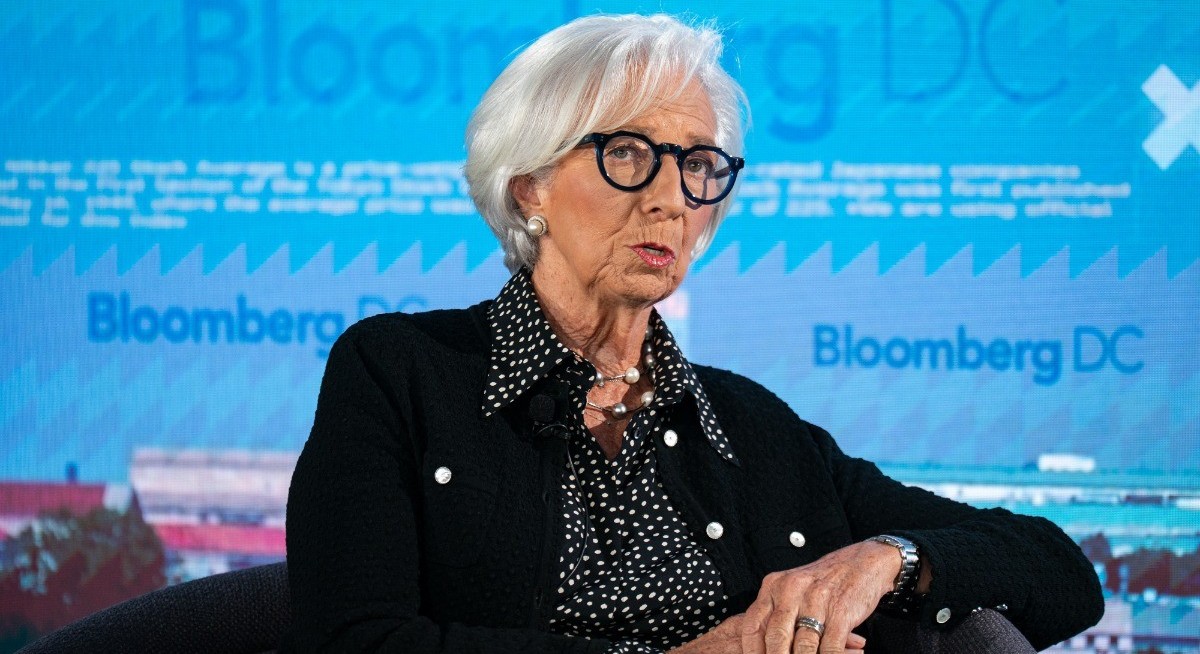


(June 15): European Central Bank (ECB) president Christine Lagarde warned that high energy prices are starting to feed through to other parts of the economy.
“Indirect effects of inflation, we have absolutely started to see that more or less everywhere in recent weeks,” Lagarde said on Monday in a French radio interview.
“When we start to feel second-round effects bubble up — which are risks of wage increases in particular — we necessarily have to take measures,” she said. “There’s one indicator we look at particularly, which is underlying inflation.”
The ECB hiked interest rates last week for the first time since 2023 after the war in the Middle East drove up prices. Officials aren’t ruling out a second increase as soon as their July meeting, though markets have pared their expectations as a resolution to the more than three-month conflict nears.
Money markets are still betting the ECB will raise its deposit rate by another quarter-point to 2.5% by year end. They also see a 25% chance of a further move, to 2.75%. That had been fully priced as recently as last week.

See also: Fed and BOE stay guarded after 100 days of Iran war
Monday’s remarks came hours after the US and Iran said they had reached an interim agreement to reopen the Strait of Hormuz, prompting a sharp drop in energy prices.
“If this news is confirmed by developments in the coming days and the signature of a memorandum of understanding, it’s good news,” Lagarde said. “We can only welcome it, above all if it means reopening and de-mining the Strait of Hormuz.”
Bundesbank president Joachim Nagel cautioned later that it will still take months for oil supplies to return to normal, even if the strait reopens in short order. Price pressures are likely to rise again once fiscal support for soaring energy bills expires, he added.
See also: UK economy shrank in April as Iran war started to take toll
In a separate interview, Latvian central-bank chief Martins Kazaks said the ECB is ready to take further action to stop higher energy prices spreading to the rest of the economy.
There have also been warnings, however, that lifting borrowing costs will cause undue pain, with growth in the 21-nation eurozone already flagging.
“I hear criticism,” Lagarde said “But I have to kill inflation if it awakens because if inflation gets out of the bottle, getting it back in again will be much more difficult and costly, and a long-term inflation situation is unacceptable.”
Lagarde also told France Culture:
- “When there’s a bit of a storm, the captain remains on board.”
- “So the captain of the ECB is on board and today we are facing a situation that we hope will improve a bit with the agreements that have perhaps been found in terms of war in the Middle East.”
- “My duty is to complete the price stability mission and that for now is what guides my action. I will be attentive to statements from people, to campaigns, to programmes and that if I see that the anchorage of France at the heart of the EU is threatened by misunderstandings, wishing thinking and separatism, I will speak out. But saying that I am a candidate to anything, absolutely not.”
- “That is one of the keys of the success of the US — the dollar is strong because there are mass Treasuries and investors consequently have liquidity. Today we don’t have that. It’s not that we don’t know how to do it; we did it once in response to Covid.”
- “We don’t necessarily need Covid to do that and what I hope, in the perspective of an economic and monetary union, for which we take care of the monetary part, is for the financial and economy part to be developed between member states, notably the euro area, around federating projects that justify collective financing.”
Uploaded by Tham Yek Lee




