


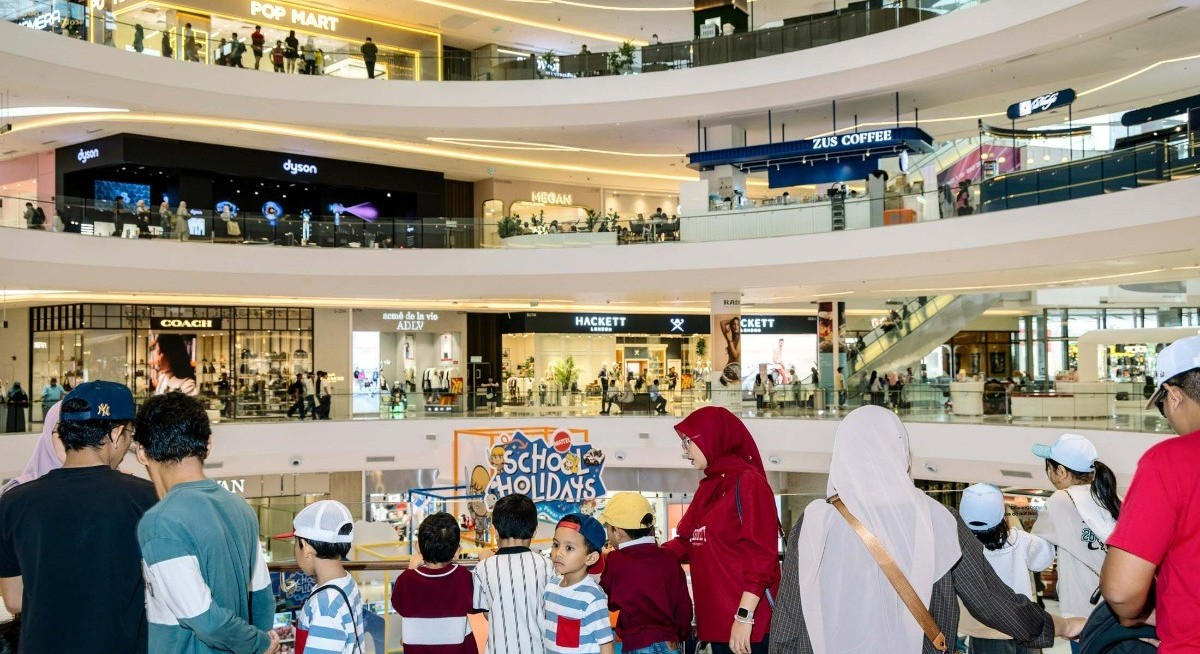


HO CHI MINH CITY/KUALA LUMPUR (June 12): Prasana Rao thinks nothing of spending 12 hours at a stretch in her favourite mall near Kuala Lumpur. With her newborn baby and as many as 14 family members in tow, she often heads to IOI City Mall for a day of “retailtainment”, drawn by the climate-controlled comfort that offers respite from Malaysia’s heat. The sprawling complex features an Olympic-sized ice rink, an indoor farm, late-night cinemas, pickleball and badminton courts, and more than 800 stores.
“I’ve gone to this mall in the morning and only come out at night,” says the 34-year-old, making her way to a baby apparel store on a recent Sunday. “Here, you can get anything you want.”
This city-within-a-city — a multi-storey edifice of glass elevators and crisscrossing escalators — has some three million visitors a month. It’s both a cathedral of consumerism and a home away from home.
“This is our way of living,” says Chris Chong, chief operating officer of IOI City’s parent, IOI Properties Group Bhd.
“Where do people go for the weekend? They go to the mall. It is in our DNA.”
From Malaysia to Vietnam and Thailand, malls are expanding across Southeast Asia, fuelled by a rising middle class and shifts in urban living. The region is home to five of the world’s 10 largest malls, many functioning as social hubs where families and friends spend growing incomes and leisure time.
See also: Orchard Road, suburban mall rents could rise up to 2% in 2026: Savills Research
Around 48 malls, totalling 14 million square feet of space, will be completed across Ho Chi Minh City, Hanoi, Singapore and Bangkok over the next two years, according to CBRE Group.
In many Asian cities, malls are “third places” — social anchors between work and home, says Beibei Li of Carnegie Mellon University’s Heinz College. “Instead of parks or plazas, people meet, hang out, date, study and spend weekends in malls.”

See also: In quick commerce, every millisecond hits the bottom line
A very different story is unfolding in the US, where mall culture took shape in the 1950s, driven by postwar prosperity and suburbanisation, but has more recently been on the decline. Decades of overbuilding left far more retail space per capita than demand could sustain. Consumers shifted their spending online, foot traffic fell, and big-box tenants closed, triggering a cycle of falling occupancy and underinvestment.
Many malls have since been repurposed into offices, logistics hubs or mixed-use developments, though some surviving centres have seen a modest revival among Gen Z shoppers seeking in-person experiences.
From a peak of about 1,500 in the early 1990s, the number of US malls has fallen to around 1,150, according to Malls.com, which tracks shopping malls globally. Virtually none have been built in the past two decades, and while around 250 are performing well, the rest “mostly have a negative trajectory”, says Vince Tibone, head of Green Street’s US industrial and mall research.
Many now have a “tired aesthetic”, he says. “You feel like you have stepped back into the 1990s and there hasn’t been a dollar in capex spent on them in 30 years.”
Those malls still drawing crowds are shifting towards “experience-driven retail”, with gaming zones, bowling and cinemas serving cocktails and craft beer that appeal to younger consumers, says Keith A Fraley of New York’s Fashion Institute of Technology. In effect, they are converging towards a model long seen in Southeast Asia, where malls were designed from the outset as destinations rather than purely shopping centres.
“Cities like Manila, Bangkok and Kuala Lumpur have malls embedded into the cultural fabric,” Fraley says over coffee at SC VivoCity mall in Ho Chi Minh City, where he attended a nearby conference. The previous evening, the mall — which includes a rooftop children’s water playground — hosted a concert.

To stay ahead of Singapore and the region’s corporate and economic trends, click here for Latest Section
The transformation of malls into “third places” is visible across Asia, including in China and South Korea. But the phenomenon is especially pronounced in Southeast Asia, where malls often serve as de facto public spaces and community gathering points in dense, rapidly urbanising cities with limited alternative social infrastructure. They are often integrated with high-density housing, offices and transport and serve as refuges from heat, humidity, pollution and seasonal rains.
Their development accelerated in the region after the late-1990s Asia financial crisis, according to Mati Brooks, the editor of Malls.com. Today, there are as many as 2,000 malls, and “physical retail is still being built in the region at a scale and density the US never reached”.
“Multigenerational family visits are the rule,” Brooks says. A Saturday at Bangkok’s Icon Siam or Manila’s SM Mall of Asia “is closer to a town fair than to a shopping trip”.
Southeast Asian malls act as “value-multiplying infrastructure” that help accelerate nearby home sales and office rentals at premium prices, according to Lenita Tobing, Jakarta-based managing director and senior partner at Boston Consulting Group. “They are often the anchor that makes everything else more valuable, driving footfall, formalising retail and catalysing entire urban clusters around them,” she says.
It can take 15,000 steps — about 11km (seven miles) — to traverse IOI City Mall. The complex, resembling a giant flower bud with a leaflike roof, is the centrepiece of a resort project featuring hotels, offices and residential buildings that spans 319 hectares (788 acres) — almost the size of New York’s Central Park. The mall’s cavernous atriums can be disorienting: Regulars learn to park strategically to avoid lengthy walks back to their vehicles. It operates like a mini-metropolis. While shops close at night, cleaning and maintenance crews work around the clock. It caters to nearly every need, with medical clinics, a pharmacy and retailers ranging from H&M and Marks & Spencer to Dior and Chanel. Around 7,000 people work there, and occupancy of its 2.54 million square feet of leasable space stands at 99%, with a waiting list for tenants, Chong says.
Malaysians meet, fall in love and marry at the mall, which hosts banquet facilities and bridal services for Malay, Indian, Chinese and Western-style weddings. Prime Minister Datuk Seri Anwar Ibrahim recently visited to attend prayers at one of its four prayer halls. A bus service linking the complex with Singapore, some 340km southeast, is set to launch, and expansion plans include another one million square feet of leasable space, a concert hall, a 10-acre park and a luxury hotel.
On a recent Sunday, visitors watched Bengal cats and marmoset monkeys at the indoor farm, while children clambered over obstacle courses at the adventure park. The smell of freshly baked bread and sizzling meats from some of the mall’s 200 eateries wafted through the shopping courts.
Danial Irfan, who visits the mall at least twice a month, paused with his girlfriend and friends overlooking the ice rink.
“Sometimes, even if I don’t have anything planned, I come here,” says the 30-year-old project manager.

Yet even as malls entrench themselves in daily life, the pace of development is beginning to test the limits of demand.
The expansion across Southeast Asia could lead to too many stores in cities like Bangkok and Kuala Lumpur, though this hasn’t been tested by an economic slowdown yet, Brooks says. Rising mobile e-commerce is also adding pressure on physical stores. SM Prime Holdings Inc, which operates 90 malls in the Philippines, has paused plans to spend as much as 100 billion pesos (US$1.6 billion or $2.12 billion) this year on new projects amid economic volatility linked to the Iran war. Its SM Mall of Asia complex overlooking Manila Bay includes a 20,000-seat concert and sports arena, a rooftop football pitch and a game centre.
Still, Thailand’s Central Pattana, which operates 38 complexes, plans to invest more than US$3.8 billion ($4.88 billion) in new developments over the next five years. “Our malls are not just shopping centres. They are destinations where families come together and communities are built,” says chief executive officer Wallaya Chirathivat. The company reported 10% year-on-year revenue growth in its mall segment in 2024, a 4% increase last year and a 6% rise in the first quarter of 2026.
Bangkok, a city of about 10 million residents, has roughly 20 megamalls and scores of smaller complexes, according to market researcher Kadence International. Some are linked by elevated walkways and are becoming tourist draws in their own right — rivalling the city’s famous temples and floating markets.
In Vietnam, malls are starting to reshape the landscape. Vincom Retail JSC, which has 90 complexes and reported a 6.6% revenue jump in 2025 to 8.4 trillion dong (US$319 million or $410 million) from leasing and other services, last year opened a megamall near Hanoi that features Korean-style saunas. Retail giants from Japan and South Korea are also ramping up investment in the country.
As mall culture takes hold, consumer behaviour is shifting. Dam Sen Cultural Park, an amusement and water-based theme park in Ho Chi Minh City, saw attendance fall 15% last year, and reported that customers were being drawn instead to malls’ low-cost or free activities. Traditional retail is also being disrupted. Once hubs of commerce and social life, many of Vietnam’s outdoor “wet” markets are seeing reduced traffic as shoppers turn to malls instead.
“The number of customers coming to my stall has fallen by about half compared with five to 10 years ago,” says Nguyen Van Dieu, 50, handing leafy greens to a customer on a motorbike. Nestled in a quiet Ho Chi Minh City alleyway, his stall is overflowing with broccoli, tomatoes and carrots. A vendor next door sells live basa and red tilapia in pans full of water. It’s a world away from the nearby Vincom Center, a multilevel mall in the city’s tallest skyscraper, Landmark 81.
There, Hoang Thi Bao Yen, wearing a pleated skirt and visor, sits on a bench with her friend after a game of pickleball. She makes a face when asked about shopping at a wet market. The 40-year-old mother prefers the mall’s modern retail, including its supermarket. The centre has a playground for her children and food outlets for family birthdays and other celebrations.
“Malls have become a part of my daily routine,” Yen says. “Going to malls is now a part of Asian culture.”
Uploaded by Chng Shear Lane




