


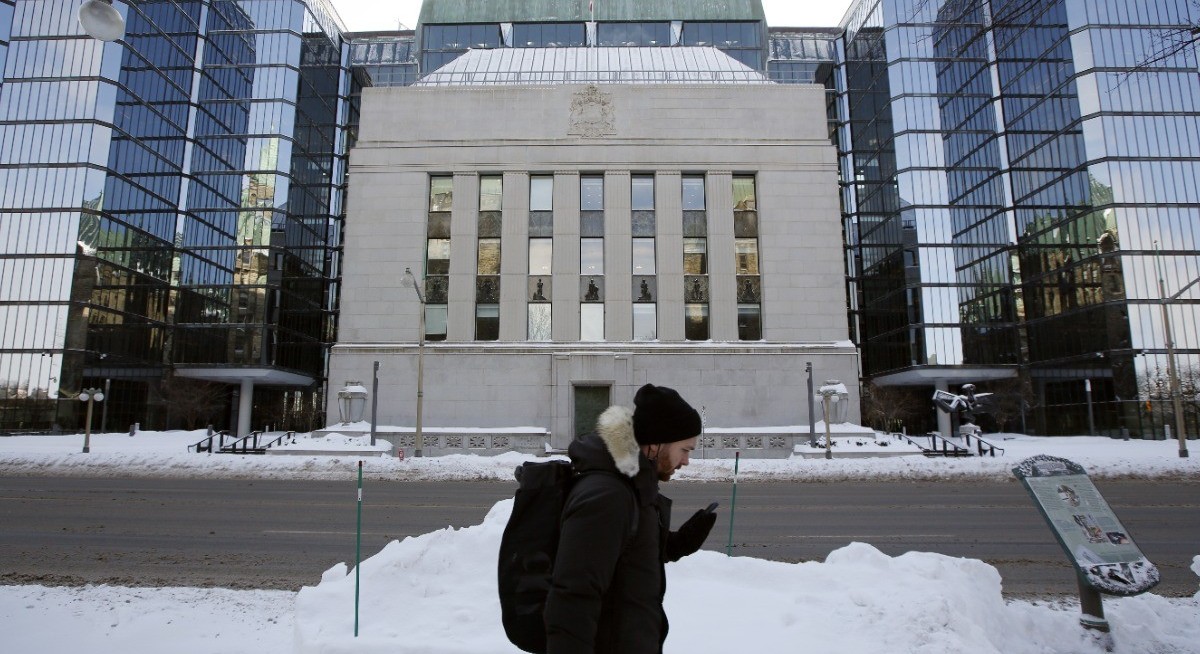


(Jan 29): The Bank of Canada held interest rates steady, but officials made clear that they’re not sure about the duration of their pause, nor in which direction borrowing costs are headed.
Policymakers led by governor Tiff Macklem kept the policy rate at 2.25% for a second straight meeting on Wednesday, as widely expected by markets and a Bloomberg survey of economists.
“The Canadian economy is adjusting to the structural headwinds of US protectionism,” Macklem said in prepared remarks, adding his governing council believes “elevated uncertainty makes it difficult to predict the timing or direction of the next change in the policy rate.”

At the same time, officials suggested the outlook would have to change significantly to move them off the sidelines, while repeating that they were “prepared to respond.”
“The current policy rate remains appropriate, conditional on the economy evolving broadly in line with the outlook we published today,” Macklem said.
See also: China eases duties on EU dairy in latest sign of trade thaw
The loonie extended a rally versus the US dollar after the release of the decision, rising 0.3% to C$1.3536 as of 9.55am in Ottawa, its strongest level since October 2024. Canadian debt was little changed, with the two-year yield trading around 2.58%.
The bank offered up new forecasts in a monetary policy report, and sees Canada’s economy growing 1.1% this year and 1.5% in 2027, “broadly in line” with its October projection. Output is expected to stall in the fourth quarter of 2025, the bank said, but the economy didn’t take as much damage from the tariff hit as was previously believed last year, with growth revised higher to 1.7%.

See also: US, Japan zero in on energy and chips for US$550 bil fund — Bloomberg
The neutral suite of communications suggest the central bank is comfortable holding borrowing costs steady until it sees how volatile US tariff policy will evolve, and how that will impact the Canadian economy. At the same time, policymakers pushed back on expectations of a sustained pause, or even whether the bank’s next move will be a cut or a hike, citing heightened uncertainty.
The upcoming US-Mexico-Canada Agreement review is a key risk to the outlook, the bank said.
On Saturday, US President Donald Trump signalled an early escalation in those talks with a threat of 100% tariffs on Canadian goods if the country “makes a deal with China”. Prime Minister Mark Carney recently agreed with President Xi Jinping to lower tariff barriers, but Canada isn’t pursuing a free-trade arrangement with China.
“US trade policy remains unpredictable, and geopolitical risks are elevated,” Macklem said, adding that it’s “too early to tell how well the Canadian economy will adjust to current tariffs and ongoing uncertainty.”

Bank of Canada governor Tiff Macklem said the Canadian economy’s 'restructuring, including more diversified trade and a more integrated internal market, will support some recovery in our productive capacity. But it will all take some time'.
On one hand, “the transition to the new trade environment could be smoother than we expect, with stronger business and household spending,” Macklem said. Alternatively, he said the labour market “could weaken further as trade impacts deepen, leading to lower household spending. Financial conditions could also tighten if volatility returns to markets”.
To stay ahead of Singapore and the region’s corporate and economic trends, click here for Latest Section
Charles St-Arnaud, chief economist at Servus Credit Union, said “there is nothing in today’s decision that would change our view that the Bank of Canada will leave its policy rate on hold for an extended period.”
Tariff fallout
Macklem said the impact of US tariffs was visible in the labour market, particularly at the start of 2025 when sectors hit with levies cut production and jobs. Employment in the second half of the year improved, he said, but the unemployment rate, at 6.8%, “remains high”, youth joblessness is elevated, and fewer firms are planning to hire.
The bank said inflation was likely to stick close to the 2% target over the forecast horizon, with “trade-related cost pressures offset by excess supply.”
It said the main upside risks to inflation would be less excess supply than forecast, or a more costly restructuring of businesses in the face of US tariffs. The main downside risks would be the economy taking a larger hit from the trade shock or tighter than expected financial conditions.
At a 2.4% yearly pace in December, headline inflation was boosted from base effects of temporary sales tax relief last winter. They also noted that their so called preferred measures of core inflation had eased to a 2.5% annual pace.
At the same time, the bank also hiked its 2025 potential growth estimates to 2.3% from 1.6%, “so the amount of slack in the economy remains largely unchanged.”
The output gap is expected to remain open to the end of 2027, according to the bank’s forecasts.
It says past rate cuts and growing disposable incomes will support moderate household spending increases. Consumption is expected to contribute 0.7 percentage points to GDP in 2026 and 0.6 in 2027, revised slightly downward from October.
Business investment is seen strengthening modestly as firms adjust to the new trade environment and governments increase infrastructure spending. The bank expects business fixed investment to add 0.1 percentage points to GDP this year and 0.3 next year, similar to its previous expectation.
“Despite some recent optimism about the economy, it doesn’t look like minds are convinced at the bank,” Andrew DiCapua, principal economist at the Canadian Chamber of Commerce, said in a statement. “The message from governing council is pretty clear: the Canadian economy is still underperforming.”
Earl Davis, head of fixed income and money markets at Bank of Montreal, said the Carney government’s recent announcement of an increase to a sales tax credit for lower-income households is “actually very stimulative.”
“That’s almost like an ease,” he said on BNN Bloomberg Television, noting the move prompted his bank to lower its expecatations to one rate cut by year-end, down from as many as two. “The Bank of Canada might be thinking of that as well.”
Macklem said the Canadian economy’s “restructuring, including more diversified trade and a more integrated internal market, will support some recovery in our productive capacity. But it will all take some time.”
He added: “Monetary policy cannot compensate for the structural damage caused by the tariffs, and it cannot target hard-hit sectors of the economy.”
Uploaded by Felyx Teoh




