


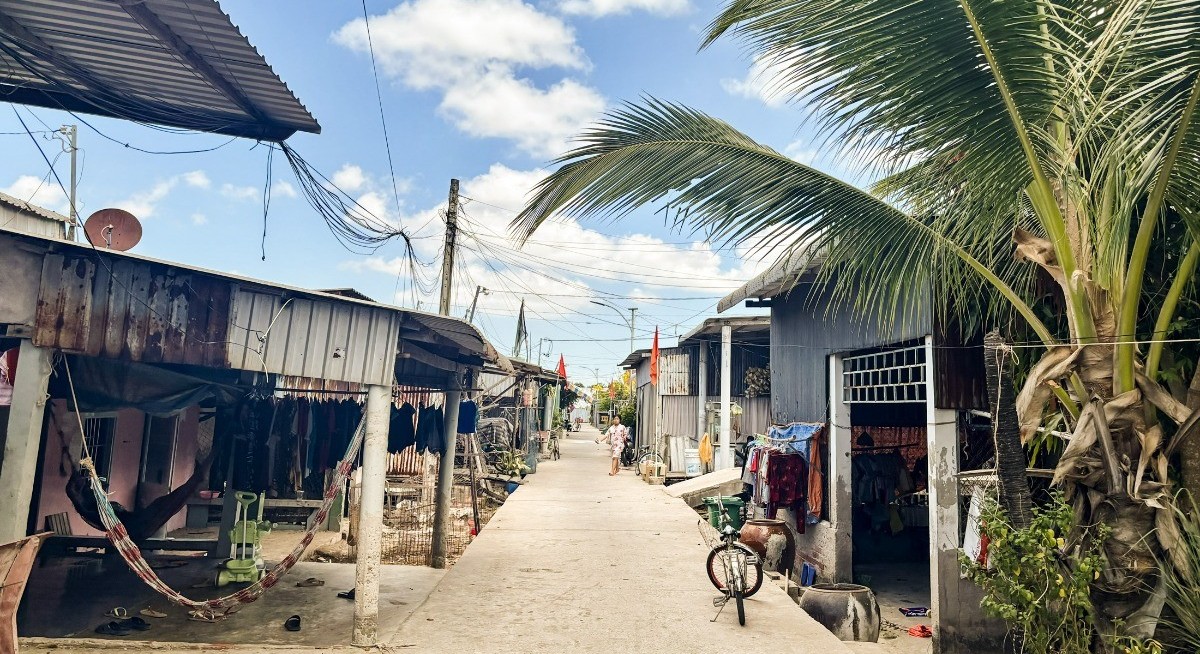


HANOI/SINGAPORE (July 6): At Vietnam’s southernmost tip, some eight hours by car from Ho Chi Minh City along potholed roads, heavy trucks rumble through mangrove swamps and shrimp farms as soldiers and construction crews work around the clock to build the country’s longest sea bridge.
The 18km crossing connects Ca Mau province to tiny Hon Khoai island — the centrepiece of a nearly US$4 billion ($5.17 billion) dual-use seaport and transport corridor linking the Mekong Delta region to global shipping routes in the Gulf of Thailand. For Hanoi, the project not only represents an expensive economic gamble, but a strategic response to growing concerns about Beijing’s expanding influence next door in Cambodia, and its increasingly dominant position in the South China Sea.
Plans for Hon Khoai island have circulated for years, but the project backed by the navy gained urgency in 2024 after Cambodia broke ground on a China-funded canal that raised fresh security concerns in Hanoi, according to a senior defence official familiar with the matter. The port would create a new gateway for trade and logistics in the Mekong Delta while giving Vietnam a stronger foothold in surrounding waters, said the official who requested anonymity and was not authorised to speak publicly.
To Lam, who took over as Communist Party chief in 2024, elevated Hon Khoai as a strategic priority in November, signalling that the focus of Hanoi’s rivalry with Beijing was shifting away from just the disputed reefs and resource-rich waters in the South China Sea.
Vietnam is watching China’s relationship with Cambodia “with growing unease”, said Le Hong Hiep, a senior fellow at the Vietnam Studies Program at Singapore’s ISEAS-Yusof Ishak Institute. “A dual-use port in the southwest, one that could accommodate military vessels, addresses these anxieties directly.”
China last year helped upgrade the Ream Naval Base on the Gulf of Thailand, while the US$1.2 billion Funan Techo Canal, a 180km artery from Phnom Penh to the coast, has fuelled fears that Cambodia could increasingly bypass Vietnamese ports and waterways, weakening a source of economic leverage over its neighbour.
See also: Fewer ships transiting Hormuz along Oman coast after U-turns
Hon Khoai “looks less like an economic bet and more like a geopolitical hedge”, said Hiep.
The island’s position on the approaches to the Gulf of Thailand will allow Vietnam to operate larger vessels closer to developments in Cambodia and the country’s southwestern maritime frontier. And unlike shallower facilities farther west, the deep-water port, which is expected to handle 20 million tons of cargo annually, is designed to receive ships of up to 250,000 deadweight tons, large enough for some of the world’s biggest commercial bulk carriers and tankers.
While details of the military component remain limited following its commencement in August, the broader plans also call for an 80km expressway alongside comprehensive logistics facilities.
See also: Tankers U-turn in Hormuz with some taking Iran route
In Ca Mau’s remote fishing community of Dat Mui, where stilt houses flank the town centre’s harbour, roadside cafes and supply shops have sprung up to cater to the influx of construction workers.
“This property used to be just abandoned swampland,” said 40-year-old Nguyen Thi Quyen, who works at the roadside restaurant her family opened last year just across from a construction site. “But we invested to fill and level the ground and set up this shop because we saw the business opportunities.”
Across the water, Hon Khoai is no longer populated, but the island has a deep military lineage and functioned as a vital transit point for revolutionary forces during the wars against France and the US. During a visit in November, Lam made a stop at a tourist complex featuring a mock fairy-tale castle, a Buddhist pagoda and a monument marking Vietnam’s southernmost point. Standing before billboards and flanked by military officers, he called Hon Khoai a “national strategic focal point”.
If completed as planned, Hon Khoai would allow Vietnam to sustain larger naval combatants and potentially foreign naval visits in a theatre where its presence has traditionally relied on smaller patrol craft, said Adam Farrar, a senior geoeconomics analyst with Bloomberg Economics.
It “would represent one of the most significant shifts in Vietnam’s naval posture in decades”, said Farrar.
Together with naval facilities on Phu Quoc and a planned multipurpose airfield on Tho Chu island, Hon Khoai would form part of a broader network of military and commercial infrastructure across Vietnam’s southwestern waters.

To stay ahead of Singapore and the region’s corporate and economic trends, click here for Latest Section
“Vietnam is basically trying to turn that area into some kind of sea fortress,” said Nguyen The Phuong, a maritime security expert at UNSW Canberra.
China’s foreign ministry said in a response to a request for comment that the country “has always adhered to the diplomatic concept of sincerity, friendship, mutual benefit, and inclusiveness” and that its “development of friendly cooperative relations with any country does not target third parties”.
“Cambodia has always said that the Funan Techo Canal project is good for the region to reduce the cost of logistics,” Cambodian Deputy Prime Minister Sun Chanthol wrote in a text message. “Nothing to do with the military use. It does not make any sense.”
Vietnam’s rivalry with China has long been linked to developments in neighbouring Cambodia. Hanoi’s 1978 intervention that toppled the Beijing-backed Khmer Rouge regime led to a decade-long Vietnamese military presence in Cambodia and helped trigger China's invasion of northern Vietnam the following year.
China's troops suffered heavy losses in that brief conflict, but it showed its naval superiority in 1988, when dozens of Vietnamese servicemen were killed as the PLA navy seized a disputed reef.
Unable to match China ship for ship, Vietnam is pursuing a strategy built around deterrence. Lam has promised a leaner, stronger military despite a defence budget over 20 times smaller than China’s roughly US$250 billion, which is equivalent to about 44% of all military spending in the region. Vietnam’s defence budget is estimated to reach US$20.4 billion by 2031, according to a Bloomberg Intelligence analysis.
Officials also see Hon Khoai as central to plans to transform one of Vietnam’s poorest provinces. Ca Mau is targeting annual growth of more than 10% through 2030, up from around 7% in 2021-2025 and in line with the government’s double-digit growth push. The port could reduce logistics costs and provide the Mekong Delta with a major deep-water gateway, while helping offset some of the commercial leverage Vietnam risks losing as Cambodia develops alternative trade routes.
“It benefits both the military and the state, to some extent, to build up infrastructure,” said Phuong. “It’s not only about defence, it's also about the economic benefits of certain interest groups inside the Vietnam political sphere.”
Not everyone is convinced about the project’s economic rationale. Vu Minh Khuong, practice professor at the National University of Singapore and former member of the Vietnamese prime minister’s advisory team, said Ca Mau isn’t necessarily an urgent need.
“It is a huge investment, so some may question whether this is the best use of resources,” he said.
Still, the project may alter the trajectory of a backwater many young locals once expected to leave behind.
“I used to think I would need to move to a big city for better job opportunities,” said Kim Nhan, 30, who works at a restaurant that now provides guestrooms on a nearby wooden boat to meet the growing number of visitors to the area. “Now, though, I want to stay because I can see that this area is creating more opportunities every year.”
Uploaded by Chng Shear Lane




