


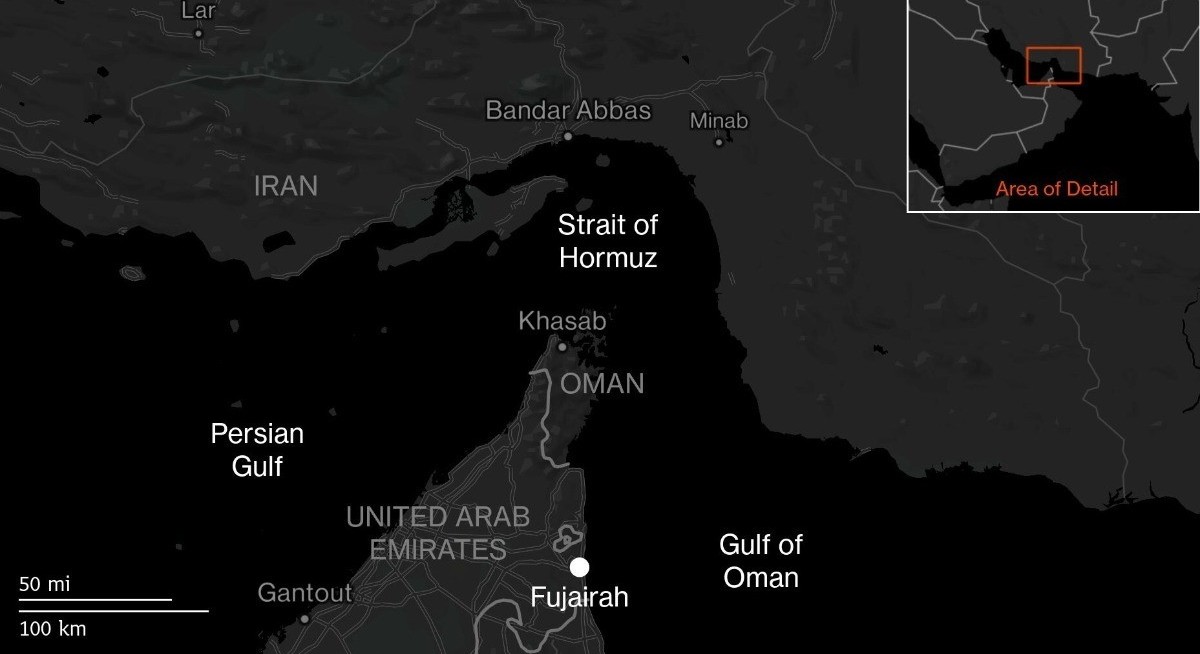


(Feb 20) : The US military is stationing a vast array of forces in the Middle East, including two aircraft carriers, fighter jets and refuelling tankers, with President Donald Trump saying that Iran had 10 to 15 days at most to strike a deal over its nuclear programme.
“We’re either going to get a deal, or it’s going to be unfortunate for them,” Trump told reporters on Thursday aboard Air Force One. On a deadline, Trump said he thought 10 to 15 days was “pretty much” the “maximum” he would allow for negotiations to continue.
“I would think that would be enough time,” he said.
The deployment is unlike anything the US has done since 2003, when it amassed forces before the invasion of Iraq. It dwarfs the military buildup that Trump ordered off the coast of Venezuela in the weeks before he ousted President Nicolas Maduro.
While the US isn’t likely to deploy ground troops, the buildup suggests Trump is giving himself discretion to launch a sustained campaign lasting many days, in cooperation with Israel. While discussions have focused on a sustained campaign far more sweeping than the overnight strikes the US launched against Iran’s nuclear programme last June, the president is also weighing a limited early strike designed to drive Tehran to the negotiating table, The Wall Street Journal reported Thursday.
“Maybe we’re going to make a deal,” Trump said in a speech on Thursday morning. “You’re going to be finding out over the next probably 10 days.”
See also: Witkoff, Kushner plan for US-Iran talks in Geneva on Thursday
Heightened geopolitical worries over US-Iran tensions sent stocks lower and extended a surge in oil, with Brent crude, the global benchmark, rising above US$71 a barrel on Thursday.
The open question is whether Iran can possibly satisfy Trump’s demands and whether, by positioning so much military hardware to the region, Trump may feel compelled to use it rather than backing down.
Tracking site FlightRadar24’s data shows a surge of flight activity by US military transport, aerial tankers, surveillance aircraft and drones to bases in Qatar, Jordan, Crete and Spain.
See also: China, India among winners after US court blocked Trump tariffs
The aircraft, whose transponders make them visible over land to the tracking site, include KC-46 and KC-135 air-to-air refuelers and C-130J cargo planes used to move troops and heavy equipment.
It also includes E-3 Sentry jets equipped with airborne warning and control system radar, which provide “all-altitude and all-weather surveillance” of potential battle zones, as well as RQ-4 Global Hawk surveillance drones.
The weapons at Trump’s disposal are formidable. The USS Abraham Lincoln aircraft carrier is accompanied by three Arleigh Burke-class guided-missile destroyers, which can carry Tomahawk missiles. The carrier’s air wing includes F-35C fighter jets.
The USS Gerald R Ford, the most expensive US warship ever built, at US$13 billion, is accompanied by guided missile destroyers, and its associated air wing includes F/A-18E and F/A-18F Super Hornets, E-2D airborne early warning aircraft, as well as MH-60S and MH-60R Seahawk helicopters and C-2A Greyhounds.
The two carriers provide “more options, and would enable us to conduct operations on a more sustained basis — if it comes to that,” said Michael Eisenstadt, director of military studies for the Washington Institute for Near East Policy. He said the buildup “signals to the Iranians the need to be more flexible in negotiations.”
Trump met with his son-in-law, Jared Kushner, and special envoy, Steve Witkoff, on Wednesday for an update on the negotiations with Iran. Officials met in the Situation Room on Wednesday to discuss possible action and were told to expect that all US military forces deployed to the region would be in place by mid-March, according to a US official.
A major strike against Iran — where leaders are anxious about regime stability following widespread unrest — risks entangling the US in its third war of choice in the Middle East since 1991, against a more formidable adversary than the US has faced in decades.
To stay ahead of Singapore and the region’s corporate and economic trends, click here for Latest Section
Trump’s use of the military in his second term has been characterised by short and successful engagements with minimal harm to American troops, including the bombing of Iranian nuclear targets in June, attacking alleged drug-trafficking boats and the raid that extracted Maduro in early January.
But if fresh strikes on Iran prompt a wider conflagration, the president could face considerable public pressure. Trump spoke against US engagement in foreign wars on the campaign trail, but has gone on to bomb Iran, Tehran-backed Houthi militants in Yemen and militants in Syria.
“With Iran’s air defences largely neutralised by previous US and Israeli strikes, the US strike fighters would operate largely with impunity over Iranian airspace,” said Bryan Clark, a defence analyst for the Hudson Institute and a former Navy strategy officer. “There is always the risk of downed pilots, but I think the bigger risk is to ships. The same cruise and ballistic missiles the Iranians gave to the Houthis could be turned against US ships in the Persian Gulf, Arabian Sea and Red Sea.”
Thousands of US servicemembers in the region are also within range of Iranian ballistic missiles, and regime officials have vowed to respond with full force to a US strike.
Beyond attacks on US military assets, Iran could try to close the Strait of Hormuz, the narrow waterway between Oman and Iran traversed by 25% of maritime oil traffic.
The US strikes in June 2025 focused on three sites associated with Iran’s nuclear programme, but a more ambitious effort to topple the regime in Tehran could involve attacks on sites associated with the Islamic Revolutionary Guard Corps and potentially senior leadership including Supreme Leader Ayatollah Ali Khamenei.
But Iran might be able to withstand such decapitation attempts.
“Israel already killed the top leaders of the IRGC in its opening strikes in the June war and Iran was able to reconstitute and respond within 24 hours,” said Jamal Abdi, president of the US-based National Iranian American Council. “They’ve now planned for these possibilities in future wars and so now may be even more resilient if senior leaders are killed.”
White House press secretary Karoline Leavitt said Wednesday that Iran was expected to offer a response to the negotiations within “the next couple of weeks,” but did not preclude the possibility of military action before that. “The president will continue to watch how this plays out,” she said.
Uploaded by Felyx Teoh




