


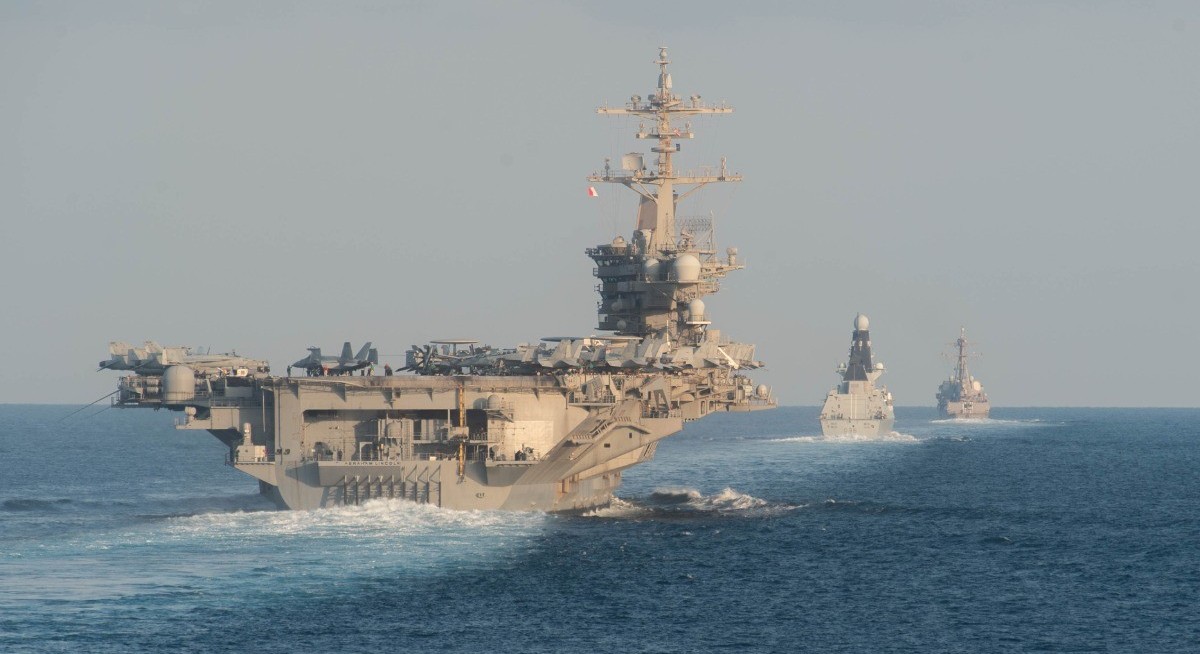


(Jan 30): The arrival of a US aircraft-carrier strike group in the Middle East has given President Donald Trump new, more forceful options to carry out his threats to attack Iran, but the choices carry serious risks of retaliation from Tehran.
At the same time, Trump’s shifting messages about his goals — removing Iran’s leaders, punishing the regime for its deadly crackdown on protesters or extracting a new nuclear agreement — have raised questions about just what the mission would be, or whether the threat may be an effort to force Tehran to negotiate.
His latest warnings, along with Iran’s threats of response against US installations in the region, have fuelled a spike in oil prices this week, with Brent rising almost 6% to around US$70 a barrel. Still, they pared gains on Friday after Trump said overnight he had had discussions with Iran and indicated he expected them to continue.
“The arrival of the Abraham Lincoln carrier strike group provides Trump with an expanded set of offensive options,” said Dana Stroul, a former senior Pentagon official now at the Washington Institute for Near East Policy. “But he still needs to define an objective for the military.”

Trump revealed little about any plans for military strikes on Iran during a cabinet meeting on Thursday at the White House, only making a brief reference to “the large fleet of ships that’s heading over to the Middle East.”
See also: Starmer says UK won’t be forced to choose between US, China
During an event later on Thursday, Trump referenced the flotilla again, saying “hopefully we won’t have to use it”. The president said the US held talks with Iran in recent days.
“I told them two things. Number one, no nuclear and number two, stop killing protesters. They’re killing them by the thousands,” Trump said.
US military strikes against Iran remain likely, according to Becca Wasser and Dina Esfandiary of Bloomberg Economics, who note that the buildup has broadened the options at Trump’s disposal and helped to shore up US and allied defences against Iranian retaliation.
See also: Canada won’t back down on trade pivot as energy minister heads to India
Beyond Iranian nuclear sites, a US military operation could target critical military infrastructure, missile and drone production facilities, Islamic Revolutionary Guard Corps locations and leaders, and government buildings and senior officials, Wasser said.
Saudi Arabia and the United Arab Emirates warned this week that they wouldn’t allow their airspace to be used for any strikes, concerned about making themselves targets for Iranian retaliation. But the arrival of the carrier group gives Trump more options for attacks without relying on allies.
The Lincoln strike group has about 45 aircraft, including the F-35Cs, which means “we don’t need the permission of any regional state to launch from there, so it’s an important building block,” said Michael Eisenstadt, a fellow with the Washington Institute for Near East Policy.
Still, “for a serious strike, you’d need either two or three carrier strike groups, or lots of Air Force aviation based ashore,” he said.
The US also said it has F-15E aircraft in the region capable of carrying heavy GBU-28 bombs that can target deeply buried facilities.
Trump’s pivot from pressuring Iran over the protests to demanding effective capitulation on long-standing, complex negotiations over its nuclear programme has placed the country’s leaders in a tricky situation.
There haven’t been credible attempts to negotiate over Iran’s nuclear programme for weeks, and the turn to pushing the country’s leaders for a quick deal caught some involved in the negotiation process by surprise, according to people familiar with the matter.
To stay ahead of Singapore and the region’s corporate and economic trends, click here for Latest Section
After US bombing raids on nuclear sites in June, Trump declared that the nuclear programme had been obliterated. But in a social media post on Wednesday, he called for Tehran to “negotiate a fair and equitable deal — NO NUCLEAR WEAPONS”, with no mention of his earlier threats over the regime’s crackdown on protesters.
While Iran acknowledges the nuclear sites were severely damaged and enrichment activities have been suspended, they haven’t allowed the UN atomic watchdog to resume monitoring. The country still retains its nuclear knowhow and could easily reconstitute its enrichment work, International Atomic Energy Agency director general Rafael Mariano Grossi said last week.
Bombing alone is unlikely to eliminate Iran’s stockpile of highly-enriched uranium. That material has long been considered the most pressing nuclear danger, because the material can quickly be machined into the fuel for a weapon. Targeting the inventory without being able to physically verify the outcome of the attack would simply risk dispersing the danger.
A US armada headed by the Lincoln aircraft carrier and its strike group, which includes six Tomahawk-enabled guided missile destroyers, arrived in the region this week. The vessels join a number of smaller naval ships, as well as more than 30,000 US troops based in the region.
Trump warned in the social media post on Wednesday that the “massive armada” is “ready, willing and able to rapidly fulfill its mission,” saying “The next attack will be far worse” than last year’s strike on the nuclear facilities.
At the same time, Secretary of State Marco Rubio told a Senate committee the deployment was a defensive one, to protect US forces in the region from any Iranian strikes.
Israel’s 12-day war severely damaged Iran’s air defences and depleted its stockpiles of missiles and other weapons but Tehran still has the ability to threaten the US and its allies in the region.
“They still have a decent stockpile of missiles that can reach Israel,” said Fabian Hinz, an analyst at the International Institute of Strategic Studies.
Iran’s maritime capabilities include an array of mines, as well as anti-ship missiles and guided rockets, drones, midget submarines and unmanned surface vessels, Hinz said.
“If they want to start harassing the civilian shipping in the Persian Gulf for example, they would probably succeed quite easily and would be very difficult to stop them,” he said.
Uploaded by Felyx Teoh




