


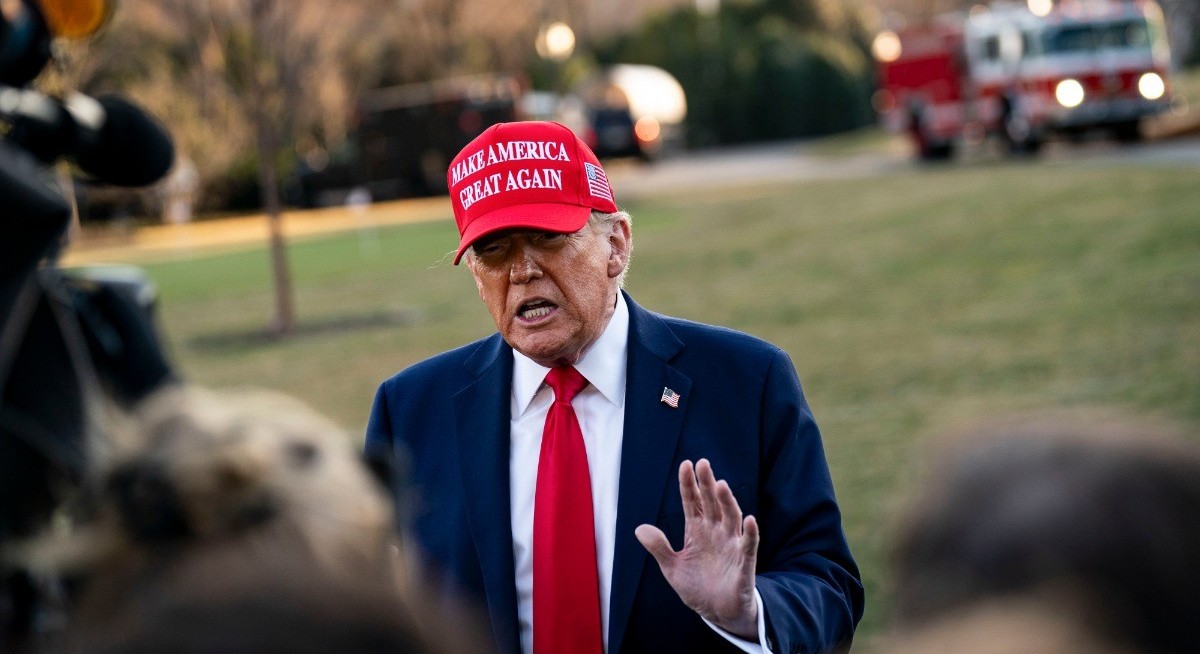


(March 17): US President Donald Trump reiterated his appeals for other nations to help secure the Strait of Hormuz, saying Iran was nearly obliterated even as the war keeps roiling oil markets and global shipping.
“Numerous countries have told me they are on the way — some are very enthusiastic about it, and some aren’t. Some are countries that we have helped for many, many years,” Trump told reporters on Monday during a White House event.
The president voiced frustration with nations that have been publicly non-committal about helping ensure vessels can transit the waterway. Later on Monday, he said he had requested China — among those he has asked for support — to delay a summit with his counterpart Xi Jinping for about a month, saying it is important for him to remain in Washington to oversee the war.
Trump has called out Nato and others, claiming they had leaned on the US for “tens of billions of dollars” in protection, yet failed to act when asked.
Trump’s remarks dovetail with a series of attacks in recent days that indicate neither side is letting up. Asked on Monday if the US could end the war this week, Trump responded, “Sure,” but added: “I don’t think so, but it will be soon.”
Oil rose after its first decline in almost a week, as Iran stepped up attacks on energy infrastructure around the Persian Gulf. Brent advanced above US$103 ($131.77) a barrel, after slipping 2.8% on Monday.
See also: Thai Parliament set to vote on Anutin’s bid to stay on as PM on Thursday
The effective closing of the Strait of Hormuz — a transit point for about a fifth of the world’s oil — has forced the likes of the United Arab Emirates (UAE) and Kuwait to reduce oil output further. Still, a trickle of vessels is beginning to find a way through the waterway.

“We’re hammering their capacity to threaten commercial shipping in the Strait of Hormuz with more than 30 mine-laying ships destroyed,” Trump said. He added US officials weren’t certain whether Iran has actually laid mines in the strait but warned that it would be “a form of suicide” if they did.
See also: EU pushes to shift naval mission to protect Strait of Hormuz
Trump said more than 7,000 targets have been struck and that Iran’s “anti-aircraft is decimated, their radar is gone and their leaders are gone. Other than that, they are doing quite well”.
The president also threatened to expand strikes on Kharg Island to target oil infrastructure, saying on Monday, “We can do that on five minutes’ notice. It will be over.” The Persian Gulf island is Iran’s main export hub and was hit by the US late last week.
As the war entered its 18th day, the UAE closed its airspace for about two hours as its defences intercepted drones and missiles. Air traffic later returned to normal.
Iran struck new targets including a key UAE oil hub. The UAE oil-export terminal of Fujairah suspended loadings temporarily after a drone strike on Monday — the second attack in as many days. Israel carried out more airstrikes on infrastructure in the Islamic Republic’s capital, Tehran.
Saudi Arabia has begun pumping oil through a pipeline that runs from its eastern oil fields to a port at Yanbu on its western coast. That will allow it to avoid the strait for at least some of its crude exports. There have been 16 reported attacks on vessels in and around Hormuz since the war began, according to the UK maritime trade operations.
Surging oil prices since the start of the war — up about 40% in the past two weeks — have in turn pressured US gasoline prices, with midterm elections that will decide control of both houses of Congress just months away. The average cost of a gallon of gas has risen each day since the conflict began, according to American Automobile Association data.
Underscoring the domestic stakes for Trump, administration officials on Sunday asked Americans for patience.
To stay ahead of Singapore and the region’s corporate and economic trends, click here for Latest Section
He has called on world powers — including France, the UK, Japan and China — to help the US reopen the strait by sending warships to provide escorts to commercial vessels.
Trump added that Secretary of State Marco Rubio would announce countries that would help the US with that effort, saying some of the nations involved would be “fairly local.”
“If there was an easy way to fix Hormuz, it would have been fixed in the Reagan administration,” Caroline Glick, an adviser to Israeli Prime Minister Benjamin Netanyahu, said in an interview, adding that Israel was doing what it could to help secure the waterway while acknowledging limitations in combating Iran’s “terror on the seas”.
The response from other allies across Europe and Asia has ranged from caution to ambivalence if not outright rejection. European officials have begun debating whether to redirect a Red Sea naval mission towards Hormuz, but the move requires unanimous approval and faces opposition in some capitals, including Berlin. In Asia, key US partners including Japan and South Korea have stopped short of committing ships.
Trump on Monday said he was “very proud of what we did”, arguing that without US action Iran would have had nuclear weapons — something the regime in Tehran denies seeking — and that other nations should be “thanking me”.
In Japan, officials said there were no plans to dispatch ships to escort stalled tankers — an issue that has complicated relations with the US before Prime Minister Sanae Takaichi’s White House visit on Thursday. The UK similarly wouldn’t commit to a full naval mission, even as Prime Minister Keir Starmer said he would explore options with allies.

While China hasn’t made any direct response to Trump’s request for help in the strait, the state-run Global Times dismissed the idea as a US attempt to spread the risk “of a war that Washington started and can’t finish”.
On Monday, Trump highlighted the uncertainty over any talks, including who in the Iranian government could help end the war.
“We don’t know who their leader is. We have people wanting to negotiate. We have no idea who they are,” he said, adding that it was unclear if the new supreme leader, Mojtaba Khamenei, was even alive.
“A lot of people are saying that he’s badly disfigured. They are saying that he lost his leg, the one leg, and he’s, you know, been hurt very badly. Other people are saying he’s dead,” Trump said.
Iranian Foreign Minister Abbas Araghchi has denied seeking talks or a ceasefire.
The conflict has left almost 4,000 people dead across the region, according to tolls from governments and non-governmental organisations.
The war has highlighted divisions within Trump’s base — with many supporters expressing dismay. Trump was joined at an event on Monday afternoon by Vice President JD Vance, a potential 2028 contender, who has been a critic of US involvement in extended overseas conflicts.
Pressed on his views, Vance said he had long agreed “that Iran should not have a nuclear weapon” and praised Trump’s handling of the war.
“We have a smart president, whereas in the past, we have had dumb presidents,” Vance said during the Oval Office event. “I trust President Trump to get the job done.”
Uploaded by Tham Yek Lee




